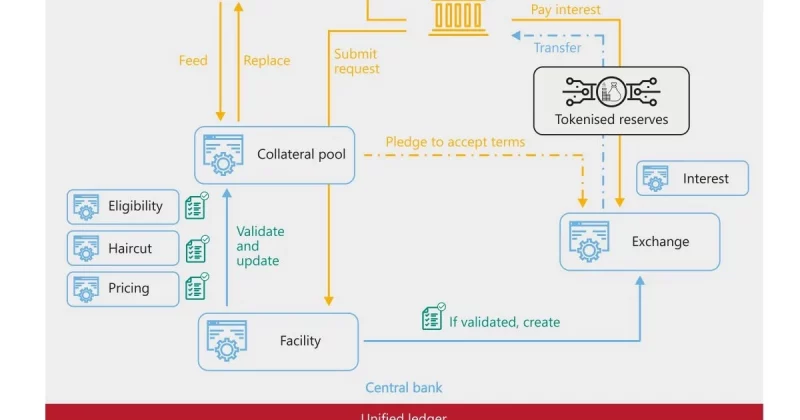

The proposed ledger would allow central bank money, commercial bank money and securities to interact on a common DLT-based platform.
The Swiss National Bank, UBS, SIX and six other institutions have started an exploratory project to assess a distributed ledger-based Swiss Financial Ledger that could bring central bank money, commercial bank money and securities onto a shared financial platform.
Other participating institutions are UBS, SIX, Zürcher Kantonalbank, PostFinance, Banque Cantonale Vaudoise, Basler Kantonalbank, Sygnum Bank and Seturion. The initiative is part of the SNB’s Project Helvetia and builds on Project Agorá, which explores how tokenization could improve the speed, cost and security of wholesale cross-border payments.
The proposed infrastructure would be evaluated for both domestic financial transactions and cross-border payments. Participants will examine how different forms of money and securities could interact on the ledger, alongside technical architecture, governance structures and operational requirements.
The initiative also includes a newly established Helvetia Strategic Board, comprising the participating institutions, with the Swiss Bankers Association serving as an observer.
The SNB said the project will assess the potential benefits, feasibility and risks of extending Switzerland’s existing financial market infrastructure through DLT.
However, the exploratory work does not mean that a Swiss Financial Ledger will be launched or that the central bank will issue tokenized central bank money for financial institutions. The initiative’s objective is to investigate possible improvements to the country’s financial infrastructure.
What is Project Helvetia?
Project Helvetia is a research program led by the Swiss National Bank to explore the settlement of blockchain-based financial assets using central-bank money. Its experiments have examined both wholesale CBDC and links between distributed-ledger platforms and Switzerland’s existing payment system, including their use in interbank, monetary policy, and cross-border transactions.
The SNB has extended the initiative until at least June 2028 to study the RTGS-link approach in greater depth and assess its operational, legal, and policy implications before determining the future direction of Switzerland’s payment system.
Disclosure: This article was edited by John Chen. For more information on how we create and review content, see our Editorial Policy.