The more you study cryptocurrency, the more confused you may become.
It might sound strange, but the more information cryptocurrency beginners gather, thinking that ‘if I just learn more, I’ll be able to make a decision,’ the more paralyzed they actually become.
Bitcoin will keep going up.
No, it’s too late to buy now.
Ethereum is next.
From now on, it’s Solana.
You should wait for a crash.
If you’re dollar-cost averaging, you don’t need to worry about the price.
Even just watching three YouTube videos will present you with completely different opinions.
And if you open X, a cryptocurrency you didn’t know about yesterday suddenly starts looking attractive.
‘In the end, what should I believe?’
This doesn’t necessarily happen because you lack knowledge.
The problem is actually that you haven’t decided what criteria to use to adopt information and what to discard.
You’ve opened an account.
You’ve bought a little Bitcoin.
But if it drops 5%, you get anxious.
If it goes up 15%, you regret not buying more.
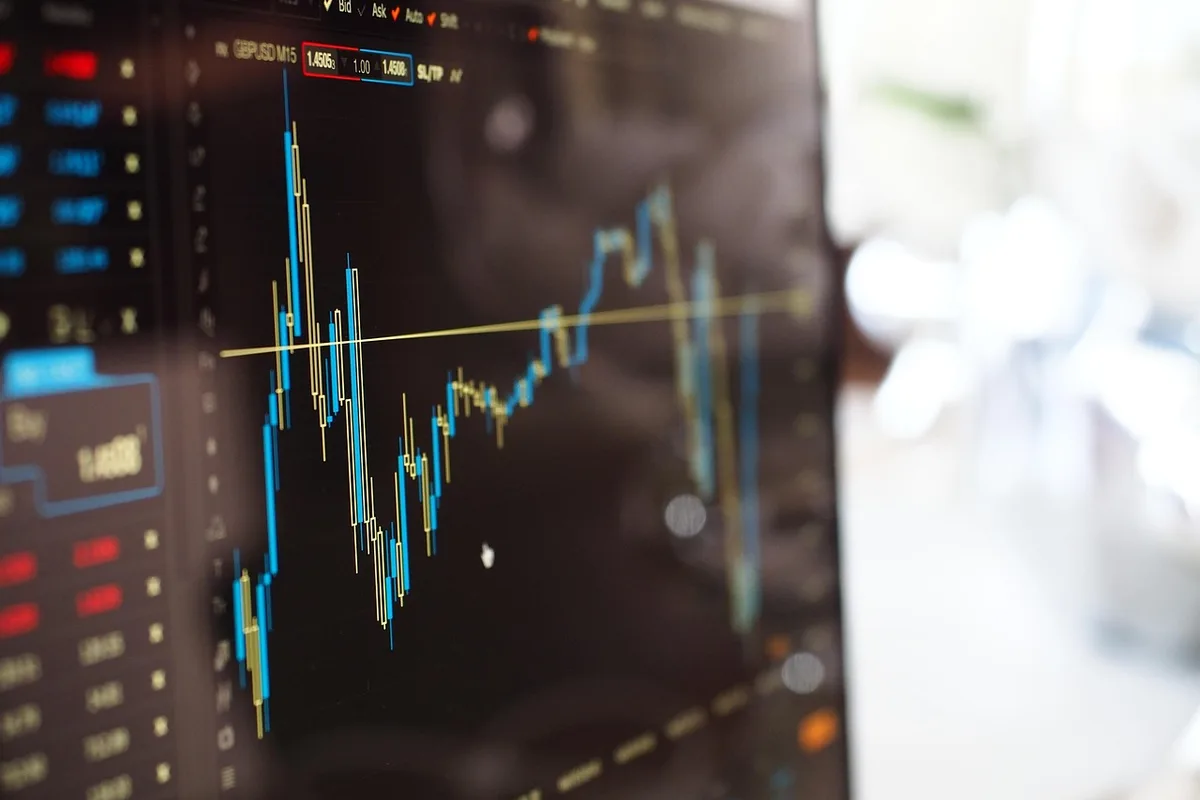
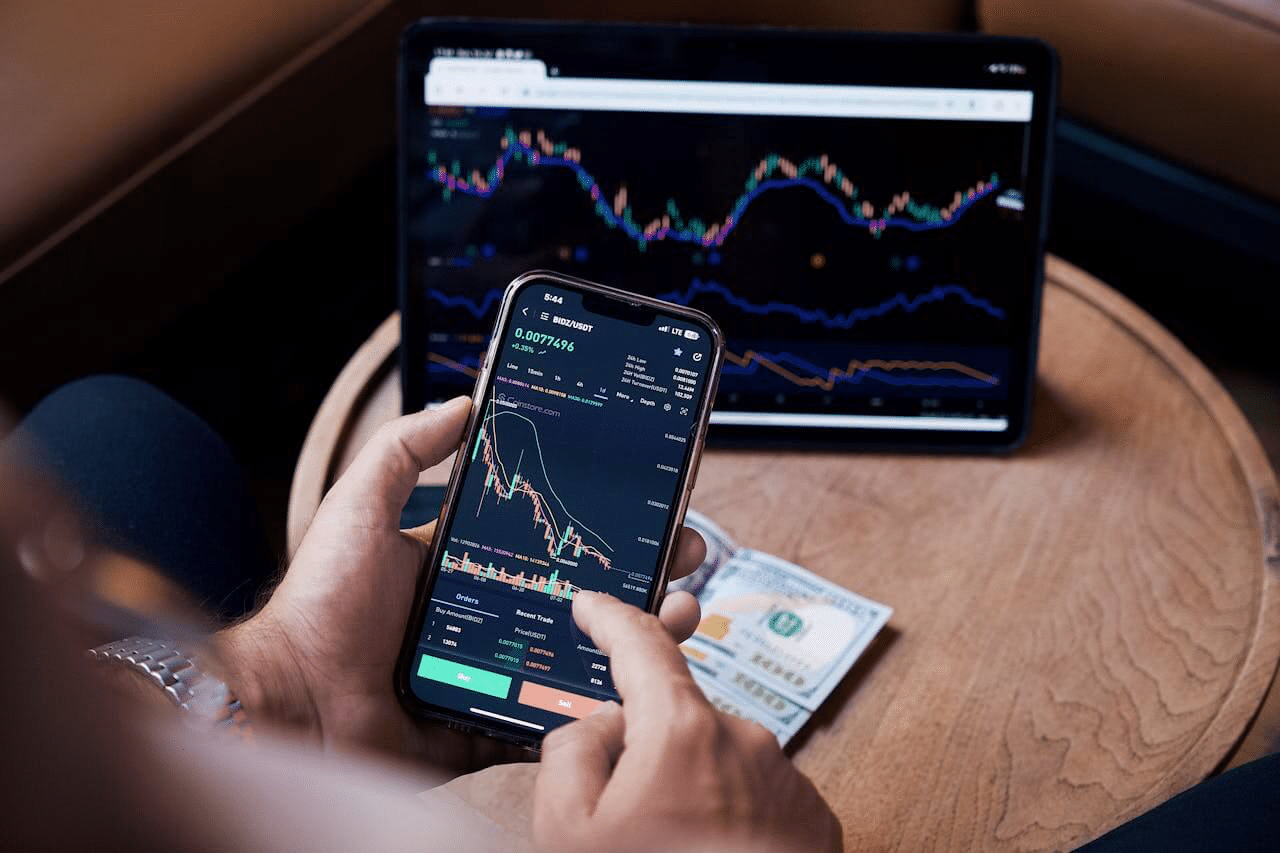
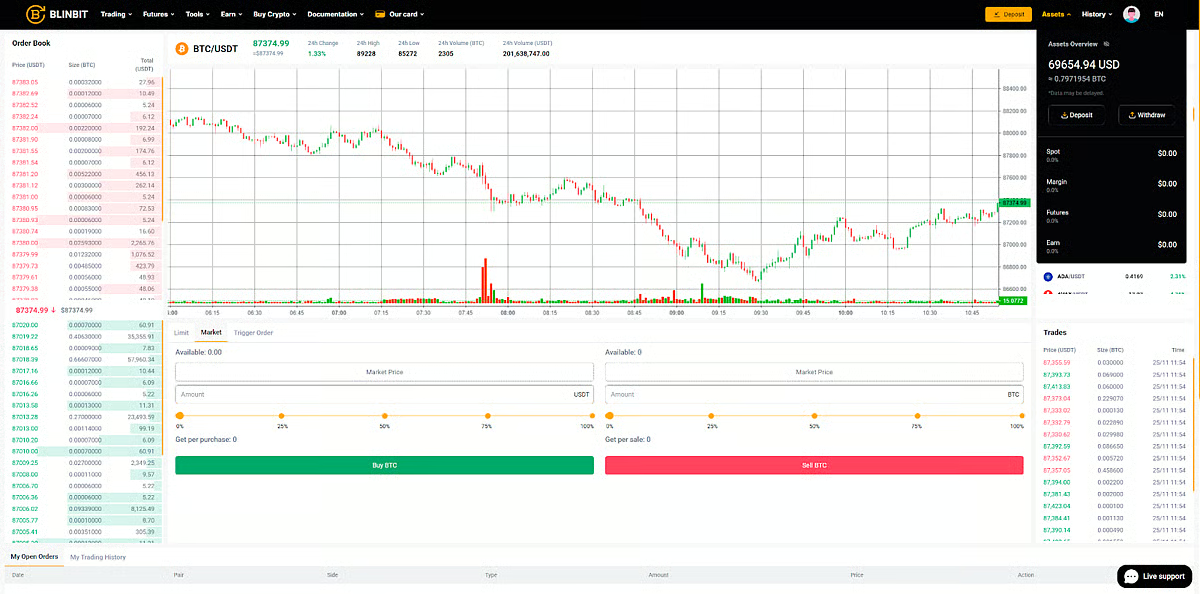
At night, you open the charts again.
For people like that, it might be better to look at a completely different place before searching for the next coin.
What you need to re-examine is not the coin.
It goes back even further than that.
Why ‘if I study more, I’ll understand’ is a detour
When people start with cryptocurrency, many follow a similar sequence.
First, they research exchanges.
Next, they research promising coins.
They subscribe to YouTube channels.
They follow people on X who seem knowledgeable.
They study how to read charts.
Their knowledge definitely increases.
Yet, strangely, the hesitation at the moment of purchase never goes away.
Yesterday, you watched a bullish video and wanted to buy, but today you see a crash prediction and cancel your order.
If the price goes up, you feel like you missed out.
If it goes down, you get scared, thinking, ‘It might go down even further.’
Even though you look at charts every night,
‘At what percentage increase will you sell?’
‘How many years do you plan to hold it?’
‘What is the maximum drop you can withstand?’
If asked these questions, you cannot answer.
This is quite troublesome.
You are studying, but your criteria for judgment are not developing.
In fact, the more information you gain, the more reasons you have to be confused.
(We tend to think that gaining more knowledge will naturally lead to confidence, but this is where the opposite often happens.)
So, what is missing?
The problem wasn’t the amount of knowledge, but the ‘order’.
If you are treating cryptocurrency as a way to build assets, starting with the coins themselves is a bit of a stretch.
What many beginners think is,
Find a coin
↓
Buy
↓
Aim for profit
is the flow.
However, when you think about it as managing your own money, there are things you should decide before that.
What do you want to increase your money for in your life?
How much will be left over each month?
How much money can you allocate to investment?
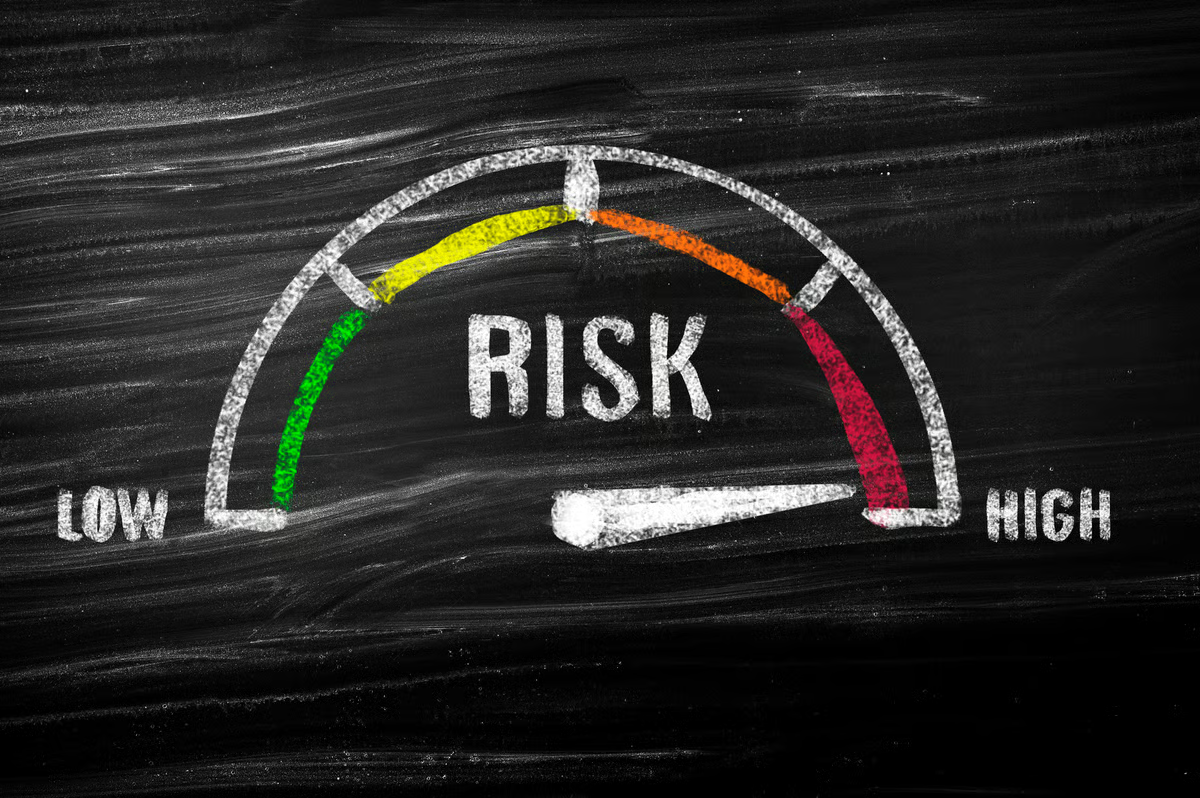
What level of price drop can you accept?
How many years do you intend to invest?
Under what conditions will you buy?
Conversely, under what conditions will you not buy?
Only after deciding all this do you finally look at the coins.
With this order, the meaning changes even if you are buying the same Bitcoin.
‘I’ll buy 300,000 yen worth because it looks like it will go up’
versus
If you allocate 300,000 yen after setting aside an emergency fund, determining your investment period, monthly contribution amount, and acceptable loss,
your mindset on days when prices drop will be completely different.
In the former case, the market dictates your decisions.
In the latter, you view the market within the framework of your own plan.
What catches the eye in the Cryptocurrency Master Course isn’t just flashy coin recommendations.
The product information includes:
-
an asset management plan sheet,
-
a concrete to-do list for cash flow improvement,
-
and a checklist for improving investment performance,
which are mechanisms for translating your thoughts into actual actions.
Looking at this, the goal of this course starts to look a little different.
The reason beginners stumble isn’t just ‘not knowing the market’
If you think the reason your results are unstable is ‘because I haven’t studied the market enough,’ you end up just gathering more information.
However, there is no end to gathering information.
Once you finish researching Bitcoin, you become curious about Ethereum.
Once you research Ethereum, Solana catches your eye.
If you move on to chart analysis, the things you need to learn keep piling up: moving averages, MACD, RSI, and so on.
That in itself is not a bad thing.
The problem is becoming highly knowledgeable about market information without having decided anything about your own money.
For example, even if you know 20 ‘recommended coins,’
If you haven’t decided ‘how much I will invest per year’
you cannot determine how much to buy.
Even if you can read charts,
if you haven’t decided ‘how many years from now and for what purpose this money will be used’
you cannot judge how much you should care about short-term price movements.
Furthermore, what is easy to overlook is gathering only the reasons to buy.
‘It has potential’
‘It is getting attention’
‘It might still grow’
Reasons to want to buy are easy to find.
However, ‘under what conditions I will not buy’ and ‘at what point I will sell’ remain blank.
With this, you will be lost whether the market goes up or down.
It is less about a lack of study and more about a lack of design.
Whether or not you realize this changes how you view information from then on.
More important than the 55 videos is the fact that ‘6 hours are connected into one’
According to the product information, the Cryptocurrency Master Course provides 55 videos, about 6 hours of content, and over 800 slides.
Looking at the numbers alone, it is a significant amount of information.
However, the fact that there are 55 videos alone is not the deciding factor.
If you search YouTube, you can find endless free videos.
Suppose you continue to watch YouTube, X, and blogs for 3 hours every week.
That is 156 hours for one year.
It is 468 hours for three years.
Of course, learning from free information is also fine.
However, the problem is not the time itself, but the fact that 468 hours worth of information is not necessarily connected to a single decision-making framework.
The premises differ between someone who looked at it yesterday and someone who looked at it today.
You see a talk on short-term trading right after hearing about long-term investment.
After watching a video on asset formation, you get pulled into posts about skyrocketing coins.
With this, even if your knowledge increases, it is difficult for your own decision-making axis to connect into one.
If you look at the figure of about 6 hours, rather than thinking ‘it’s short so it’s a bargain,’
it is more meaningful to see if you can learn from asset formation to cryptocurrency in a single sequence
than to look at that.
In fact, the product information provides not just simple input, but also plan sheets, to-do lists, and check sheets.
If you view it as a mechanism to return to your own numbers and think, rather than a course where you just watch a lot of videos, the way you measure value changes.
And there is one more part in the numbers that cannot be overlooked.
The experience of having 200,000 yen increase creates a dangerous misunderstanding in reverse
Shorty, the seller of this course, discloses his experience since 2017 in the product information.
He says he started cryptocurrency in 2017 when he was a university student with about 200,000 yen in capital from a friend.
At the time, his style was to gather information from social media and buy coins that looked good.
He looks back on that as ‘gambling investment’.
Although his 200,000 yen increased to 400,000 yen and 500,000 yen during the period when the market rose, the market collapsed afterward, and his friend lost most of their assets and withdrew.
It is said that Shorty continued to study after that and realized a profit of 5 million yen in 2021.
What is interesting here is that this is not a story about someone who understood everything from the beginning.
Rather, at first, they were on the side of buying because prices were going up.
Moreover, their money increased once.
This is actually quite a scary experience for a beginner.
When the entire market rises and your assets increase during a period when you have almost no knowledge,
‘Maybe I have an eye for picking coins’
it is no wonder you might feel that way.
However, when the market environment changes, the same approach does not necessarily work.
The more you have experienced winning, the harder it can be to doubt your methods.
Therefore, what you should look at is not just ‘which coin went up.’
On what basis do you invest money, and on what basis do you stop?
The conversation comes back to this.
Even without experimental data, the goals of the course can be compared.
In this product information, there are no experimental results such as ‘how many yen increased’ by the author themselves using the course.
Therefore, there is no need to fabricate non-existent profit records to talk about it.
Instead, what I want to compare is the flow leading up to a decision.
Information gathering type
Look at the price.
Look at social media.
Watch a video.
Find more coins you’re interested in.
Research a little more.
Get confused by conflicting opinions.
Watch even more information.
Decision-making type
Confirm the money needed for daily life.
Determine the amount available for investment.
Determine the investment period.
Determine the acceptable level of risk.
Determine the conditions for buying and not buying.
Look only at targets that meet those conditions.
Even though it’s the same ‘studying,’ it’s quite different.
In the former, every time information increases, the factors for judgment increase.
In the latter, the more criteria you create, the more you can reduce the information you don’t need to see.
For example, when you find a cryptocurrency that is skyrocketing on social media.
In the past, you would have…
‘I might miss out’
and started searching.
If you have criteria,
You can start with, “Does this fit my rules?”
It allows you to distinguish whether something is worth researching before you even consider buying it.
It may seem like a small difference, but it makes a huge impact on your daily investment decisions.
Five years from now, if you keep increasing your information like this…
I don’t mean to say that you will lose money if you don’t use the course.
If you can create your own judgment criteria on your own, that is perfectly fine.
What is scary is that the same state you are in now will continue for years.
One year later.
You are on YouTube again,
“Is it too late for Bitcoin?”
searching for that.
Three years later.
You have become quite knowledgeable about cryptocurrency names and news.
But when asked, “How much do you invest per year?”, you cannot answer.
Five years later.
You have seen bull and bear markets many times.
You searched every time.
You also watched a massive amount of videos.
Even so, you don’t have a single investment rule of your own left.
This is the end of the units.
It is not just money that you are losing here.
It is time.
It is the fatigue that occurs every time you make a decision.
It is the effort of researching from scratch every single time.
And years from now,
you might think,
‘I wish I had decided how to use my money first instead of just looking for coins back then.’
No one can determine future prices.
However, whether time passes without you creating criteria for judgment is something you can change starting now.
What you should change in cryptocurrency is the order of judgment, not your ‘predictive power’.
If I were to summarize everything discussed so far in one sentence, it would be this:
The key to reducing hesitation in cryptocurrency is not to increase information, but to create your own judgment criteria first.
You do not need to be able to predict every price correctly.
In the first place, you cannot build an asset plan on the premise of always accurately predicting future prices.
What you need is to move from a state where you can only think about,
‘Will it go up or down?’
to thinking about,
‘How much will I invest?’
‘For how many years will I manage it?’
‘How far can it drop while I still maintain my plan?’
‘Under what conditions will I not buy?’
Shift your perspective to this.
Even when looking at the same chart, the meaning of what you see changes.
From being swayed by the market to viewing the market within your own plan.
This is the change you want to aim for.
What you need is not the ‘next winning coin’
When you start with cryptocurrency, your questions inevitably become like this.
‘What is going to go up next?’
‘Is it okay to buy Bitcoin now?’
‘Will Ethereum still grow?’
‘How about Solana?’
But as long as you keep repeating only those questions, you will be lost from scratch every time a new coin appears.
What you really need first is not the name of a coin.
It is a foundation for judgment that you can use even when the coins change.
Investable amount.
Investment period.
Risk tolerance.
Cash flow.
Conditions for buying.
Conditions for not buying.
Conditions for review.
Once this is decided, even when you see cryptocurrency news, you can think:
‘Should I buy?’
not just,
‘Is this even part of my plan in the first place?’
You can think this way.
Rather than adding one more recommendation, you will be able to discard unnecessary information yourself.
For beginners, this change might be even more significant.
Reaching a state where you can return to your own rules without checking prices from the morning.
Try to imagine it.
You wake up in the morning and Bitcoin has dropped significantly.
Until now, you would open your smartphone, search social media, watch several videos, and become restless, wondering:
‘Should I sell?’
‘Or should I buy more?’
If you have established criteria for judgment, the first place you check will change.
How many years you decided to invest for.
How much money you were allocating to investment.
What degree of decline you had anticipated.
What the conditions were for buying more.
This is the foundation of your investment.
What happens that would make you reconsider the plan itself?
You can return to the rules you set before looking at the price.
This doesn’t mean you will ‘never feel anxious.’
You might still feel scared when you see prices drop.
However, there is a significant difference between the state of searching for others’ opinions the moment you get scared and the state of being able to return to your own criteria.
According to the product information, the Cryptocurrency Master Course includes 55 lessons, approximately 6 hours of content, and over 800 slides, along with asset management plan sheets, concrete To-Do lists for cash flow improvement, and checklists.
It is stated that you have permanent access and that there are no additional fees for added content.
Therefore, rather than being a course you watch all at once for 6 hours and finish,
‘Use it to return to your own criteria when you are unsure about a decision’
is another way to think about using it.
The product information claims there are 668 five-star ratings, and student testimonials include:
‘I wish I had bought it sooner’
‘It became clear what I needed to do that day and that month’
‘My incorrect knowledge was brought to light’
‘I was able to continue even though I’m not good at studying’
These kinds of comments are also introduced.
In this situation, I wouldn’t just look at whether they ‘made a profit.’
Investment returns are also influenced by market conditions.
Instead, I would look at:
Did it make what you need to do clear?
Have you realized your own misconceptions?
Have you become able to create an investment plan?
Have you established a format that you can continue with?
This is because these aspects are easier to use as material for evaluating the course material itself.
There are also people for whom paying 49,800 yen makes little sense.
Of course, this course is not for everyone.
For example,
-
If you only want to know which coins will increase tenfold starting tomorrow
-
If you only want trading signals
-
If you don’t want to think about anything yourself
-
If you don’t even want to spend about 6 hours studying
-
If you haven’t separated your investment funds from your living expenses
-
If you are looking for a profit guarantee
-
If spending 49,800 yen would interfere with your daily life
If you are in these situations, there is little reason to use this.
Even in the product information, it is not aimed at people looking to make hundreds of millions in a short period, nor are results guaranteed.
Conversely,
You have been involved in cryptocurrency for about 0 to 2 years.
You know about Bitcoin and Ethereum.
You also watch YouTube.
And yet, you lack confidence.
You are scared when the price drops.
You are vague about how much to invest each month.
You cannot answer how many years you will hold it.
You have never put your asset plan into numbers.
If several of these apply to you, what you are missing might not be the next recommended coin, but the order in which you assemble your entire investment.
Having read this far,
‘I understand the concept. But in my case, how much should I allocate to investment?’
‘In what order should I create the rules?’
‘What exactly is covered in the actual course?’
If you feel this way, that is when it makes sense to look at the Cryptocurrency Master Course in detail.
There is also a way to build an asset management plan from scratch on your own.
There is also a way to learn only from free videos and blogs.
However, if you have been collecting information for half a year or a year and your decision-making hasn’t become any easier, there is room to try changing the ‘order of learning’ rather than the ‘content of learning’ before continuing with the same method.
What you want shouldn’t be a life where you are searching for answers every time the price moves a little.
Even on days when the market moves,
‘First, let me check my rules’
a state where you can return to that.
It is a state where you can treat cryptocurrency not as ‘price movements that might hit or miss,’ but as part of your own asset plan.
If you want to check the specific content for that, the mechanisms included, and whether it is a course that suits you, please take a look at the details below and decide.
#AD #Cryptocurrency #Crypto #Bitcoin #CryptoInvestment #Investment #SideHustle