The UK has set out a clear ambition: to be a global leader in the future of payments and digital finance.
With a strong financial services ecosystem, a respected regulatory tradition, and a growing fintech sector, the UK is well positioned to shape how digital currencies and tokenised assets evolve, but ambition alone will not secure leadership.
The decisive factor will be how effectively the UK aligns its approach with emerging global frameworks.
Digital finance is inherently borderless. Tokenised assets can be issued in one jurisdiction, traded in another, and settled across distributed networks that operate continuously across time zones.
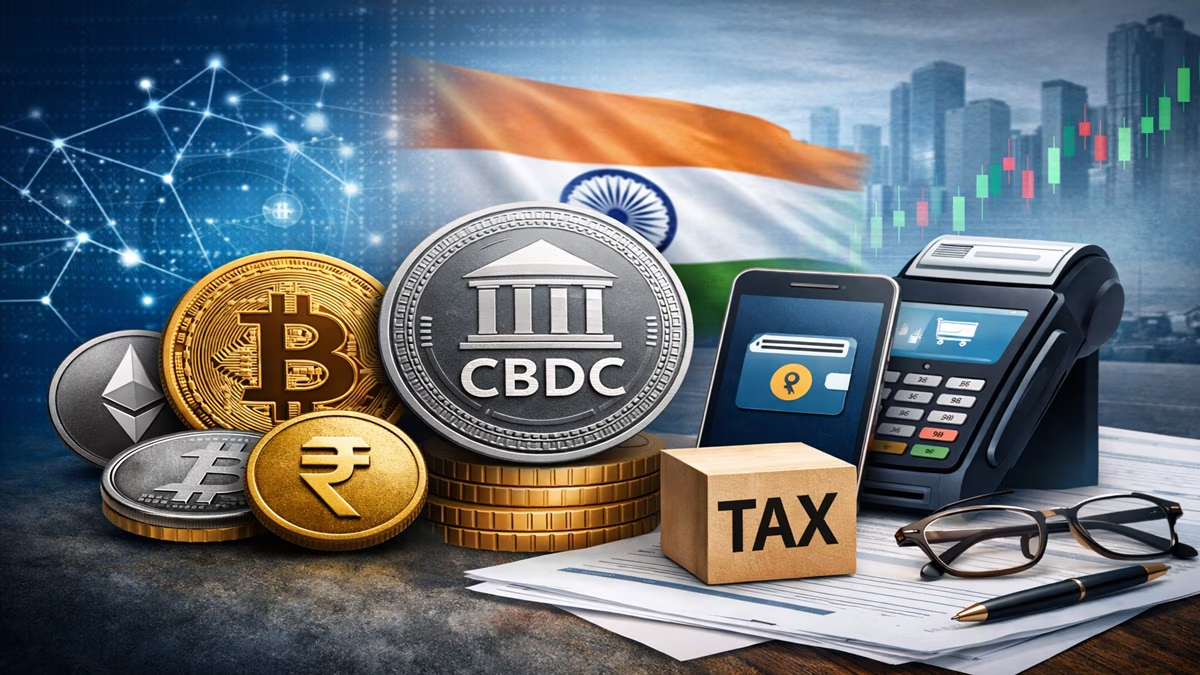
Central bank digital currencies (CBDCs), stablecoins, and tokenised securities are all part of a rapidly converging ecosystem where harmonisation of technological standards, not isolation, determines success.
In this context, fragmented regulatory approaches are more than an inconvenience; they are a structural barrier to scale.
If the UK seeks to lead, it must do so in step with global standards that enable systems to work together efficiently across countries, across asset classes, and across payment networks.
History offers a useful lesson. Financial innovation tends to flourish when supported by common standards, whether in accounting, disclosure, or market infrastructure. Conversely, fragmentation introduces friction, increases costs, and erodes trust. The same dynamic is now playing out in digital finance.
Today, we are seeing a proliferation of national and regional approaches to digital assets and payments. While this reflects legitimate nuances in legal systems and policy priorities, the cumulative effect risks creating a patchwork of rules that complicates cross-border activity.
Firms operating internationally face duplicative compliance requirements. Investors encounter inconsistent levels of transparency and protection. Market infrastructures struggle to connect.
Interoperability remains at the heart
For the UK, this presents a strategic choice. It can develop a domestically optimised framework that may limit international harmonisation, or it can actively contribute to shaping global standards that facilitate cross-border integration. The latter path is more complex, but it is also the one that will potentially unlock scale.
At the heart of this issue is interoperability: the ability of different ledgers, payment systems, and market infrastructure to exchange assets and information reliably and with legal certainty. Interoperability does not necessarily imply regulatory harmonisation, but the two are closely linked. A bridge between two ledgers is of limited value if participants lack confidence in settlement finality, asset ownership, custody, operational resilience or recourse when failures occur.
In digital finance, interoperability operates at several levels.
First, there is cross-border interoperability: ensuring that digital payment systems and asset platforms in different jurisdictions can interact without legal or technical barriers. This is essential for international trade, investment, and remittances.
Second, there is cross-asset interoperability: enabling different types of digital assets, such as tokenised securities, stablecoins, and CBDCs, to function within a unified ecosystem. This reduces the need for intermediaries and supports more efficient capital flows.
Ask FT Adviser
BETA feature — this feature is still being tested and developed
Third, there is network interoperability: allowing different payment systems and distributed ledger technologies to connect. This is where emerging technologies such as Layer 2 networks and cross-ledger bridging solutions come into play.
Layer 2 networks are designed to improve scalability by processing transactions off the main ledger while maintaining security and finality. Cross-bridging technologies enable assets and data to move between otherwise separate blockchains or ledgers. Together, these innovations hold significant promise. They can reduce congestion, lower costs, and enable more complex financial interactions.
However, their effectiveness depends on trust. Users must be confident that assets transferred across a bridge are secure, that data remains accurate, and that risks are properly managed. This is where global standards become important. To support interoperability at scale, digital finance systems must be underpinned by common principles in three critical areas:
-
transparency;
-
safeguarding; and
-
risk management.
Transparency ensures that market participants have access to clear, reliable information about digital assets and the systems that support them. This includes disclosures about how assets are issued, how transactions are validated, and how risks are mitigated. Without transparency, confidence cannot be sustained.
Safeguarding of assets is equally vital. Investors need assurance that their holdings are protected, whether they are held in custody, transferred across networks, or represented in tokenised form. This requires robust frameworks for custody, segregation, and recovery in the event of failure.
Risk management must address both traditional financial risks and new risks introduced by digital technologies. Operational resilience, cyber security, and governance are all critical considerations, particularly in systems that rely on distributed infrastructure and cross-ledger interactions.
Global standard-setting bodies and industry groups have already begun to develop frameworks in these areas. The challenge now is to ensure that national regimes align with these efforts, rather than diverge from them.
The UK has an opportunity to play a leading role in this process. It should not approach digital finance regulation as a purely domestic exercise, nor wait for complete global uniformity before acting. Instead, by engaging actively with international standard-setting initiatives, the UK can help shape practical global standards that allow innovation to scale safely.
This does not mean relinquishing regulatory autonomy. Rather, it means recognising that in a digital, interconnected financial system, effectiveness depends on coherence across jurisdictions.
In practical terms, this could involve closer collaboration with organisations such as the Financial Stability Board, the International Organization of Securities Commissions, and the Bank for International Settlements. It also requires engaging with industry stakeholders to ensure that emerging technologies, such as Layer 2 scaling solutions and cross-ledger bridges, are developed in a way that meets regulatory expectations.
From the perspective of CFA Institute, the imperative is clear. Innovation in financial markets must be accompanied by robust standards that protect investors and uphold market integrity. This principle applies as much to digital finance as it does to traditional markets.
The UK’s strength lies in combining innovation with credible market standards. Its regulatory institutions, legal system and capital markets expertise position it to champion the next stage of digital finance. But credibility will depend on whether the UK can connect its domestic ambitions to the wider international agenda.
This requires a sustained commitment to interoperability, internationally coherent standards, and recognition that in digital finance, cross-border co-ordination is essential rather than optional.
Phoebe Chan is capital markets policy research specialist at CFA Institute