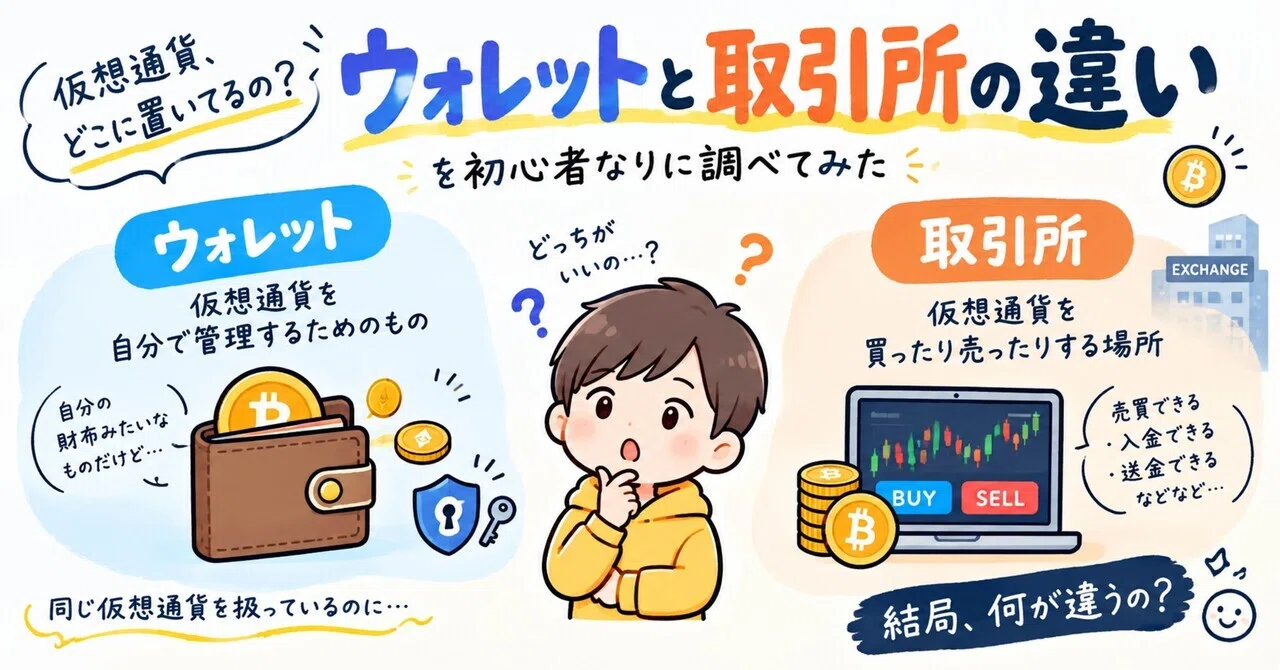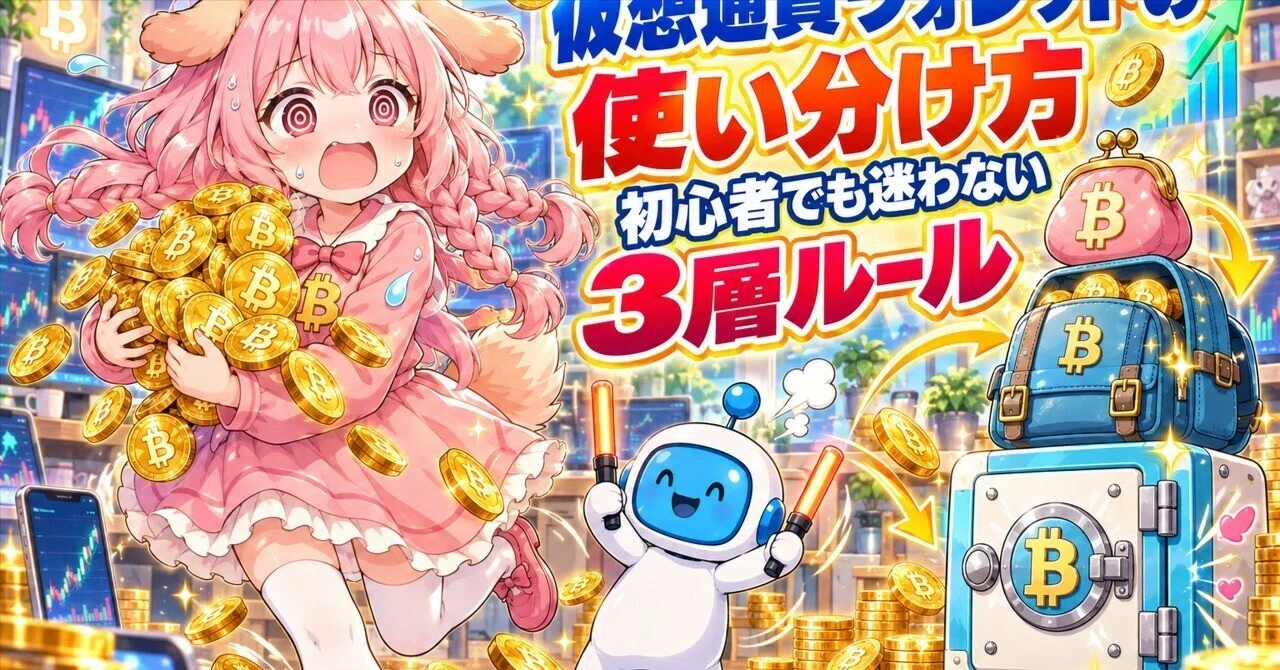
Bito-chan: I’ve been leaving my Bitcoin on the exchange, but is that really okay?
Robo-kun: Domestic exchanges are required to manage assets separately. So, you don’t need to panic just yet.
Bito-chan: But I often hear people say, “You should use different wallets for different purposes.” What does that mean and how do I divide them?
Robo-kun: It means using an exchange for buying and selling, a software wallet for NFTs, and a dedicated device for long-term holding.
Bito-chan: I’m good at dividing things! I have two wallets—one for snacks and one for bones!
Robo-kun: For bones…? Well, the concept is the same! You divide where you keep things based on their purpose (laughs).
Bito-chan: I think I can do that! Which one should I start with?
Robo-kun: That depends on how much you have and your goals. Let’s organize it step by step together!
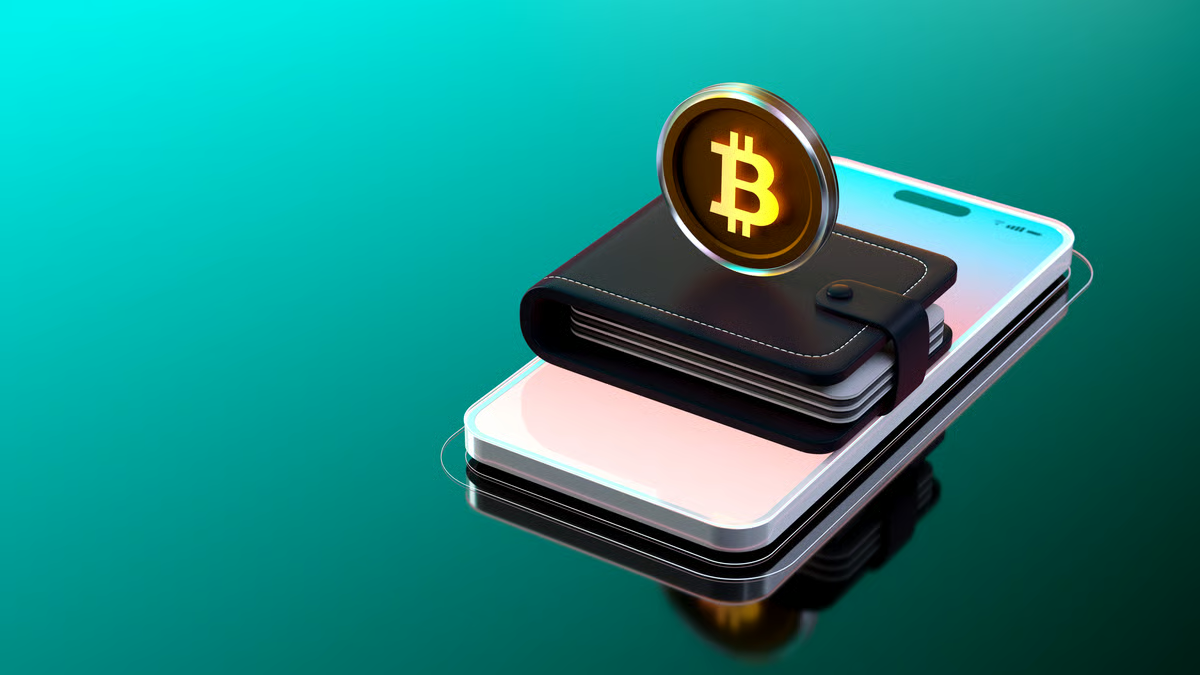
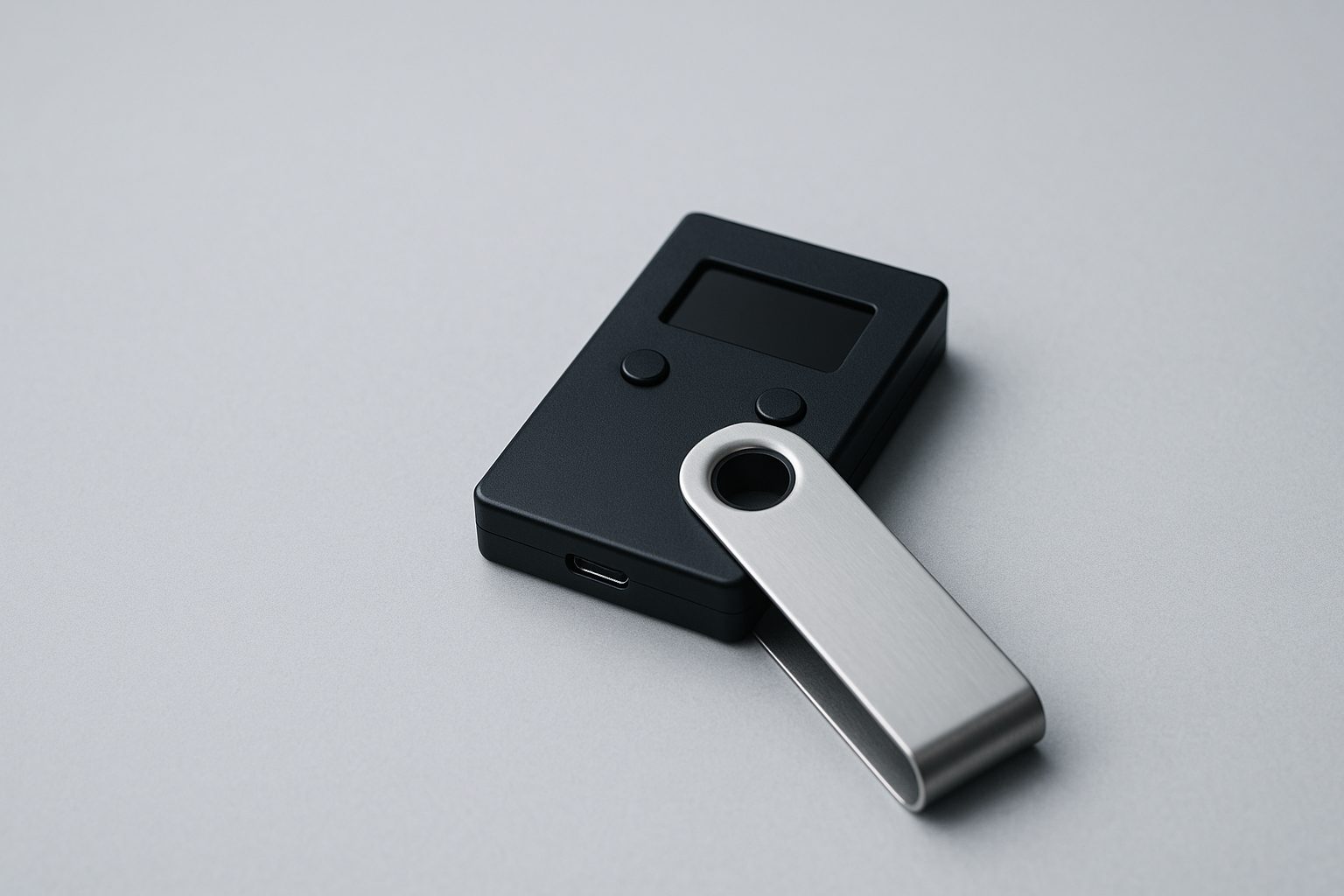
The basic rule for cryptocurrency wallets is to use a 3-tier approach: “domestic exchanges for trading,” “software wallets for DeFi and NFTs,” and “hardware wallets for long-term storage.” A software wallet is an app on your smartphone, while a hardware wallet is a dedicated USB-type device.
Many people are likely worried, thinking, “Is it really okay to leave it on the exchange?” “Do I need MetaMask or a dedicated device?” or “Will I lose my assets due to transfer errors or scams?” However, as long as your holdings are still small, you don’t need to force yourself to move them to your own wallet.
In this article, we will explain the mechanism of wallets, compare the three types, discuss how to use them based on purpose and holding amount, and provide tips to avoid mistakes in transfers and storage. Let’s find the right place for your assets together.
👉 What you will learn in this article
-
The mechanism of wallets (private keys, seed phrases, addresses) and the differences between the three types of wallets
-
How to use wallets based on purpose and holding amount, and recommended combinations
-
Procedures to prevent transfer errors with small test transfers and points to be careful about when choosing a network
-
How to safely store seed phrases and countermeasures against approval scams, fake apps, and impersonation DMs
What is a cryptocurrency wallet? Is it okay to leave it on an exchange?
Bito-chan: First of all, is a wallet just a purse that holds money?
Robo-kun: Actually, the contents are keys. The coins themselves are on the blockchain.
Bito-chan: So the difference is whether the exchange holds the keys or you hold them yourself?
Robo-kun: Exactly! The former is custodial, and the latter is self-custody.
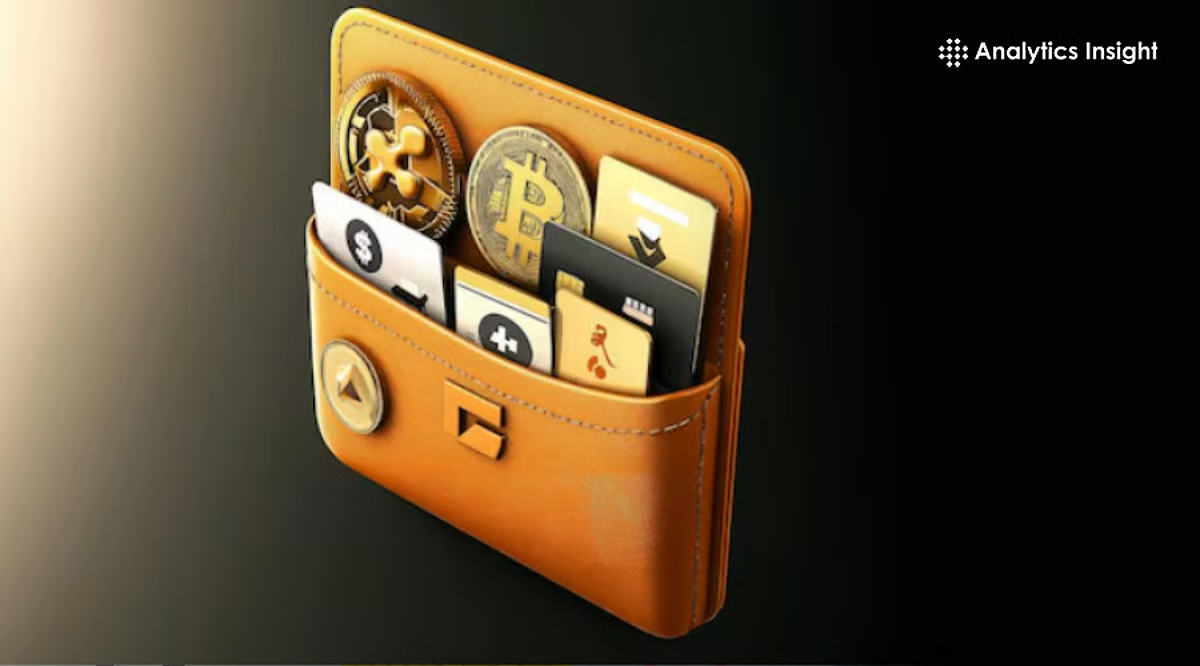
When you hear “wallet,” you tend to imagine a “purse to put coins in,” but in reality, the cryptocurrency itself is not inside the wallet. Coins exist on the blockchain (a ledger shared by everyone to record transactions), and a wallet is a tool to store the “keys” used to move them.
The Relationship Between Private Keys, Seed Phrases, and Addresses
The contents of a wallet consist of a set of three elements. Comparing them to a bank makes their roles easier to understand.
In the world of cryptocurrency, the person who holds the private key is the owner of those assets. If your seed phrase is leaked, anyone, even a complete stranger, can move your assets.
The Difference Between Custodial (Exchanges) and Non-Custodial (Self-Custody)
Wallets are divided into two types based on who holds the keys. Custodial means the exchange holds the keys for you, while non-custodial means you hold the keys yourself, such as with MetaMask or hardware wallets like Ledger.
Neither is inherently superior; they simply serve different roles. Your preference depends on whether you prioritize convenience or want to isolate your assets from exchange-related risks.
Why Keeping Assets on a Domestic Exchange Still Offers a Certain Level of Security
To operate a cryptocurrency exchange business in Japan, registration with the Financial Services Agency is required under the Payment Services Act. Exchanges like Coincheck and bitbank are registered, and they are legally obligated to practice segregated management, which means keeping customer assets separate from company assets.
Furthermore, under Cabinet Office ordinances, exchanges are required to manage at least 95% of the cryptocurrency entrusted by customers in cold wallets (storage disconnected from the internet). Even when major overseas exchanges have collapsed in the past, there have been cases where customer assets at Japanese subsidiaries were returned thanks to this segregated management.
Points to Note
-
Even if assets are returned in the event of a bankruptcy, there is a possibility that it will take time to get them back
-
Segregated management cannot protect you if your own account is hijacked
-
Always set up two-factor authentication (a system that uses a smartphone verification code in addition to your password) when logging in
In other words, depositing assets into an exchange does not mean they are “absolutely safe,” but rather that they have “a certain level of security.” So, when managing them yourself, what is the difference between a hot wallet connected to the internet and a cold wallet that is disconnected? We will compare them next.
What is the Difference Between Hot and Cold? Comparing 3 Types of Wallets
Bito-chan: So, hot and cold just mean warm and chilly?
Robo-kun: It’s actually about whether or not they are connected to the internet.
Bito-chan: So, not being connected is safer, right?
Robo-kun: It’s harder to steal from, but it takes more effort. Let’s compare them in a table.
Differences Between Hot Wallets and Cold Wallets
What separates hot from cold is whether the private key is located in a place connected to the internet. To use a familiar analogy, a hot wallet is like the wallet you carry every day, while a cold wallet is like a safe in your home.
Hot wallets are used while constantly connected to the internet, such as smartphone apps or browser extensions (small apps added to your browser) like MetaMask. While they allow you to send funds immediately whenever you want, their weakness is that they are susceptible to phishing that leads you to fake sites or to virus infections on your device.
A cold wallet is a form of storage where the keys are kept disconnected from the internet, with hardware wallets like Ledger being the prime example. Since you only connect it to a computer or smartphone when signing transactions (the electronic signature that authorizes a transfer), it is difficult to steal, but it does increase the hassle of carrying and operating it.
Key Point
Even cold storage is not absolutely safe. If you enter your seed phrase into a fake site or sign with the device without checking the details, your assets will be lost. The difference between hot and cold wallets is not about being ‘dangerous or safe,’ but rather about which you prioritize: convenience or resistance to theft. difference.
The domestic exchanges mentioned in the previous section also use a mix, keeping the majority of customer assets in cold storage while keeping a portion in hot storage to handle withdrawals. Even for those who keep their assets on an exchange, both mechanisms are being used behind the scenes.
Comparison Table of Exchange, Software, and Hardware Wallets
The three types of wallets you will actually use are exchange wallets, software wallets, and hardware wallets. Depending on who holds the keys and how you connect to the internet, the level of convenience and the nature of the risks change.
The ‘Approval Scam’ in the table refers to a tactic where you are made to connect your wallet to a fake service and grant permission (approval) to move your assets. This often happens when using DeFi (financial services without banks) or NFTs (proof of ownership for digital data), and extra caution is required with software wallets.
Looking at the three side-by-side, it is clear that no single one is the ‘correct’ answer. It is practical to combine them based on their roles: exchanges for buying and selling, software for blockchain-based services, and hardware for long-term storage.
How to use them based on purpose and holdings? Recommended combinations
Bito-chan: In the end, which one should I use?
Robo-kun: You should decide based on what you use it for and how much you have.
Bito-chan: Should I buy a dedicated device even if I only have a little bit?
Robo-kun: While you have a small amount, focusing on the exchange is fine. You don’t need to force yourself to move it.
Usage by purpose: Trading, DeFi/NFTs, and long-term storage
The axis for how to use them is simple: decide where to store your assets based on ‘what you will do with that money.’ The correspondence between purpose and storage location can be organized into the following three categories.
For software wallets, a key tip is to create an address separate from your main assets, known as a burner address. Use only this burner address for DeFi (financial services without banks) or NFTs (digital works and certificates).
If you only put in what you intend to use, even if you accidentally connect to a scam site, you can limit the damage to just the contents of that address.
Guidelines for usage by amount held
From here, we will follow Bito as the protagonist to see how the storage location changes as the amount held increases. The amounts are merely guidelines for this article.
-
Bought 30,000 yen worth of Bitcoin on a domestic exchange: While the amount is small enough that losing it wouldn’t affect your daily life, leaving it on the exchange is a perfectly valid option.
-
Wanted to try buying one NFT: Prepare a software wallet and transfer only the small amount needed for the purchase.
-
Long-term holdings have increased to several hundred thousand yen or more: Once the amount reaches a level where losing it would impact your life, consider storing it in a hardware wallet to diversify exchange risk.
Bito: “Is it okay to just leave it on the exchange while I only have 30,000 yen?”
Robo: “Yes. What matters isn’t the amount, but whether you’d be in trouble if you lost it.”
Key Points
The criteria for judgment are not the amount itself, but two factors: whether you would be in trouble if you lost it and whether you can consistently manage your seed phrase yourself. If you are not confident in your management skills, there is no need to force yourself to move to self-custody. Please make your final decision based on your own circumstances.
Recommended Combination Patterns for Beginners and Intermediates
As Bito grows, the combinations can be divided into the following three patterns.
For the first one, a domestic exchange registered with the Financial Services Agency, such as Coincheck or bitbank, is sufficient. Make sure to set up two-factor authentication (a system that also requires a code sent to your smartphone when logging in) as soon as you create your account.
Bito: “It’ll be the best if I have all of them! Should I add about 5 more?”
Robo: “If you add too many, you won’t know what is where.”
The more wallets you have, the more complicated the management of seed phrases and destination addresses becomes, which actually makes mistakes more likely. Even if you add a Ledger for long-term storage, keeping it to a maximum of three tiers will make it manageable without strain.
How to avoid losing assets when transferring and storing between wallets?
Bito: You can send money with just one button, right?
Robo: If you choose the wrong network, it might not be recoverable.
Bito: Oh, that’s scary! Is it safe if I take a screenshot of the seed phrase?
Robo: Screenshots are a no-go! Write it on paper and store it offline.
If you are going to use different wallets, you cannot avoid these three things: transfers, seed phrase storage, and fraud prevention. Since none of these can be undone, let’s first understand the patterns where mistakes are likely to happen.
Transfer Procedures Between Wallets and Precautions
Unlike bank transfers, cryptocurrency transfers cannot be undone once sent. A particularly common mistake is choosing the wrong network (like the tracks that carry the currency). If you choose a different one from the receiving side, such as Ethereum, BNB Chain, or Polygon, you may not be able to recover your assets.
-
Copy the address of the receiving wallet.
-
Select the currency and the same network as the receiving side on the sender side.
-
Paste the address and visually verify the first and last few characters.
-
Perform a test transfer with a small amount.
-
Confirm receipt before making the actual transfer.
Bito: “Isn’t a test transaction a waste of fees?”
Robo: “It’s much cheaper insurance than losing the entire amount.”
When sending from a domestic exchange to an external wallet, you must comply with the Travel Rule introduced in June 2023 (a system that notifies the sender and recipient information during a transfer). You will need to enter the recipient’s details and the type of destination wallet, and since some destinations may not accept transfers, be sure to check the guidelines of each exchange in advance.
Moving assets between your own wallets is generally not taxable. However, the portion of transfer fees paid in cryptocurrency and swaps (exchanging currencies) in DeFi can be subject to taxation. Keep a record of your transaction history, and for details, check the National Tax Agency’s guidance or consult a tax accountant.
How to Safely Store Your Seed Phrase
The basic rule is to handwrite your seed phrase on paper and store it offline. Do not use screenshots, cloud storage, memo apps, photos, or email, as these carry the risk of leakage via the internet.
Bito: “If I take a photo of it, I won’t lose it!”
Robo: “That is the easiest way for it to be leaked.”
Key Points
-
To prepare for fire or loss, store it in a fireproof location or in multiple separate places.
-
Do not show it to family members casually.
-
Official wallet support or exchanges will never ask for your seed phrase.
For hardware wallets, if it’s a Ledger, purchase it from the official website or an authorized dealer. Avoid used items or products from flea market apps, as there is a risk of fakes that come with a pre-set seed phrase.
Common Fraud/Trouble Cases and Countermeasures
Most scams use tactics that rush the victim to deprive them of time to think. Here are four typical scenarios and their countermeasures.
If you use the aforementioned ‘disposable’ address for DeFi or NFTs, you can minimize the damage even if you accidentally approve a malicious transaction.
Bito: “If I’m being rushed, I should take a deep breath first!”
Robo: “Yes. You should be suspicious of anyone who tries to rush you.”
All of these are irreversible mistakes, but by following these three rules—’perform a test transaction with a small amount,’ ‘store your seed phrase on paper,’ and ‘access from the official website’—you can prevent most typical failures. If you feel something is suspicious, stop what you are doing and check the official guidance.
Where should you base your trading? Start with an account at a domestic exchange
Bito-chan: Where should I choose an exchange to serve as the foundation for my usage?
Robo-kun: The prerequisite is to choose a domestic exchange registered with the Financial Services Agency.
Bito-chan: I want somewhere that is easy for beginners to use.
Robo-kun: Coincheck allows you to buy from as little as 500 yen and the app is easy to see.
Bito-chan: Is the company operating it reliable?
Robo-kun: It is a subsidiary of the Monex Group, which is listed on the Tokyo Stock Exchange Prime Market.
Bito-chan: Is it all good news? Are there any points to be careful about?
Robo-kun: You should know that the spread at the exchange office becomes a cost.
Why Coincheck is suitable as a foundation for your wallet strategy
Coincheck is a registered exchange operator under the Financial Services Agency and is a subsidiary of the Monex Group, which is listed on the Tokyo Stock Exchange Prime Market. It operates under the rules of segregated management and cold wallet storage mentioned in the previous section. Therefore, it is a great base for your 3-layer rule, allowing you to consolidate your Japanese yen trading and small-amount storage in one place.
You can purchase from as little as 500 yen, and the number of currencies handled is among the largest in Japan. According to official announcements, its app has been No. 1 in downloads for 7 consecutive years. On the other hand, when buying at the exchange office (a counter where you trade directly with the exchange), the spread, which is the difference between the selling and buying price, becomes a real cost. Withdrawal fees to external wallets also vary by currency, so be sure to check the official website before sending.
Flow from account opening to sending to an external wallet
First, complete account opening and identity verification, and set up two-factor authentication (a mechanism that requires a code from a smartphone authentication app in addition to a password when logging in). Next, make a small purchase and leave it on the exchange for a while to get used to price movements. If you want to try DeFi or NFTs, it is sufficient to perform a small test transfer according to the steps in the previous section before moving it to a software wallet. You don’t need to complete your strategy all at once, so please proceed one step at a time at your own pace.
Frequently Asked Questions (FAQ)
Q1. How many cryptocurrency wallets should I have?
For beginners, starting with one domestic exchange account is enough. If you want to use DeFi or NFTs, it is reasonable to add one software wallet, and then consider a hardware wallet as your long-term holdings increase. If you increase the number too much, it becomes difficult to manage seed phrases and passwords, so aim for a maximum of 3 layers.
Q2. When should I buy a hardware wallet?
A good guideline is when your long-term holdings reach an amount that would affect your life if lost, and you want to diversify the risk of leaving them on an exchange. Always purchase products like Ledger from the manufacturer’s official website or an authorized dealer. Avoid used items or listings on flea market apps, as the possibility of them being tampered with by a third party cannot be ruled out.
Q3. What happens if I lose my seed phrase?
If your app or device is still usable, create a new wallet immediately, write down the seed phrase on paper, and move your assets there. If you lose both the device and the seed phrase, no one, including the operating company, can recover them. Consider this completely different from losing an exchange password, which can be reset through identity verification.
Q4. Is there tax when moving between my own wallets?
In principle, there is no tax on transfers between wallets in your own name. However, the portion of transfer fees paid in cryptocurrency and swaps in DeFi can be subject to taxation. Keep a record of the date, time, quantity, and fees of the transfer, and if you are unsure, check the guidance from the National Tax Agency or consult a tax accountant.
Q5. What happens to my deposited cryptocurrency if the exchange goes bankrupt?
Domestic registered operators are required to perform segregated management, and customer assets are managed separately from the company’s assets. However, if a bankruptcy occurs, there is a possibility that it will take time to return the assets, so the risk is not zero. One idea is to move a portion of your long-term holdings to a hardware wallet to diversify.
🔰 A reliable domestic exchange where even beginners can start from 500 yen
Coincheck is a domestic exchange that boasts the highest number of app downloads for 7 consecutive years and has overwhelming support from beginners. You can start with as little as 500 yen, and it requires no difficult operations, allowing you to complete everything with just your smartphone.
The operation is under the umbrella of the Monex Group, which is listed on the Tokyo Stock Exchange Prime Market, and it is a legitimate business registered with the Financial Services Agency, so asset management is secure. It provides the perfect environment for your first crypto asset debut.
Account opening and maintenance fees are all free. Before you miss your chance while hesitating, take the first step by registering for free.
-
✅ Account opening and maintenance fees are all free
-
✅ Beginner-friendly with purchases starting from 500 yen
-
✅ Legitimate exchange registered with the Financial Services Agency
-
✅ Operated by Monex Group, listed on the Tokyo Stock Exchange Prime Market
Summary | Use 3 Tiers for Cryptocurrency Wallets Based on Purpose and Holdings
Bito-chan: So wallets are meant to be used differently depending on the situation!
Robo-kun: That’s right, the basic rule is to divide them into 3 tiers based on purpose and the amount held.
Bito-chan: Trading on exchanges, NFTs on apps, and storage on dedicated devices, right!
Robo-kun: Correct! Using a burner address for DeFi and NFTs is safer.
Bito-chan: But do I have to get everything from the start?
Robo-kun: As long as your holdings are small, focusing on the exchange is fine.
Bito-chan: Start with a test transfer, and write the seed phrase on paper!
Robo-kun: Perfect! You can ignore all DMs asking for your keys.
Bito-chan: Okay, I’ll put the seed phrase in a frame and display it in the living room!
Robo-kun: That’s the one thing you should never show anyone! Keep it hidden (laughs).
Bito-chan: Where should I buy a hardware wallet?
Robo-kun: Buy a new one from the official store. Used ones might be tampered with.
Bito-chan: I’ll start small on the exchange first! I’ll use the frame for selfies instead.
The basic rule for cryptocurrency wallets is to divide them into 3 tiers based on purpose and the amount held. Trading is done on domestic exchanges. When interacting with DeFi or NFTs, use a burner address (a trial address where you don’t keep important assets) created with a software wallet used on a smartphone or browser. For long-term storage, the role division is to use a hardware wallet that keeps your private keys disconnected from the internet. However, as long as your holdings are small, you don’t need to force yourself to move to self-custody; focusing on the exchange is sufficient. If you manage it yourself, start with a small test transfer. Write your seed phrase (12-24 English words used to restore your wallet) on paper and store it offline, and ignore any DMs asking for your keys, no matter who the sender is.
The next step is to prepare an account at a domestic exchange that will serve as your trading hub and get used to the operations by trading small amounts. Once your holdings increase or you become interested in NFTs or DeFi, you can gradually expand your usage to software wallets and then hardware wallets.
First, open an account at a domestic exchange registered with the Financial Services Agency and start at your own pace with an amount you are comfortable with.
📖 Check out the blog for the complete version with diagrams, speech bubbles, and exchange comparisons👇