The more you study cryptocurrency, the more confused you may become.
‘I’ll buy once I’ve studied cryptocurrency more.’
This seems like a cautious and quite reasonable way of thinking.
However, there is an unexpected pitfall here.
You watch YouTube, check X, and research Bitcoin, Ethereum, and Solana.
Your knowledge has increased since yesterday.
And yet,
‘Is it okay to buy now?’
‘Should I wait for a crash?’
‘Is it better to do dollar-cost averaging?’
‘When should I sell if I make a profit?’
Deciding actually becomes more difficult.
This is not necessarily due to a lack of study.
It is possible that the order in which you are gathering information is reversed.
You are still new to cryptocurrency, and you have opened an account.
You have even bought small amounts before.
But if it drops by 5%, you get anxious, and if it goes up, you think, ‘I should have bought more.’
For people like that, there is a part they should review before increasing the number of coins they research.
Once that changes, even the way you view cryptocurrency will change.
Thinking that ‘I will be able to decide once I know more’ was natural.
What beginners look into first is usually similar.
Which exchange is good?
Will Bitcoin still go up?
Is it too late for Ethereum now?
What is the next cryptocurrency likely to grow?
Gathering this kind of information is not strange.
In fact, it is normal.
The problem is what happens after that.
Yesterday, a video I watched said, ‘Bitcoin is strong.’
Today, another video says, ‘Beware of a major drop.’
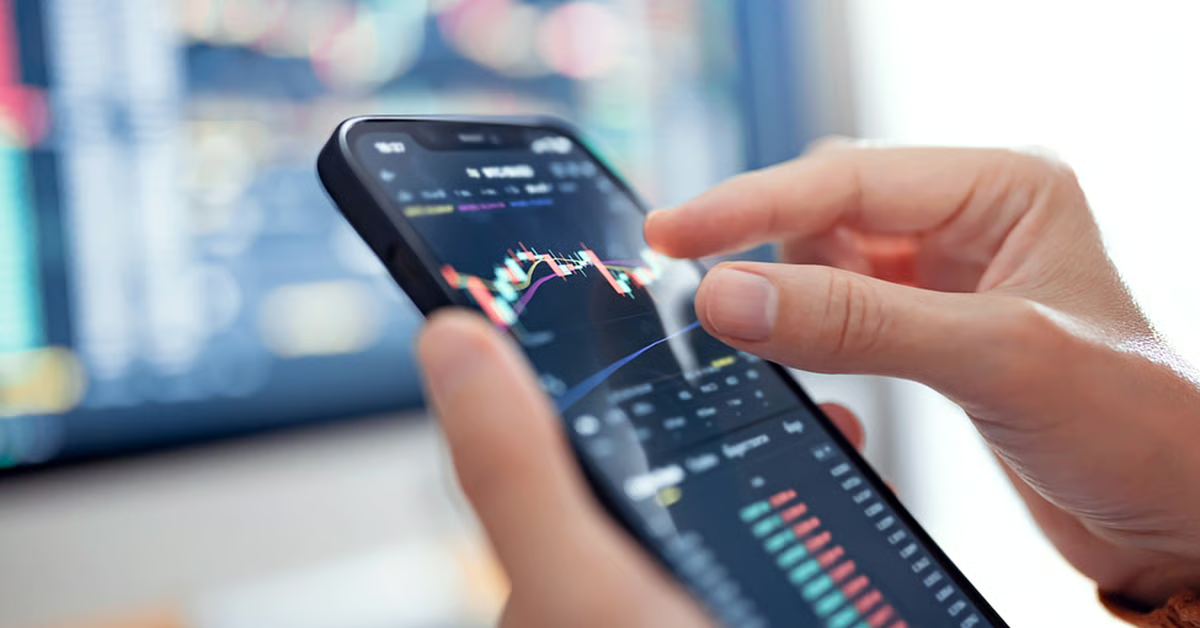
I check the price during my lunch break.
By night, an unknown cryptocurrency is trending on X.
I get curious again.
I research it.
I get confused.
I cannot escape this loop.
(Even though I’ve researched this much, why can’t I decide more than before?)
It is no wonder if you feel that way.
The cause lies somewhere other than the amount of knowledge.
The reason you cannot decide is ‘lack of design’ rather than ‘lack of information’.
People who remain indecisive about cryptocurrency often have candidates they are considering buying.
However,
‘How many years will you operate?’
‘How much will you invest each month?’
‘What level of decline can you withstand?’
‘What would happen that would make you not buy?’
‘Under what conditions will you review your strategy?’
These are not decided.
There is a big difference here.
‘Bitcoin looks like it will go up, so I will buy 300,000 yen worth.’
Compared to someone who says that,
someone who decides on the money to keep for living expenses, the investment period, the monthly additional amount, and the price movements they can withstand before investing 300,000 yen.
Even with the same 300,000 yen, their actions on a day when prices drop will likely differ.
The former uses price as their judgment criteria.
The latter has their own internal judgment criteria.
In other words, the problem is,
not that you don’t know what to buy, but that you haven’t decided what criteria you will use to make your decisions.
If you skip this and only increase your information, your confusion will also likely increase.
Starting with the order of ‘Coin -> Chart -> Buy/Sell’ makes it easy to get lost.
When starting with cryptocurrency, many people imagine this kind of order.
Look for coins.
↓
Look at charts.
↓
Buy.
↓
Aim for profit.
It seems natural.
However, if you think about it in terms of wealth building, the order changes.
First, you should think about your own life and money.
Life planning.
↓
Monthly cash flow.
↓
Amount available for investment.
↓
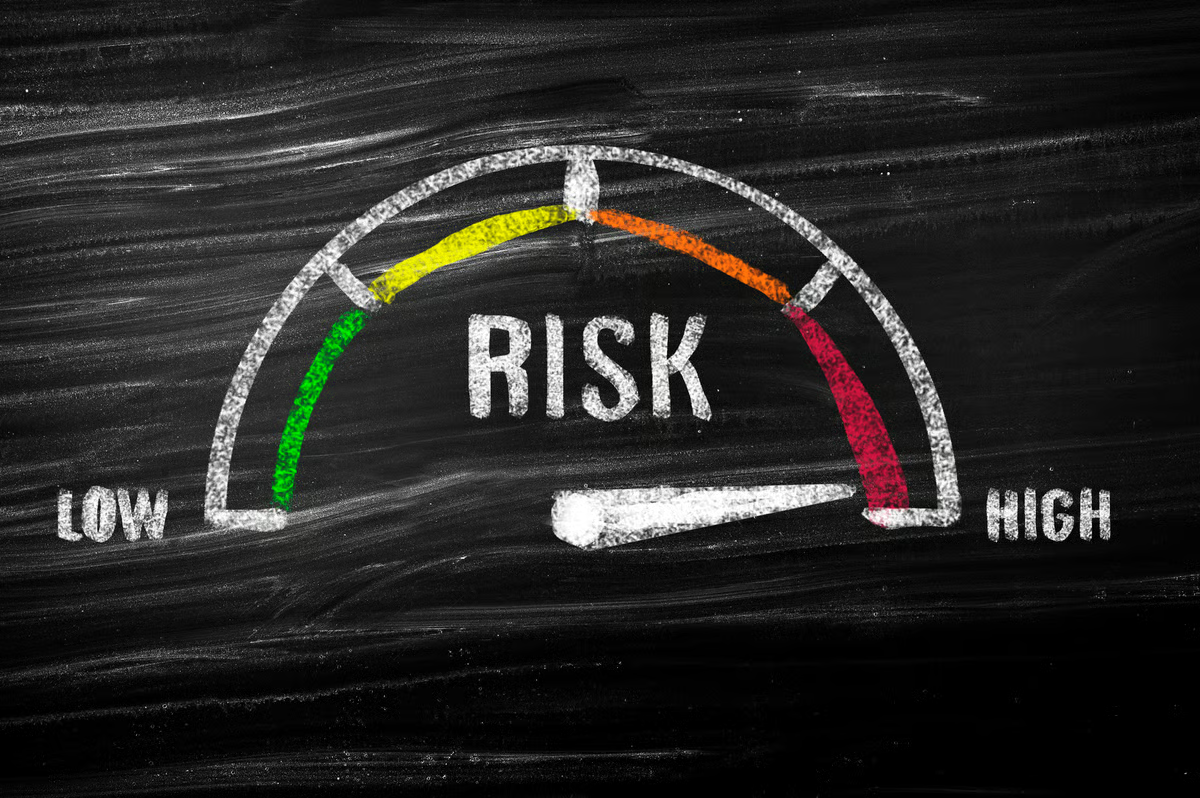
How much price volatility you can accept.
↓
Investment period.
↓
Your own rules.
↓
The coin comes last.
With this order, it becomes harder to decide your investment amount based solely on the reason that ‘it has been going up recently.’
There are things you should look at before looking at charts.
Once you understand this, the reason why beginners ‘study but cannot move forward’ becomes quite clear.
Focus on the ‘order’ rather than 55 videos
The Cryptocurrency Master Course is advertised as having 55 videos, about 6 hours of content, and over 800 slides.
In terms of numbers alone, it is certainly a lot.
However, looking only at the number of videos makes it difficult to understand the value of this course.
There are countless cryptocurrency videos on YouTube as well.
You can even watch 50 hours for free.
The difference does not come from the quantity.
Is it about connecting scattered information yourself, or learning in a structured order from the beginning?
This is it.
If you keep watching YouTube, X, and blogs for 3 hours every week, that is 156 hours per year by simple calculation.
For 3 years, that is 468 hours.
Of course, there is nothing wrong with watching free information itself.
However, every time, you have to ask,
‘Who should I trust?’
“This is different from what I saw before.”
“What should I do in my case?”
If you keep thinking like that, you are spending time even if it is free.
Moreover, the amount of time spent is not proportional to how easy it is to make a decision.
Looking at the numbers, you can see that it is difficult to solve this just by the ‘amount of study.’
In the course, you don’t just learn information about cryptocurrency;
-
an asset management plan sheet,
-
a concrete To-Do list for cash flow improvement,
-
and a checklist for improving investment performance
—materials to help you put things into action—are also provided.
This is the interesting part.
Beginners tend to only look for ways to increase their yield.
But, for example, if you can reduce your monthly fixed costs by 20,000 yen and put that into investments, that is 240,000 yen per year.
You can think about asset formation from a completely different direction than just chasing ‘which cryptocurrency will go up a few percent more.’
And the course consists of 55 videos, totaling about 6 hours, as disclosed by the seller.
For someone who spends 3 hours a week gathering information, that is about two weeks’ worth of time.
Of course, this doesn’t mean you will make a profit just by watching for 6 hours.
What I want to compare is not that, but
whether you can turn the time you spend searching into time for creating your own decision-making rules.
—that is the point.
It is more realistic to look at the mechanism than at flashy ‘experimental results’
In investment-related articles,
‘I made X amount of money by doing this’
stories stand out.
However, it is difficult to judge the quality of the material itself based on that alone.
This is because market conditions also affect profits.
If you look at it through the Cryptocurrency Master Course, the mechanism is actually easier to understand.
Create an asset management plan.
Check your own cash flow.
Decide the amount you can allocate to investment.
Decide not only the conditions for buying, but also the conditions for not buying.
When in doubt, return to the necessary content.
Used this way, its nature is quite different from ‘materials that tell you which cryptocurrency will hit it big.’
The seller, Shorty himself, looks back on his time as a college student in 2017, when he started cryptocurrency with a friend with about 200,000 yen, and initially engaged in ‘gambling investment’ by gathering information on social media and buying coins that looked good.
When the market rose, his 200,000 yen increased to 400,000 or 500,000 yen, but after the market collapsed, his friend lost most of his assets and withdrew.
He explains that he continued to study and realized a profit of 5 million yen in 2021.
This is not a story about someone who knew everything from the beginning.
Buying because it is going up.
Being interested in what you saw on social media.
Experiences that started from such points are also connected to the design of the course.
If things stay as they are, you might be doing the same searches five years from now.
You don’t need to assume that the worst future to avoid in cryptocurrency is a ‘market crash.’
There is a more immediate problem.
It is continuing to go years without having any criteria for judgment.
One year from now.
You will be on YouTube again,
searching, ‘Is it too late to start cryptocurrency now?’
Three years from now.
You have become knowledgeable about coin names.
You know quite a bit of market terminology, too.
But if someone asks, ‘How many years are you planning to invest?’, you cannot answer.
Five years from now.
The market has gone up and down many times.
You have watched a massive amount of videos.
Yet, you still have no investment rules of your own.
What is scary is not how the prices moved.
It is that you are still struggling in the same way you were five years ago.
This does not mean that starting early guarantees you will make money.
What you can build early is not ‘profit,’ but the habit of making your own decisions about your own money.
That is the one thing you are missing.
Therefore, procrastination also has a cost.
What changes the results is the ‘order of judgment,’ not the amount of information.
To summarize what we have discussed so far, it comes down to this.
The key to reducing hesitation in cryptocurrency is not to increase information, but to establish your own criteria for judgment first.
Even if you know 100 recommended coins, you will still be hesitant if you haven’t decided when not to buy.
Even if you look at charts every day, if you haven’t decided on your investment period, you will easily be swayed by today’s price movements.
Conversely, once you have decided on your investable amount, time frame, and rules, when you see new information, you will find it easier to categorize it as:
‘This is relevant to me’
‘I don’t need to look at this right now’
and separate them accordingly.
There will even be times when the ability to discard information is more useful than the ability to collect it.
What you need is not a ‘winning coin,’ but a system you can decide on yourself.
Here, let’s return to the story from the beginning.
What a cryptocurrency beginner needs is not to endlessly search for the next coin that will go up.
What is needed is
a system that makes it harder to lose your judgment even when the market moves.
Instead of thinking about ‘when to sell’ after seeing unrealized gains, think about the exit before you even enter.
Instead of worrying about the investment amount after the price drops, decide on the amount you can afford to invest beforehand.
Instead of wanting to buy after it becomes a hot topic on social media, decide in advance ‘under what conditions I will not buy.’
With this order, even the meaning of looking at market news will change.
This is because news becomes not something that ‘moves you,’ but ‘material to check against your own rules.’
Cryptocurrency changes from ‘price movement’ to ‘part of an asset plan’
Until now,
‘Will Bitcoin go up?’
‘When should I buy Ethereum?’
‘Which cryptocurrency will grow next?’
‘Is a crash coming?’
These questions might have been at the center of your focus.
Once you have a foundation for judgment, the questions themselves change.
‘How much will I invest annually?’
‘How many years will I manage this?’
‘What percentage will I allocate to cryptocurrency?’
‘What level of decline can I accept?’
‘Under what conditions will I not buy?’
‘When will I review this?’
Once it changes to this extent, cryptocurrency is no longer just about price movements.
It becomes part of your own asset plan.
Even if you wake up in the morning and the price has dropped by 10%, you don’t reflexively buy or sell, but first check your own rules.
Even if an unknown cryptocurrency is trending on X during your lunch break, you don’t immediately fall into a search rabbit hole.
You don’t keep watching multiple YouTube videos at night to keep checking for answers.
At the very least, you can see ‘what you need to check and decide’.
Isn’t this the state you want, rather than a flashy future?
Build it yourself, or learn it in order
Of course, you can build this decision-making framework from scratch yourself.
Organize your household finances.
Research asset management.
Learn how cryptocurrency works.
Research taxes.
Create your own investment rules.
You can just assemble it one by one while comparing multiple sources of information.
If you are someone who wants to do that work yourself, that is fine.
The Cryptocurrency Master Course is an option for those who want to proceed with that information gathering and organization as ‘learning in a specific order’.
In addition to 55 videos, approximately 6 hours of content, and over 800 slides, it includes an asset management plan sheet, a concrete to-do list for improving cash flow, and a checklist for increasing investment performance.
The content is available for permanent viewing, and it is stated that additional content will be provided at no extra cost.
Conversely,
I only want to know which coins will go up 10x starting tomorrow.
I only want trading signals.
I don’t want to think for myself.
I don’t want to do 6 hours of learning.
I am looking for a profit guarantee.
If spending 49,800 yen would interfere with your daily life.
In that case, this direction is not for you.
This is not a product for those aiming for hundreds of millions of yen in a short period, nor is it a guarantee of results.
Conversely,
If you have been involved in cryptocurrency for about 0 to 2 years.
You cannot feel confident no matter how many YouTube videos you watch.
You feel anxious every time the price drops.
You have not decided how much to invest each month.
You cannot answer how many years you will be investing.
Even if you think about conditions for buying, you have not decided on conditions for not buying.
You have been repeating ‘I’ll do it after I study more’ for over half a year.
If you are in this state, it is worth checking once if what you are missing is not coin information, but an ‘investment plan’.
Instead of just looking at the numbers of 668 reviews and a 5-star rating, look at what students have shared,
‘It became clear what I needed to do that day and that month’
‘My incorrect knowledge was brought to light’
‘I was able to continue even though I’m not good at studying’
If you focus on content like this, it becomes easier to see what this course aims to achieve.
Not the amount of profit, but whether you can get closer to a state where you can make decisions.
Use that as a standard to check if it suits you.
Will you ‘continue researching for another half a year’?
Or, perhaps you should try putting your money and investment rules into numbers for once.
What you should look at next might not be a new coin.
#AD #Cryptocurrency #Crypto #Bitcoin #CryptoInvestment #Investment #SideHustle