
Date Created: November 11, 2026
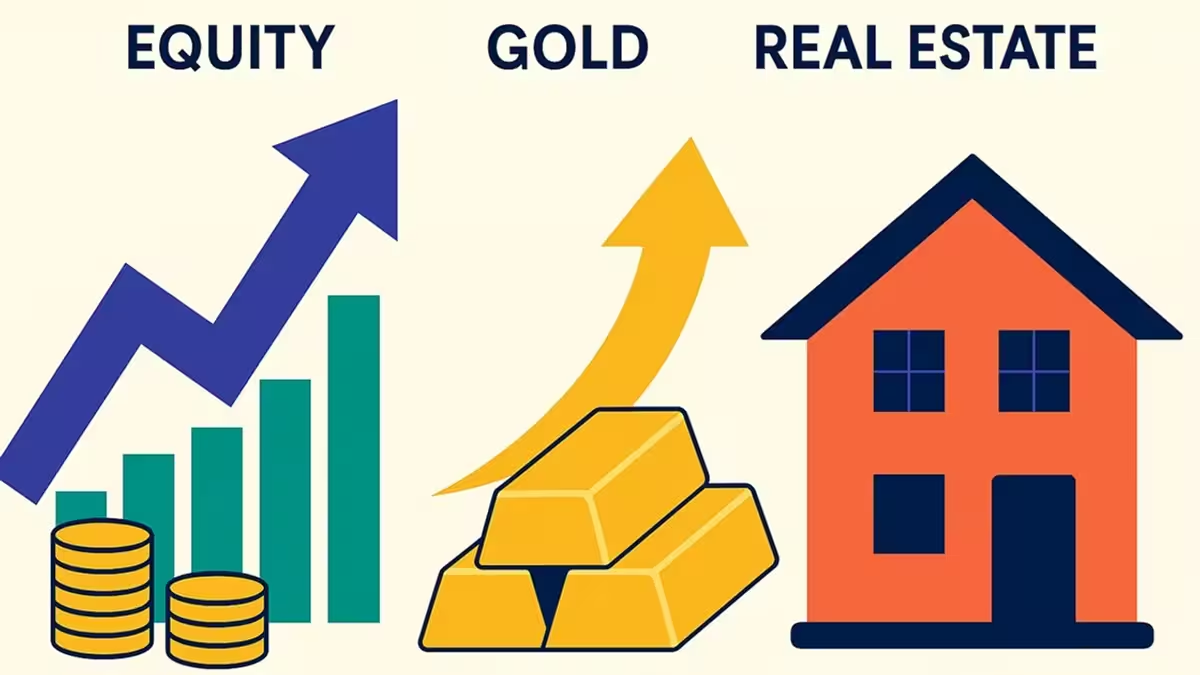
“Stock prices and real estate prices in developed countries rise in the long term due to inflation. If the inflation rate is 2%, risk assets will rise by about 7-8% per year. Therefore, you should buy an index and hold it for the long term.”
This way of thinking captures the essence of long-term investing.
In fact, historically, stocks have generated returns that exceed inflation. The idea of investing long-term in the profit growth of excellent companies without fearing short-term crashes is rational.
However, the claims that “they will definitely rise in all developed countries” and “both stocks and real estate will converge to 7-8% per year” are not accurate.
This is because past average returns and the returns that will be realized in the future are different things.
1. Have global stock markets really been rising for over 100 years?
The “Global Investment Returns Yearbook 2026” published by UBS in March 2026 contains long-term investment data from 1900 to 2025.
The average annual return of US stocks is as follows.
US Stocks – Nominal Annual Rate
9.8%
US Stocks – Real Annual Rate
6.6%
1900-2025, dollar-denominated long-term returns including dividend reinvestment. Source: UBS Global Investment Returns Yearbook 2026.
Netherlands
Also, the stock returns from 1900 to 2025 were 8.5% per year for the entire developed market and 6.9% per year for the entire emerging market. Both are long-term results denominated in US dollars.
Netherlands
Therefore, the claim that stocks generate high returns in the long term has sufficient historical basis.
However, just because the average over a period exceeding 100 years is around 8%, it does not necessarily mean that the next 10 or 20 years will yield the same figures.
2. It took over 34 years for Japanese stocks to recover to their all-time high
A prime example illustrating the difficulty of long-term investing is the collapse of the Japanese bubble economy.
The Nikkei Stock Average recorded its then-all-time high closing price of 38,915.87 yen in December 1989. However, it was not until February 22, 2024, that it surpassed that level in closing price.
This means it took more than 34 years.
Reuters
Of course, this is a comparison of stock price indices that do not include dividends. If dividends are reinvested, the investment performance will differ.
Even so, it is an important case study showing the possibility that stock prices may remain stagnant for a long period.
In stock investing, results vary greatly depending on the country, the era, and the timing of when the investment began.
One must not confuse the historical trend that ‘stock prices tend to rise in the long term’ with the guarantee that ‘you will make a sufficient profit regardless of when you buy.’
3. Is it true that real estate prices also rise by 7-8% annually?
This is where special caution is required.
The study ‘The Rate of Return on Everything, 1870–2015,’ published in 2017 by researchers at the Federal Reserve Bank of San Francisco and others, analyzes the returns on stocks, housing, and bonds across 16 developed countries over approximately 145 years.
This research revealed that housing has also generated high long-term returns comparable to stocks.
San Francisco Fed
However, what is important is the point that the investment return on real estate is different from the appreciation rate of real estate prices.
The total return on real estate investment is generally composed of the following elements:
-
Capital gains from the appreciation of real estate prices
-
Rental income
-
Costs such as maintenance and repair expenses
-
Taxes and financing costs
The above research also distinguishes between fluctuations in housing prices and rental income after accounting for maintenance costs and the like.
St. Louis Fed
In other words, just because the long-term return of real estate investment as a whole was high, it does not mean that condominium prices themselves rise by 7-8% every year.
The difference is clear when looking at the Japanese real estate market
According to the Ministry of Land, Infrastructure, Transport and Tourism’s 2026 Land Price Publication, the year-on-year growth rates for residential land are as follows.
Region
2026 Residential Land Growth Rate
National Average
+2.1%
Three Major Metropolitan Areas
+3.5%
Tokyo Area
+4.5%
Osaka Area
+2.5%
Regional Areas
+0.9%
Ministry of Land, Infrastructure, Transport and Tourism
The national average is significantly lower than 7-8%.
Furthermore, in Japan, after the bubble burst in the early 1990s, residential and commercial land prices fell for a long period. This trend is clearly reflected in the long-term land price data from the Ministry of Land, Infrastructure, Transport and Tourism.
Ministry of Land, Infrastructure, Transport and Tourism
In the case of real estate, asset value is greatly influenced by demographics, transportation access, the regional economy, and the aging of buildings.
In areas where the population is declining, housing prices may fall even if inflation continues.
4. If city-center condominiums rise by 25%, will they converge to 7-8% in the future?
This is also not necessarily correct.
Suppose a certain city-center condominium rose by 25% in one year.
Even if the past average growth rate was 7%, it does not necessarily mean that the price will fall the following year.
On the other hand, there is no guarantee that the 25% increase will continue in the future.
Subsequent prices are determined by interest rates, wages, rents, housing supply, demand from foreign investors, and so on.
The important thing is that returning to a past average is not the same as a price approaching a sustainable, appropriate level.
The same thing happens in the stock market.
Even if corporate profits are growing at 10% per year, if stock prices rise by 30% per year in advance, the price-to-earnings ratio (PER) may be expanding.
In that case, even if profit growth continues, the stock price may remain flat due to the contraction of the PER.
While corporate profit growth is important for long-term stock price increases, the stock valuation at the time of purchase cannot be ignored.
5. What is the projected stock market return for the next 10 years?
On October 21, 2026, Vanguard, one of the world’s largest asset management companies, released its latest long-term market forecast.
The forecast is as follows.
Vanguard’s annual return forecast for the next 10 years
US stocks
4.8-6.8%
Developed market stocks excluding the US
5.3-7.3%
Emerging market stocks
3.7-5.7%
Model forecast as of October 21, 2026. These are not guaranteed yields, and actual returns for Japanese investors will vary due to taxes, exchange rate fluctuations, etc. Source: Vanguard Capital Markets Model.
Vanguard
The central forecast range for US stocks is 4.8-6.8% per year, which is not necessarily 7-8%.
Also, there is a possibility that stock prices could fall significantly during the forecast period.
On the other hand, if corporate productivity and profit margins improve more than expected due to the spread of AI, there is a possibility that returns could exceed the forecast.
While past averages are a reference for thinking about the future, those figures should not be used as-is for future predictions.
6. If you can invest at an annual rate of 7-8%, how much will your assets grow?
Let’s compare the case of investing 1 million yen for 30 years without additional investment.
Compound interest investment simulation (excluding taxes and fees)
Assumed annual rate
After 10 years
20 years later
30 years later
2%
1.22 million yen
1.49 million yen
1.81 million yen
5%
1.63 million yen
2.65 million yen
4.32 million yen
7%
1.97 million yen
3.87 million yen
7.61 million yen
8%
2.16 million yen
4.66 million yen
10.06 million yen
At an annual rate of 7%, it will be approximately 7.6 times higher in 30 years.
At an annual rate of 8%, it will be approximately 10 times higher.
Looking at this difference, the power of long-term compound interest becomes very clear.
However, this does not mean that the same rate of return continues every year. Actual stock prices fluctuate with repeated rises and falls, and even if the final average annual return is the same, the asset value along the way will vary significantly.
Also, if the inflation rate is 2% per year, the purchasing power of 10.06 million yen in 30 years will be equivalent to approximately 5.56 million yen in today’s money.
In asset management, it is necessary to look not only at the nominal amount but also at the real asset value after deducting price increases.
7. Is the strategy of holding index investments for the long term still effective?
I believe that low-cost, diversified index investing is a very rational basic strategy for long-term wealth building.
However, the judgment changes depending on the index held and the investment period.
For example, with the S&P 500, you can invest in large U.S. companies, and with all-country stocks, you can invest in a wide range of companies around the world.
Even if a specific company declines, the index’s constituent stocks are reviewed periodically. Compared to concentrated investment in individual stocks, company-specific risks can be suppressed.
However, even with all-country stocks, the ratio of the U.S. market is high, and the impact of a global stock market decline cannot be avoided.
Things to emphasize in long-term investment
-
Do not invest too much of your living expenses or money you will need in the near future into stock investments.
-
Invest primarily with funds that you will not need for 10 years or more.
-
Utilize tax-advantaged systems such as NISA.
-
Choose index funds with low management costs.
-
If your stock ratio is too high, review your allocation with cash and bonds.
-
Do not consider past average returns as guaranteed future yields.
What is particularly important is to invest with funds that you can hold for the long term.
Avoiding situations where you are forced to sell for living expenses or other reasons even when a major decline occurs is crucial for continuing long-term investment.
8. Conclusion—’Buy and hold indices’ is correct, but 7-8% per year is not guaranteed
To summarize the arguments made here, they are as follows.
Argument
Evaluation
Stocks tend to outperform inflation over the long term
Generally correct
The view that long-term stock returns are around 7-8% per year
Historically has some basis
Stock prices will always trend upward in all developed countries
Incorrect
Real estate prices also rise by 7-8% every year
Incorrect
Real estate that has surged will always converge to a 7-8% growth rate
Insufficient evidence
Holding a diversified index for the long term
A rational basic strategy
It is not merely inflation that supports the long-term returns of stock investments.
It is important that companies create new products and services, increase productivity, and generate profits, which in turn returns economic value to shareholders.
There is a strong possibility that global economic productivity will continue to rise in the future due to developments in AI, robotics, automation, and medical technology.
However, how much investment return that economic growth will generate from current stock prices is a separate issue.
Believing in long-term economic growth is different from thinking that you will make money regardless of the price at which you buy stocks.
The greatest strength of index investing is not that a 7-8% annual return is guaranteed.
It is the ability to participate in the growth of a wide range of companies without having to accurately predict the future winners.
In that sense, I agree with the idea of buying and holding an index as the foundation of long-term investing.
However, to express it more accurately, it would be as follows.
“Given the premise that the global economy and corporate profits will grow in the long term, it is rational to hold a well-diversified index for the long term using funds that one can afford. However, the historical average return of 7-8% per year does not guarantee future profits.”
Is this not a more realistic conclusion for long-term investing that can be derived from over 100 years of market data?