Annuities are appealing to a lot of retirees and future retirees because they offer guaranteed lifetime income payments. If you have enough in savings to buy a $2 million annuity, you may be asking: What does a $2 million annuity pay?
Before purchasing an annuity, you’ll want to understand several concepts first, including:
- How an annuity works.
- How much a $2 million annuity will pay.
- Advantages of a $2 million annuity.
- Disadvantages of a $2 million annuity.
- What to consider before getting a $2 million annuity.
Best Mutual Funds and ETFs for Retirement Today
| Mutual fund or ETF | Expense ratio |
| Vanguard Target Retirement 2025 Fund (ticker: VTTVX) | 0.08% |
| Vanguard LifeStrategy Conservative Growth Fund (VSCGX) | 0.12% |
| iShares Core Moderate Allocation ETF (AOM) | 0.15% |
| iShares TIPS Bond ETF (TIP) | 0.19% |
| iShares 0-3 Month Treasury Bond ETF (SGOV) | 0.07% |
| Vanguard Wellesley Income Fund Investor Shares (VWINX) | 0.23% |
| Vanguard Wellington Fund (VWELX) | 0.25% |
- People talk about investing in an annuity, but that isn’t the right terminology, according to Paul Tyler, chief marketing officer of Nassau Financial Group in Hartford, Connecticut.
- “The biggest misconception that people have is that annuities are investments,” Tyler says. “They are insurance at the core. They generally guarantee a steady stream of income payments that a person can’t outlive.”
- While annuities aren’t confusing financial products, Tyler says that a lot of people don’t understand them. “Annuities are the pyramids of retirement planning,” Tyler says. “They have been in existence about the same amount of time, but most people still can’t explain how they work.”
With an annuity, you pay a lump sum of money, and in exchange, you’ll receive a guaranteed monthly payment for life. Generally, people pay enough into the annuity to make sure the monthly payment will be anywhere from a few thousand dollars a month to $20,000 per month.
There are many different kinds of annuities, however, which can make understanding the nuts and bolts of annuities confusing. There are immediate annuities, fixed annuities and equity-indexed annuities, for instance. Learning about them and understanding the differences can be dizzying; it’s best to consult a financial advisor if you’re getting serious about buying one and getting that lifetime guaranteed monthly income.
“The amount of money you put into an annuity and the age at which you ‘annuitize,’ also known as when you draw income from the annuity, determine your lifetime annuity payout,” says Doug Ornstein, senior integrated solutions manager at TIAA Wealth Management.
“A conservative back-of-the-envelope-math approach to estimating this in today’s interest rate environment is about 5%,” Ornstein says. “Multiply a lump sum of money by 0.05, and you’ll have an annual income estimate. If you’re lucky enough to have a higher payout rate on your annuity than 5%, make sure the annuity company or pension fund are in good financial health – that is, that they have a high rating by the top third-party ratings agencies.” Those include Moody’s, Standard & Poor’s and Fitch.
What Does a $2 Million Annuity Pay?
The amount a $2 million annuity pays depends on factors such as whether you want your monthly lifetime income payments to start immediately or, say, 10 years from now. Currently, a $2 million annuity will likely pay between $10,000 to $20,000 a month for the rest of your life.
One factor to consider is whether you want beneficiaries to also receive income from your annuity. Some annuities come with timelines, so that if you die within 10 or 20 years, your beneficiaries receive your annuity for the rest of that time period. In exchange for making that deal, you receive a little less (probably a few hundred dollars a month less), but you may feel better about the financial decision.
That’s because this is, as noted, an insurance product. If you select a $2 million annuity that pays on a “life only” basis and something tragic happens to you a few months later, that $2 million is gone.
But if you buy a single life annuity policy with a 10- or 20-year timeline and you die a few months or years later, your loved ones get that guaranteed income for a while in the form of monthly payments or possibly as a lump sum death benefit.
“Because ‘life only’ payouts are only about 5% higher based on our calculations, the risk generally outweighs the benefit,” says Paul Simmons, a chartered financial analyst and senior analyst at Edward Jones.
Advantages of a $2 Million Annuity
Most people can find a lot to like about an annuity, especially a $2 million annuity. Most people can manage to live just fine off of $10,000 to $20,000 a month. In any case, if you’re considering getting any annuity, there are several advantages to consider.
Guaranteed income. This is the main selling point for anyone interested in an annuity.
“As modern medicine is helping Americans live longer and longer, running out of income in retirement has become the No. 1 fear for retirees. Certain annuities provide a guaranteed income stream that an individual cannot outlive, even if the account balance hits zero,” says Jordan Mangaliman, CEO of GoldLine Financial Services in Fullerton, California. “This can ensure a peace of mind for retirees that need lifetime income they can depend on.”
“An annuity may also help provide additional income that can allow you to delay Social Security. Depending on your situation and longevity expectations, delaying Social Security can help maximize the benefits you will receive over your lifetime,” he says.
An annuity may help you stave off future inflation. This is a big maybe, however.
“While many people keep large amounts of cash in a savings account or low-rate CD, an annuity might be a better choice to combat inflation while still preserving capital,” says Kelly Gilbert, a fiduciary investment advisor at EFG Financial in Grand Rapids, Michigan.
But not every annuity is designed to combat inflation; some don’t. While $10,000 a month for the rest of your life should keep your life running fine, things might look differently decades in the future. Consult with a financial advisor about the annuity and whether it’s designed to grow with inflation.
Disadvantages of a $2 Million Annuity
The main disadvantage of any annuity is that it isn’t like a bank account in which you put $2 million and then easily withdraw whatever amount you want. You’ll get guaranteed income for life, but if you want to withdraw $30,000 instead of $10,000 one month, things start to get complicated.
Every insurer handles withdrawals (beyond what you’ve agreed to in the contract) differently. For instance, many insurers will allow you to immediately cancel your annuity within a grace period, so that if you buy one and have second thoughts a few days later, you can cancel without penalty. But generally, if you buy an annuity and regret it a year later, you’ll have to pay what’s called a “surrender charge,” which often is about 7% of the annuity.
“Annuities are designed as long-term products,” Mangaliman says, adding that anyone buying an annuity should have more money available to them.
“I would never recommend someone put more than 75% (of their assets) into annuities because the individual should still remain liquid,” Mangaliman says. Ideally, he adds, “I would say putting half into annuities and half in other investments would be a great balanced approach.”
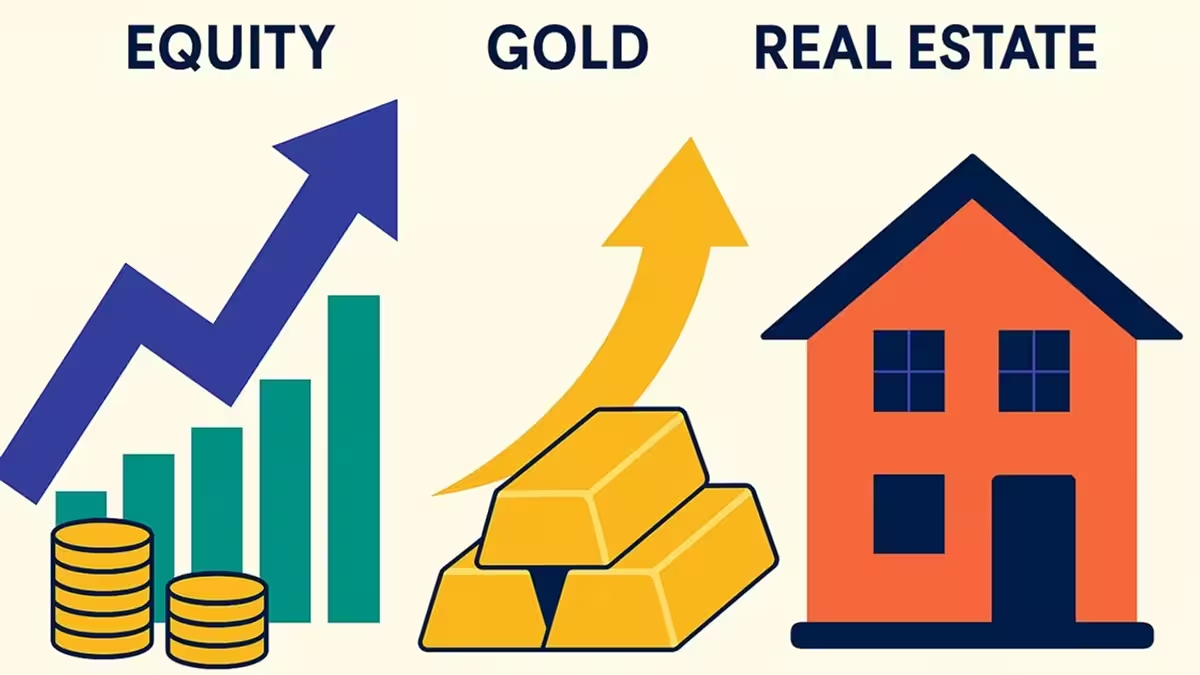
Gilbert agrees. “I generally advise that no more than 50% of your investable cash be in annuities. That percentage is regardless of age. The remaining 50% can be in the stock market, real estate or other risk-and-reward profiles. But never have all your eggs in one basket,” he says.
Other Considerations Before You Buy a $2 million Annuity
If you are interested in buying a $2 million annuity, here are a few more things to think about.
Taxes. If you’re putting money into an annuity, month after month, year after year, you won’t pay taxes on it. “However, once you begin receiving income, ordinary income rates, not capital gains rates, will apply on any earnings,” Simmons says.
Fees. Surrender charges were mentioned earlier, but there are other fees to think about. You may pay a commission to the insurance agent, an underwriting fee and a fund management fee. Fees vary, but they’re generally a small percentage of the value of the annuity. But you’ll want to discuss this with your financial advisor. And again, you really don’t want to sink money into an annuity and then decide you need that money back.
“Liquidating an annuity shortly after purchase can come with additional costs, such as surrender charges and ordinary income taxes on earnings. And if you are younger than 59½, an additional 10% penalty may apply,” Simmons says.
Make sure you understand what you’re getting into. This is really important, whether you’re buying a $2 million annuity or putting several thousand dollars into one and then paying regular premiums.
“You should be able to explain to a teenager, using minimal financial jargon, how the annuity works before you say yes. This is one of the reasons why working with a trusted financial advisor is so important for retirement planning,” Ornstein says.