India’s mutual fund industry’s biggest challenge is no longer getting people to invest—it is helping them understand where to begin.
A new report by Eminence Strategy Consulting found that lack of knowledge, rather than affordability, has emerged as the single biggest barrier to mutual fund adoption in the country. The study said 29% of non-investors stay away because they do not know enough about mutual funds, compared with just 15% who believe they do not have enough money to invest.
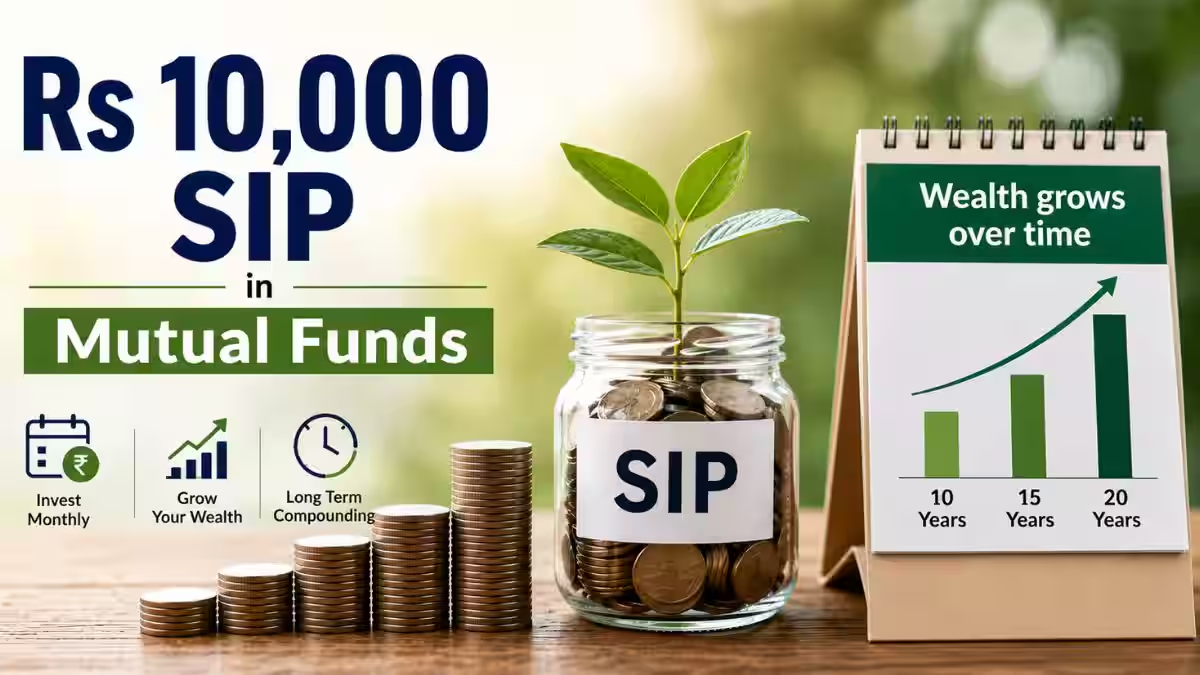
The findings come even as India’s mutual fund industry has grown to ₹81.6 lakh crore in assets under management (AUM), with 27.6 crore folios and monthly SIP contributions touching ₹30,594 crore as of May 2026. Yet, the report argues that participation has expanded much faster than investor understanding.
“India’s mutual fund adoption challenge is no longer primarily about affordability. It is about awareness, confidence, comprehension, and onboarding,” the report said.
It added that “knowledge gaps and trust deficits together account for nearly half of all non-participation,” making the industry’s biggest obstacles behavioural and informational rather than structural.
According to the study, the knowledge gap is not limited to people who have never heard of mutual funds. Instead, it reflects different challenges across age groups.
Among Gen Z investors, many respondents said they had nobody to explain the basics. Responses such as “No one guided me” and “Minimal knowledge” reflected hesitation to begin rather than opposition to investing.
For early millennials, the challenge was different. Working professionals with disposable income often struggled to identify the right product or starting point. Respondents cited concerns such as “I don’t know which fund,” “Way too many options,” and “No one around me does it.”
“The findings suggest that the knowledge gap is not a single barrier but a progression of unmet needs—from understanding how to start, to understanding what to choose,” the report said.
Besides the knowledge gap, 20% of non-investors said they stayed away because they did not trust mutual funds or the institutions managing them. The report found that these concerns ranged from fears over market volatility to bad experiences involving fraudulent investment schemes.
“The first is market-linked unpredictability… The second is institutional trust failure,” the report noted, pointing to responses such as “Market girta hai to paisa doob jaata hai” and “There was dhokha in investing.”
Another 19% of respondents were not actively opposed to investing but lacked a trigger to begin, while 18% preferred other investment avenues. The study also found that many young respondents wrongly believed meaningful investing required a large amount of money despite SIPs starting from as little as ₹100.
The report also found that investor confidence increasingly depends on the reputation of the fund house rather than just product performance.
One in three investors said they trusted a mutual fund company’s reputation more than their own understanding of mutual fund products. Half of all investment decisions could be traced back to financial advisors or personal networks, while three in five respondents said a mutual fund company’s leaders and social media communication influenced how they perceived the fund house.
The study identified fund performance as the biggest entry point for investors, but said long-term trust is shaped by factors such as fund manager credibility, brand familiarity, clear communication and customer support.
“Performance is the price of entry. Reputation is what determines whether an investor stays, grows their portfolio, or leaves during periods of uncertainty,” it said.
The report argues that investor education should become a core strategy for asset management companies rather than a supporting marketing activity.
It found that financial advisors remain the biggest source of mutual fund learning for investors, accounting for 25% of responses, followed by fund managers’ and company leaders’ content at 20%. However, nearly one in four active investors could not name a single source that had taught them about mutual funds.
“Investor education is evolving from a brand-support activity into a primary trust-formation mechanism,” the report said.
It added that institutions that consistently simplify investing, explain markets clearly and create repeat learning opportunities are increasingly shaping investor trust, long-term behaviour and retention.