
India’s mutual fund industry witnessed a decline of more than 5 per cent in assets under management (AUM) in September 2026, even as systematic investment plan (SIP) contributions remained strong, highlighting the contrasting trends of market volatility, institutional withdrawals and continued retail investor participation.
Market corrections and significant withdrawals from debt mutual funds were identified as the key factors behind the decline, experts told Zee Business.
Experts said the fall in industry AUM should be viewed in the context of equity market weakness and large institutional transactions rather than as a sign that retail investors were losing confidence in mutual funds.
Prathiba Girish, founder of Finwise, said the resilience of SIP investments was particularly encouraging given the market conditions. She noted that investors continued to contribute through SIPs even as equity markets corrected and the industry’s AUM declined.
“If five years ago someone had said that the market would go nowhere for two years and investors would still deliver record-breaking SIP numbers in a month when equity markets fell, I would not have believed it,” Girish said, highlighting the resilience shown by investors.
Market correction and debt-fund withdrawals weigh on AUM
The experts identified two major factors behind the decline in mutual fund AUM: the correction in equity markets and substantial withdrawals by institutional investors from debt mutual funds.
Feroze Azeez, Joint CEO, Anand Rathi Wealth Limited, said the Nifty declined by around 6 per cent in September, while equity mutual fund assets fell by approximately 4.25 per cent.
He attributed the decline in equity fund assets primarily to market performance rather than investor withdrawals.
“The Nifty fell by 6 per cent, and equity mutual fund assets fell by 4.25 per cent. This happened because the Nifty did not perform in September, not because of outflows,” Azeez said.
Separately, Girish pointed to substantial institutional withdrawals from debt mutual funds as another major contributor to the decline in overall industry AUM. The experts referred to quarterly withdrawals of around Rs 1.83 lakh crore from debt funds.
The distinction is important because AUM reflects both investment flows and changes in the market value of the underlying securities. When equity prices decline, fund assets can fall even if investors continue investing. Large withdrawals from debt funds can add further pressure to the overall figure.
Why were institutional investors withdrawing from debt funds?
According to Girish, the withdrawals were concentrated in institutional money, particularly in categories such as liquid funds, where large transactions can significantly affect reported assets.
She referred to outflows of around Rs 1.33 lakh crore and said such movements could be linked to institutional cash-management requirements and half-year-end balance-sheet adjustments.
“Large amounts are invested in these funds, and when large amounts are withdrawn, AUM falls quickly,” she explained, adding that similar movements are often seen around financial reporting periods.
Girish said the pattern could be related to half-year-end activity, noting that institutional withdrawals are also commonly observed around the March year-end. She did not consider the outflows, by themselves, a major cause for concern.
The explanation suggests that the overall decline in AUM should not automatically be interpreted as a broad-based exit by retail investors. Institutional flows can be large and can move sharply over short periods, affecting industry-wide figures.
SIP investments remain resilient despite market volatility
Despite the decline in AUM, the experts highlighted the continued strength of SIP contributions as a positive sign for the mutual fund industry.
Azeez said monthly SIP investments had increased substantially over the past decade. He noted that monthly SIP contributions were around Rs 3,300 crore in September 2016 and had grown to approximately Rs 33,000 crore, representing a tenfold increase.
He expects the monthly figure to reach Rs 45,000–50,000 crore over the next two years, arguing that the expansion reflects greater investor awareness.
“My view is that the retail investor who has entered the market this time has come on the basis of education, not greed,” Azeez said.
He also highlighted the growth in active-fund mobilisation. As experts discussed, inflows into active funds increased from around Rs 29,000 crore in August to Rs 38,000 crore in September. Including exchange-traded funds (ETFs) and index funds, he cited total net sales of around Rs 51,000 crore.
Azeez said the continued inflows were helping bring stability to the market at a time when equity prices remained under pressure.
Record small-cap investments raise questions about risk
The experts also highlighted strong investor interest in small-cap and mid-cap mutual funds, even as large-cap stocks underperformed.
The experts cited small-cap inflows of approximately Rs 9,300 crore in September, describing the figure as a record. Azeez said investors often gravitate towards categories that have performed well in the past.
“Basically, small-cap is popular because India buys on the basis of past performance,” he said, adding that large-cap performance had been relatively weak.
He cautioned that the combined share of small-cap and mid-cap investments in the equity flows appeared high. His comments raise a broader question about whether investors are allocating too much money to riskier market segments based on recent returns.
For investors, strong SIP inflows into small-cap funds do not necessarily mean the category is suitable for everyone. Investment choices need to reflect an individual’s risk tolerance, time horizon and overall portfolio allocation.
What should mutual fund investors do?
Girish advised investors against making major changes to their asset allocation solely because equity returns have been subdued over an extended period.
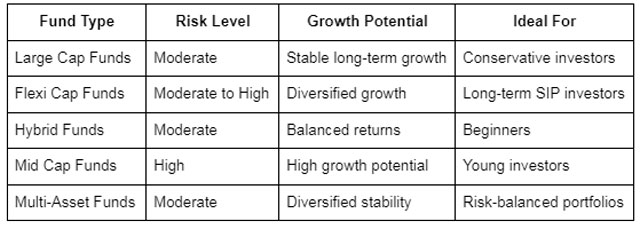
She said large-cap funds could be worth considering in light of valuations and the possibility that market segments that have underperformed may eventually recover. She also highlighted diversified categories such as flexi-cap funds.
Her broader advice was to continue SIPs, maintain diversification and avoid making abrupt allocation changes in response to short-term market movements. Investors with money needed over the next few months or within a year, she said, should consider matching their investments to their time horizon, including evaluating short-duration debt funds.
Azeez also stressed the importance of patience, noting that equity markets can recover sharply after major declines, although the timing of any recovery cannot be predicted.
The September figures therefore present two different sides of the mutual fund industry: falling AUM amid market weakness and institutional debt-fund withdrawals, alongside continued retail participation through SIPs. The experts said the decline needs to be understood in this context rather than viewed in isolation.