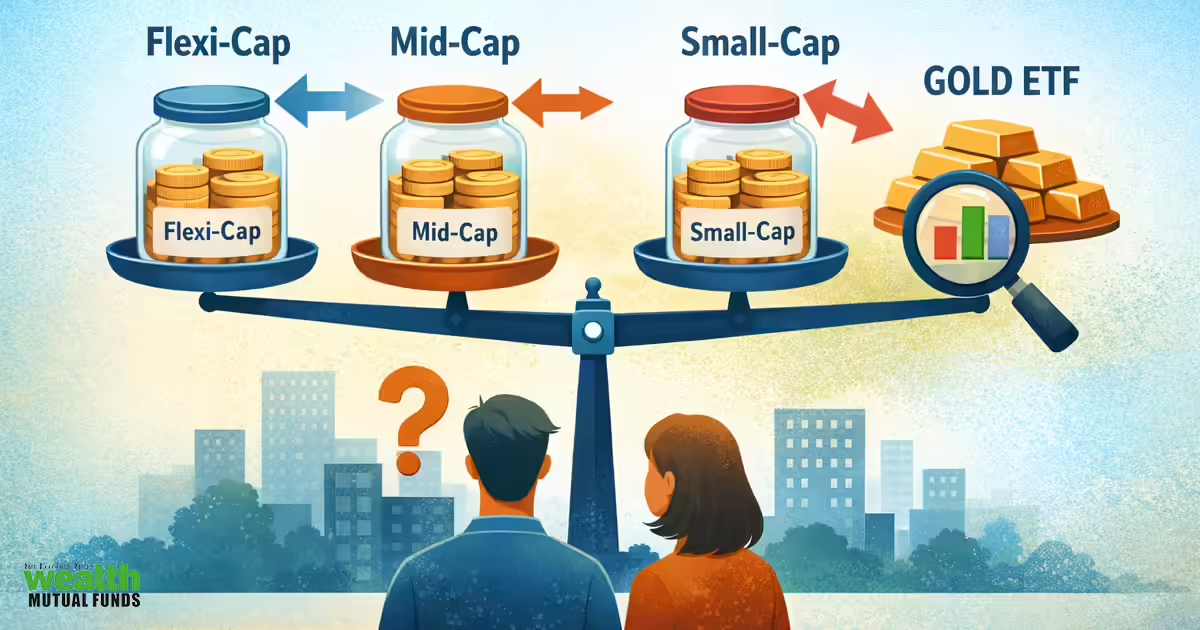
For years, mutual fund investors have faced a deceptively simple question: Should you pay a fund manager to pick stocks, or simply buy the index? Fresh data from Morningstar’s Active/Passive Barometer India suggests there is no one-size-fits-all answer.
In some categories, active fund managers have had a substantial edge over passive funds in recent years. In others, the odds have been far less favourable. And in one of the country’s most popular categories — large-cap funds — the difference between short-term and long-term results is particularly striking.
The report covers 471 unique funds and evaluates active funds against a composite of actual passive funds, rather than a costless index. It also accounts for fund survivorship, making the analysis useful for understanding how consistently active strategies have delivered over different time horizons.
As of June 30, 2026, 87.9% of active large-cap funds beat their passive peers over the preceding one year. Over three years, the figure was 86.7%. But stretch the period to 10 years and the success rate plunges to just 25.8%.
That is the central message from Morningstar’s latest study: the answer to active versus passive can change dramatically depending on the category and the period you examine.
Large-cap funds: 87.9% beat passive funds over one year
Morningstar found that 87.9% of active large-cap funds outperformed their passive counterparts over one year, while the three-year success rate stood at 86.7%. Over five years, however, the proportion fell to 54.5%.
Over a 10-year period, only 25.8% of active large-cap strategies succeeded in beating the passive comparison.
Morningstar attributes the recent improvement partly to the divergence between the Nifty 50/BSE Sensex and the Nifty Next 50. Underperformance among some index heavyweights, particularly technology stocks, created greater scope for active managers to benefit from stock selection and sector allocation.
Morningstar also cautions that its 10-year comparison has limitations because passive strategies have shorter histories in several Indian fund categories.
Small-cap funds: 75% success over five years, but only 29.2% over three
Over the five years ended June 2026, 75% of active small-cap funds beat their passive counterparts. But over three years, the success rate was only 29.2%. And over the latest one-year period, the success rate jumped to 93.3%.
“Small cap funds recorded a 75% five-year success rate, highlighting the broader opportunity set available to active managers in a relatively under researched segment. However, the three-year success rate was considerably lower at 29.2%, highlighting the variability of outcomes across time periods,” said the report.
Morningstar said the small-cap universe provides active managers with a relatively broad opportunity set for bottom-up stock selection, partly because the passive cohort is smaller and the segment is less researched.
But that opportunity has not translated into consistent outperformance across every time period.
Mid-cap funds have struggled
Only 41.4% of active mid-cap funds outperformed passive peers over three years, while the five-year success rate was just 33.3%. The one-year figure was considerably higher at 60%.
Morningstar pointed to the relatively constrained investment universe as one reason.
Fund managers are required to invest at least two-thirds of their portfolios in a universe of around 150 mid-cap stocks, limiting the range of opportunities available for differentiated positioning.
For an investor, that means simply assuming that an active mid-cap manager has more room to add value than an index fund may not be enough.
Flexi-cap funds: active managers have a modest edge
Flexi-cap funds present a more favourable recent picture.
Morningstar’s composite group — which combines flexi-cap, focused and ELSS funds — recorded a 60.2% active success rate over one year and 56% over three years.
However, Morningstar said the passive cohort in this category has a relatively short history, meaning these results need to be interpreted with caution. The passive options primarily track the BSE 500 or NSE 500.
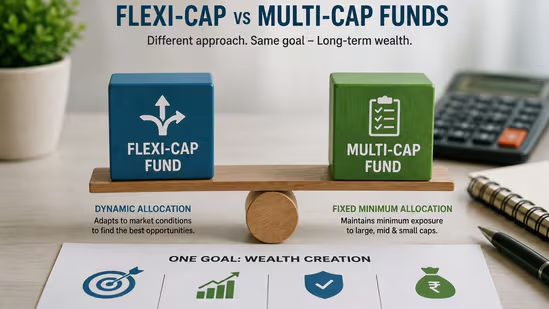
Flexi cap funds recorded success rates of 60.2% over one year and 56% over three years, offering an interesting perspective on the ability of active managers to allocate across market capitalisations.
Banking funds tell another story
Banking and financial-services funds have historically been an area where active management has had greater success.
Over five years, 69.2% of active banking and financial-services funds beat passive peers, while the 10-year success rate was 66.7%.
But the most recent one-year number was only 31.8%.
The reason, according to Morningstar, was the strong performance of the PSU Bank Index, which hurt the relative performance of active strategies compared with passive funds tracking that segment.
What about debt funds?
The active-versus-passive debate is not limited to equities.
In government bond funds, the active success rate was 55.6% over one year, 32% over three years, 56.5% over five years and 36.1% over 10 years.
Morningstar said volatility in government bond yields, particularly at the longer end of the curve, affected active managers’ performance.
Active managers did show some ability to navigate duration, but the results varied significantly depending on the period.
So, should investors choose active or passive?
The Morningstar report does not provide a blanket answer.
Instead, the data suggest that investors need to look at three things: fund category, investment horizon and the consistency of the manager’s performance.
A fund that has beaten its passive peers over the last year may not have done so over five or 10 years. Conversely, categories such as banking and financial services have shown stronger active success over longer periods even though active managers struggled over the latest one-year period.
There is another important point: Morningstar’s “success rate” is not simply the percentage of funds that delivered a higher return than an index.
The study compares active funds with a composite of actual passive funds, after fees, rather than with a costless theoretical index. It also uses the fund’s category classification at the beginning of the measurement period.
Its success rate measures the percentage of funds that both survived the period and generated returns above the asset-weighted average passive-fund return. A fund that barely beats the passive composite counts as a success just as much as one that significantly outperforms it.