How can trade reference and evaluated pricing be better aligned?
Earlier this year, we began a detailed review of IBVAL, our trade reference price, and BVAL, our end-of-day evaluated price.
We looked closely at assessing the differences. This included their respective data inputs and cleansing; how they handle market microstructure dynamics across varying conditions; and the step-by-step methodologies used to determine final prices. Teams of analysts, quants, engineers and product managers were tasked with participating in this process, and ultimately collected, reviewed, and presented detailed findings.
The scale of the exercise was substantial, covering billions of pricing data points processed through hundreds of production steps.
But the goal was clear: identify opportunities to align the products where possible, incrementally reduce any unnecessary variability between them and maintain their high standards of accuracy, functionality and business purpose.
How was the initial analysis measured?
We began with the bonds in the Bloomberg US Corporate Bond Index, which has approximately 8700 securities covering the investment grade, fixed-rate, taxable corporate bond market. Its components are already among the most liquid in the global corporate bond market, which gave us plenty of bonds and data to work with.
Next, we defined our initial aggregate metric as the median absolute IBVAL-BVAL difference on the bid side in price at the NY 4pm close on normal trading days. This is closely aligned with market interest and we believed it would provide a fair measure of our progress over time.
Once this was in place, and prior to any product modifications, we were able to begin observing this metric’s performance to establish a baseline. Then, beginning in early June, we slowly rolled out targeted enhancements.
These were expected to begin reducing the difference between products, based on a thorough testing regime. By the end of July, the initial set was complete and results could be determined.
How much did the pricing difference decline?
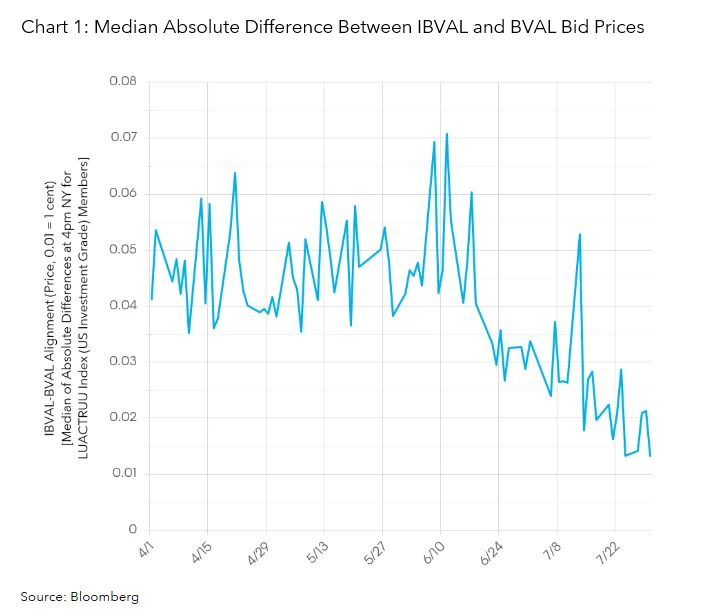
Chart 1 below shows the daily time series from April through July. Although there is some day-to-day variability around it, the pre-implementation levels suggest 4.5 to 5 cents absolute difference between the products.
Beginning in mid-to-late June, we can see that the difference begins to decline, as expected, and it continued to inch lower over the following weeks. By the end of July, it stood at (or just below) 2 cents.
That’s a realized reduction in the metric of at least 50%, suggesting that the IBVAL and BVAL levels are now much closer in practice.
Where does the alignment work go next?
Achieving this initial reduction required a significant cross-functional team effort, but the work so far has focused on only one segment of the fixed income marketwe’ll look to apply existing enhancements and innovate further enhancements on a wider set of bonds where alignment across IBVAL and BVAL is a client priority.
That largely centers on the more liquid, electronically traded segments, , where evolving trading and investment workflows are increasing the importance of consistency across pricing use cases. The work reflects Bloomberg’s continued investment in fixed income pricing as market structure and client needs evolve.
Interested to learn more? Explore IBVAL here