
Anyone who has tried to opt out of a data broker knows the feeling: you find your profile on a people-search site, you fill in the form, you get the confirmation email, and you feel rather pleased with yourself until you search your name again and see four other sites with the same address on them. The form was never really the difficulty since what wears people down is that there are hundreds of these companies and that most of them will quietly put you back.
This guide walks through how opting out really works, first by hand and then with Incogni, which we used on our own profile. We will try to be fair to both methods, because the free one is perfectly valid for some people.
What Data Brokers Know, and Where They Get It
A data broker is a company that collects personal information about people, organizes it into profiles and sells access to it: What ends up in a profile is often called your digital footprint, meaning everything you leave behind online and offline, whether you meant to or not: your phone numbers and addresses, your age and marital status, the homes you have owned, your employers, your court records if you have any, and a fair amount of what you buy and browse.
Very little of this comes from hacking: Brokers pull from state and federal public records, from your public social media profiles, from the accounts you open with online stores and apps, and above all from each other, since they buy and resell the same files. That last point is why one outdated address can follow you around for years.
It helps to know that brokers come in two kinds. People-search sites are the visible ones, where anyone can type your name and get your address and relatives, sometimes for free. The others work in the background and sell to businesses: marketing brokers to advertisers, financial brokers to lenders, recruitment brokers to employers, and risk brokers to banks and insurers. You can check the first kind yourself, whereas the second kind never shows you what it holds.
Why Opting Out Is Worth the Trouble
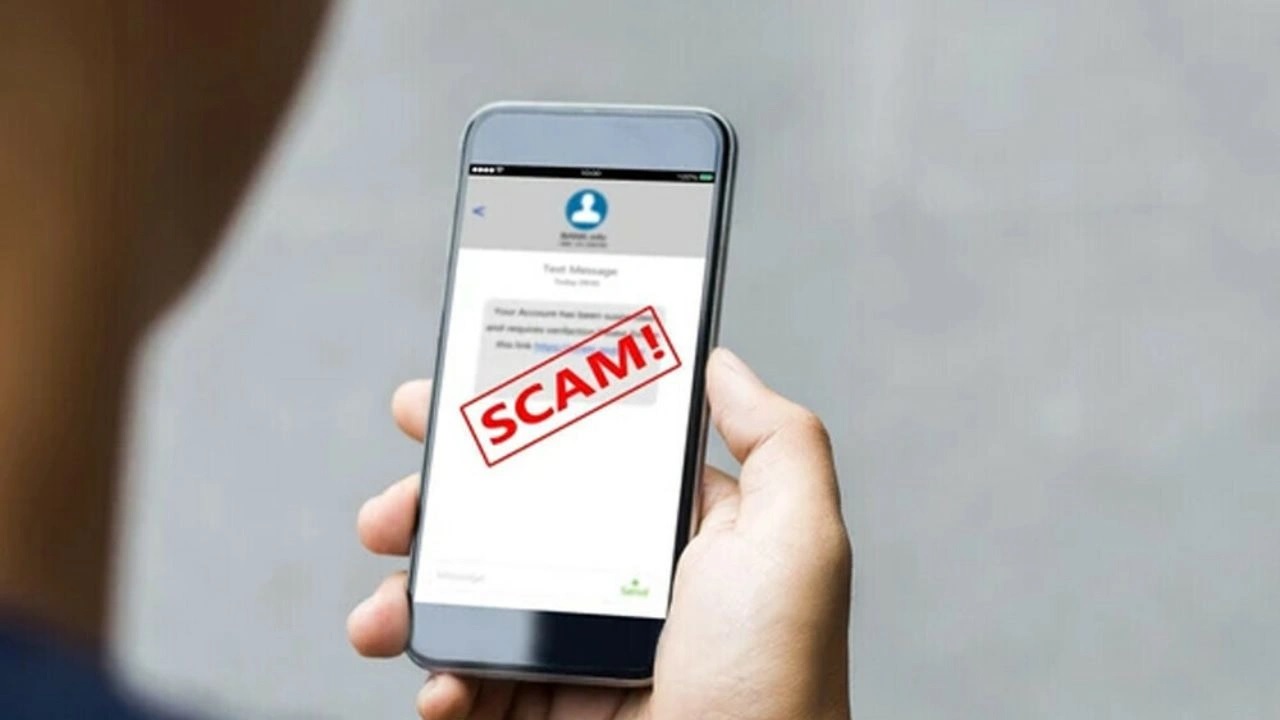
For most people the consequences are more irritating than dramatic, which is perhaps why so few of us do anything about it. Robocallers and spammers get their contact lists from brokers, targeted ads run on broker data, and the scam texts that mention your street or your bank are usually written with details that were bought for very little. Opting out cuts off part of the supply, and these five fixes for spam calls take care of what still gets through.
Things get more serious when someone is looking for you in particular. An angry ex, a difficult customer or a stranger from an online argument only needs your name and your city to find your front door, and that is a real concern for people whose work puts them in front of the public.
There is also the simple fact that brokers get breached like everyone else. In 2024, a background check company was hacked and, according to McAfee, close to 3 billion records were exposed, including Social Security numbers (SSNs). You cannot be in a leak from a database you are no longer in and that alone is a decent reason to opt out.
How to Opt Out of Data Brokers Yourself
Begin with the brokers you can see: Search your full name with your city, then your phone number and your address, and note every people-search site that shows a profile. Each of them has an opt-out page, usually linked at the very bottom under a name like “Do Not Sell My Personal Information” or “Privacy Rights.” You paste the address of your profile, give an email to confirm, click the link they send, and the listing normally disappears within a few days. Some sites ask for a phone call or a copy of an ID, in which case we would cover everything on the document except your name and address.
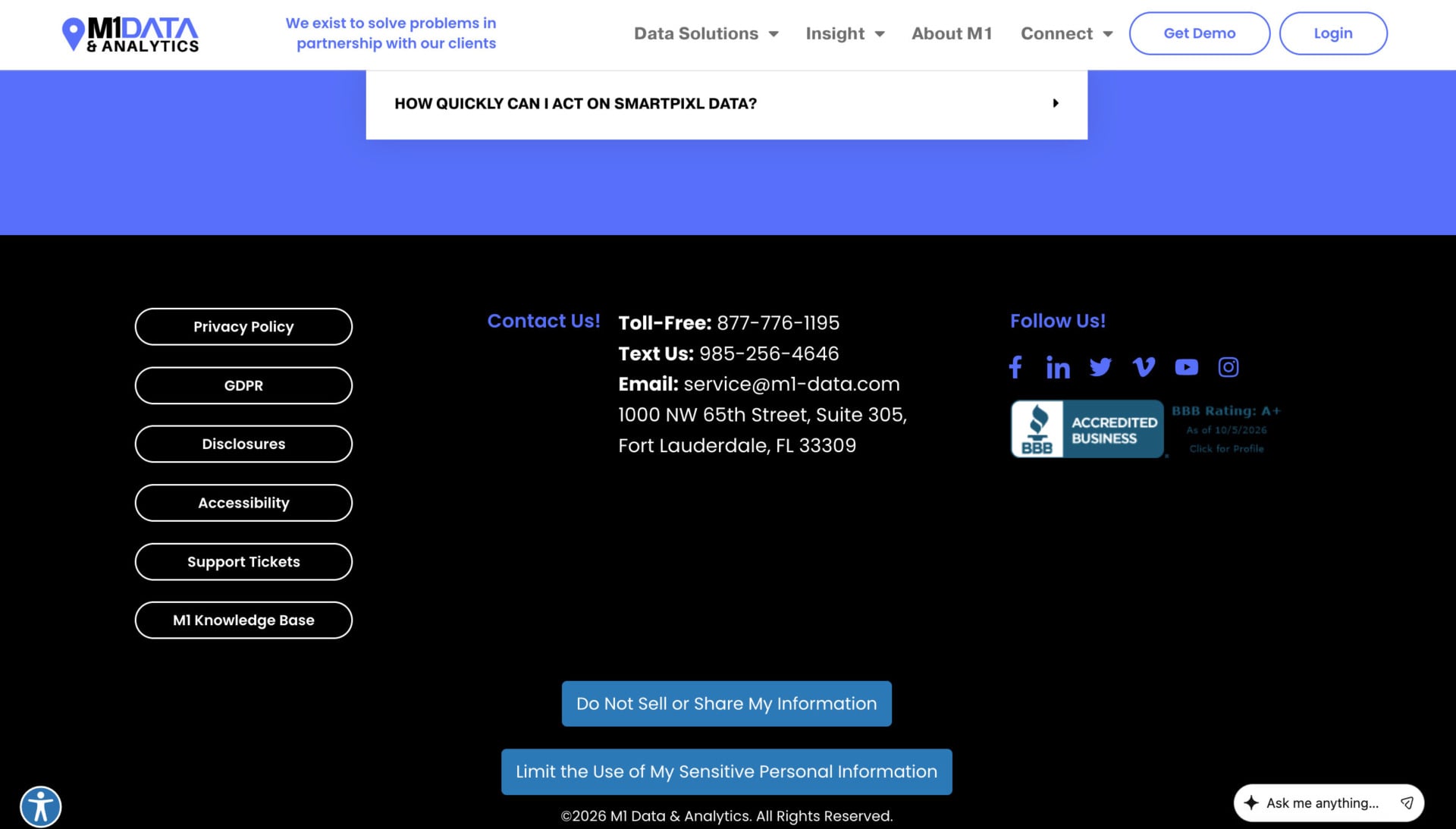
The brokers you cannot see take a different approach: Since you cannot look yourself up, you send a written request by email or through their privacy form, in which you ask them to delete your data and to stop selling it, and you cite the privacy law of your state if it has one. They are generally required to answer within about 45 days, and many will ask you to prove who you are first.
If you live in California, there is now a shortcut that did not exist a year ago. The state runs a platform called DROP where a resident files one deletion request that goes to every registered data broker and there are more than 600 of them. Since August 1, 2026, those brokers have to check the platform at least every 45 days and act on the requests. It is free, and for Californians it is the first thing we would do.
For everyone else, the work is site by site and Incogni puts the average at around ten minutes per broker. That is fine for a dozen sites and much less fine for a few hundred. Then comes the part people do not expect, which is that the job has to be redone: brokers refresh their files, so a profile you removed in winter can be back by summer, and the only way to know is to search again every few months.
Doing It Yourself or Using a Removal Service
A data removal service is a company that sends these requests on your behalf and keeps sending them. The two approaches reach the same brokers in the end, and they differ mostly in time, cost and follow-up.
Neither column is the right answer for everyone. If you enjoy this kind of housekeeping and your name only turns up on a handful of sites, the left one will serve you well. If you would never get around to the second round, which is the case for most of us, the right one starts to look cheap.
Let Incogni Handle the Opt-Outs
How Incogni Opts You Out
Incogni is a data removal service that began as a feature inside Surfshark and is now sold on its own. Its job is exactly the routine described above, done at scale: it contacts data brokers in your name, asks them to delete your records, and comes back later to check that they stay deleted.
Setting it up took us a few minutes: You enter your name, date of birth and address, and you can add up to three email addresses, three home addresses and three phone numbers, which is useful because brokers often file the same person under an old number or a previous address. You then sign an authorization form (see below) that lets Incogni act as your agent.
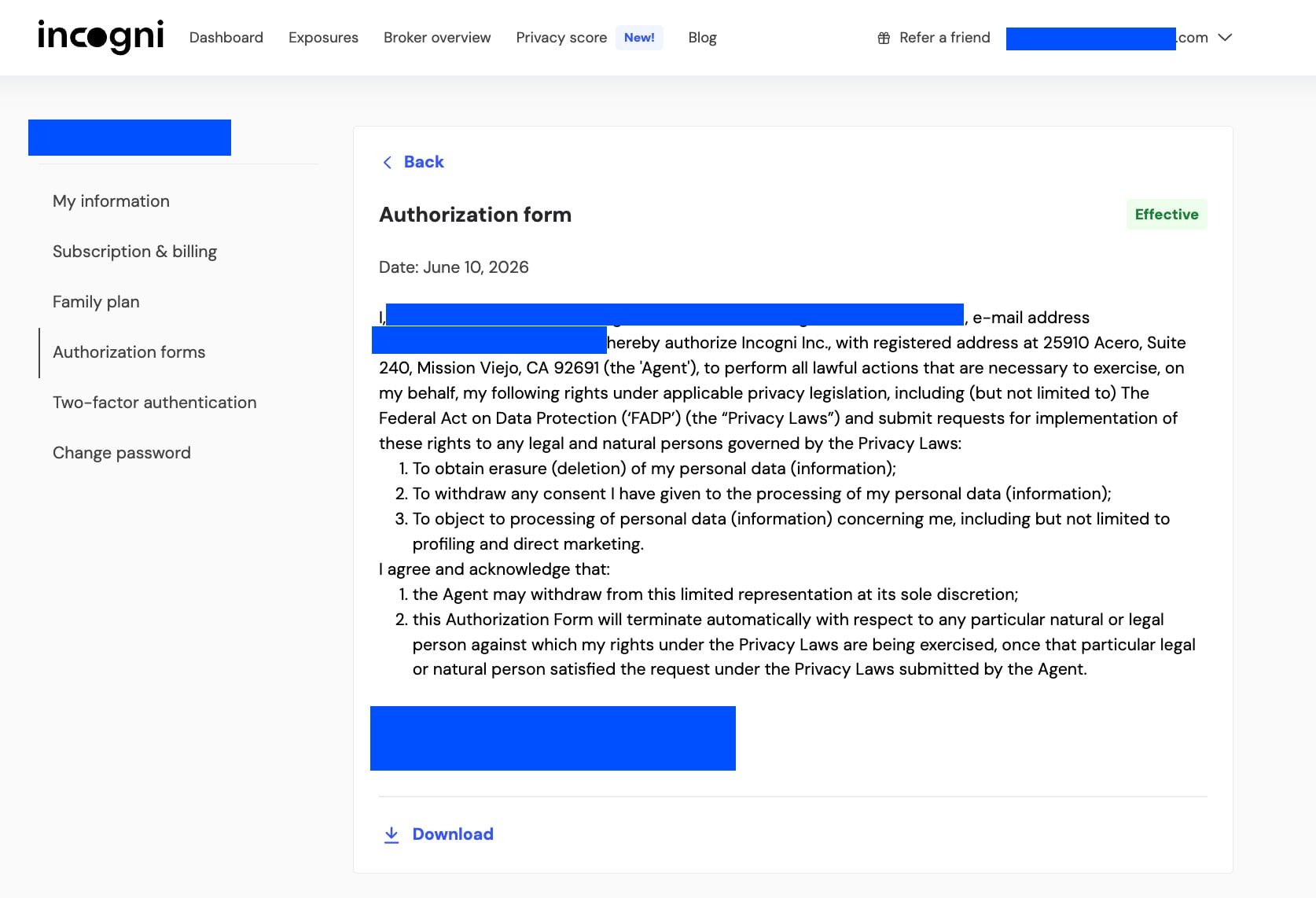
After that there are three stages and you are not involved in any of them. Incogni first scans the people-search sites on its list, over 260 of them according to the company and flags every profile that matches you. When several profiles look alike, it asks you which one is yours, and that is about the only time it needs you. It then sends a removal request for each match, and it sends a formal, legally binding deletion request to each of the private brokers, over 160 of them, since nobody can scan those.
The third stage is the one you would struggle to keep up by hand. According to a limited assurance report by Deloitte, Incogni repeats its requests at least every 60 days for public brokers and every 90 days for private ones, unless the broker has already put you on its suppression list. The same report confirms that Incogni covers more than 420 brokers, and that it did not sell its customers’ data during 2024.
Try Incogni With a 30-Day Money-Back Guarantee
What We Saw After Four Months
We opened our account on June 10, 2026, and looked at it again on October 2. By then Incogni had sent 107 removal requests to 44 brokers, of which 102 were marked completed and 5 were still in progress. The dashboard shows two waves on its graph, a first one in the opening weeks and a second in September, which matches the recurring requests the company describes.
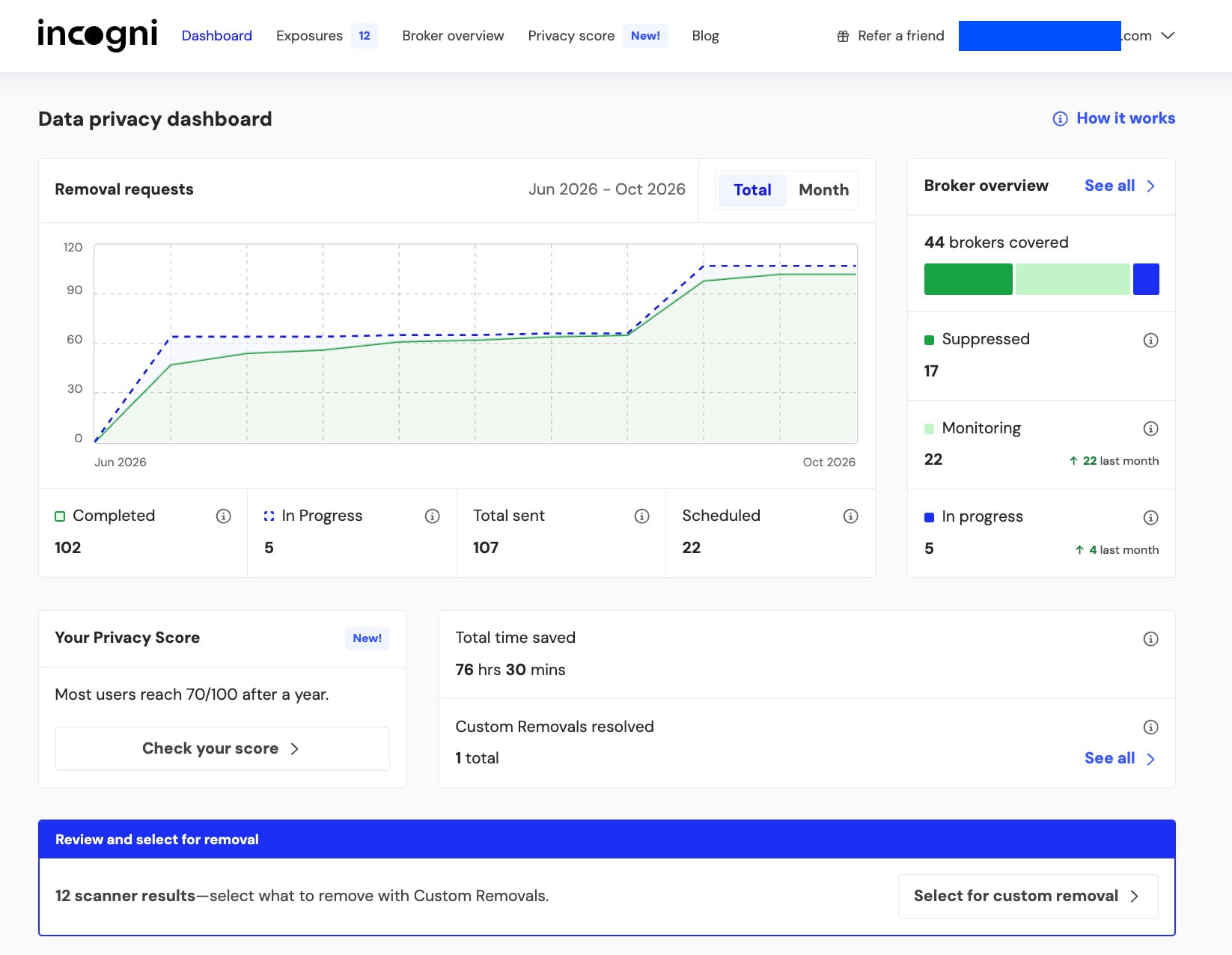
Seventeen of those brokers had added our profile to a suppression list which is the best result you can get, because it means they should not rebuild the file later. For each broker, the dashboard also shows how long it usually takes to respond, and in our case that ranged from 2 days to 15.
A few things were less convincing, and you should know them: A request marked completed can mean that the broker deleted your data or simply that it had none, and the dashboard counts both the same way. Each profile accepts a single name, which is a problem if you have changed yours. And the one custom removal we submitted took 91 days, when the estimate was 30 to 60.
Which Path Should You Take?
If you live in California, start with DROP since it is free and reaches hundreds of brokers in one go. If your name shows up on only a few people-search sites, an hour with their opt-out forms will take care of it, and you can set a reminder to check again in the spring.
If the list is longer, or if you already know you will not repeat the exercise four times a year, a removal service is the realistic option, and Incogni is the one we would choose. It does not make you invisible, and after four months a handful of sites still held some of our data. What it does is keep sending the requests long after most of us would have stopped. Data brokers are also only one part of the problem, and our guide on how to remove your personal information from the internet covers search results, old accounts and the rest. For a wider view, our ranking of the best data removal services compares Incogni with four alternatives.
FAQ
How Do I Opt Out of Data Brokers?
Search your name to find the sites that list you, then use the opt-out link at the bottom of each site and confirm by email. For brokers you cannot search, send a written deletion request. California residents can do it in one request through the state’s DROP platform, and a service like Incogni automates the whole process.
Is There a Way to Opt Out of All Data Brokers at Once?
Only in California for now, where the DROP platform sends one deletion request to every registered data broker. Everywhere else, the closest thing is a data removal service, which sends and repeats the requests for you across several hundred brokers.
How Long Does It Take to Opt Out of a Data Broker?
Filling in one opt-out takes around ten minutes, according to Incogni, and the broker then needs days or weeks to act on it. In our Incogni account, average resolution times ranged from 2 to 15 days depending on the broker.
Do Data Brokers Put Your Information Back After You Opt Out?
Often, yes. Brokers refresh their files from public records and commercial sources, so a deleted profile can reappear within months unless the broker has added you to a suppression list. That is why opt-outs have to be repeated.
How Much Does Incogni Cost?
The Standard plan costs $95.88 per year, or $15.98 if you pay month by month. Unlimited costs $179.88 per year and adds custom removals, and the Family plan covers five people for $191.88 per year. Every plan has a 30-day money-back guarantee.