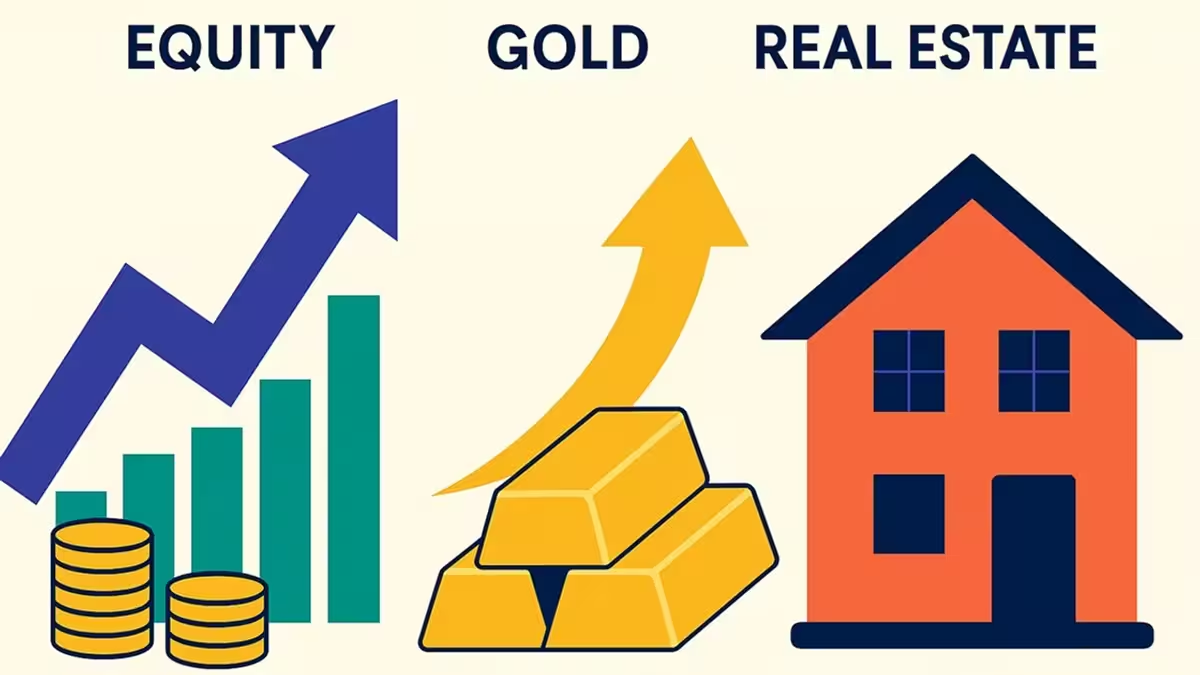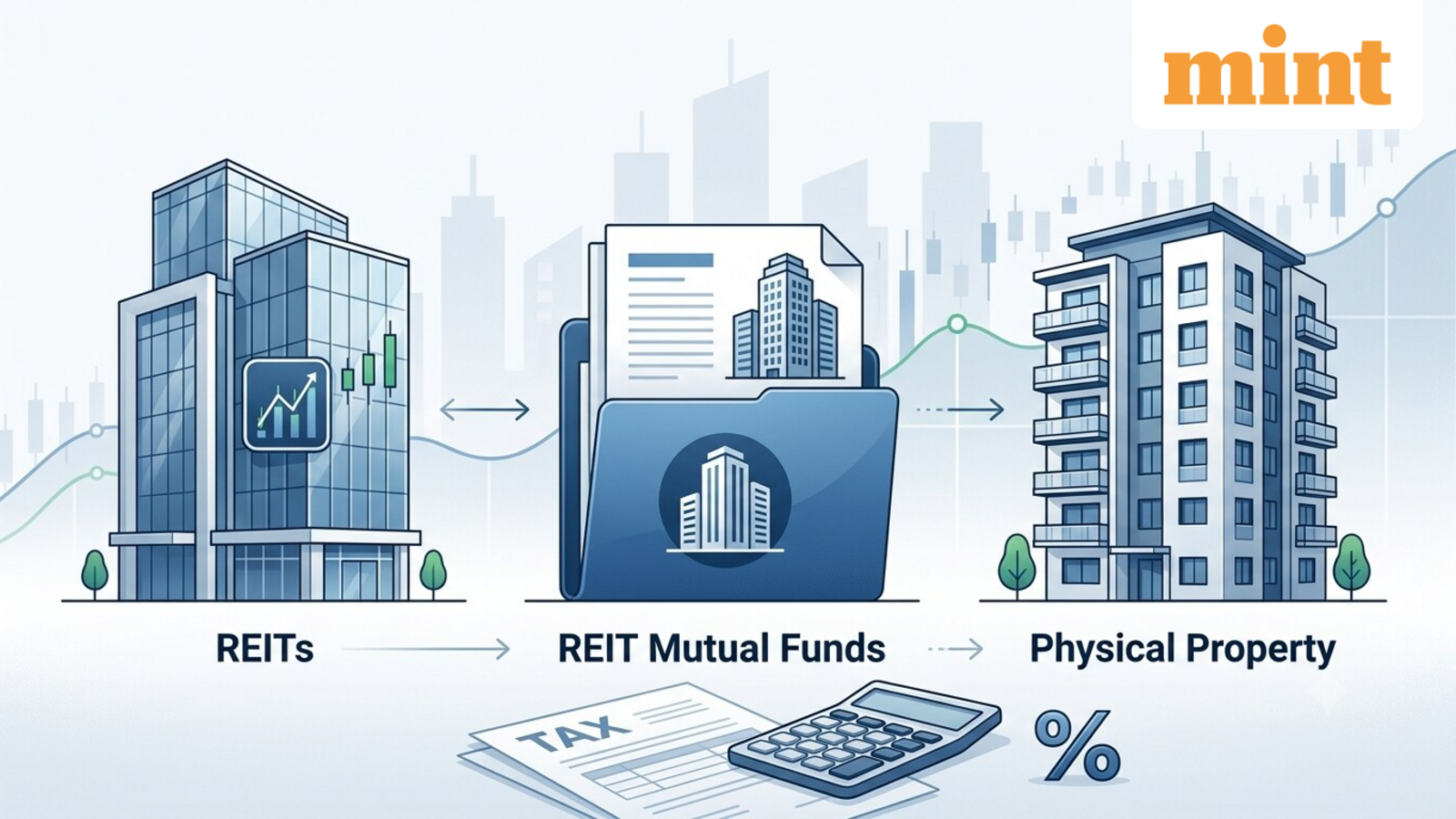
Investors can gain exposure to the real estate sector through physical property, listed Real Estate Investment Trusts (REITs), or REIT-based mutual funds. While all three provide access to the same asset class, their tax treatment differs significantly and can have a meaningful impact on post-tax returns.
Capital gains tax: REITs and REIT mutual funds have an edge
The biggest difference lies in how capital gains are taxed. For listed REITs and REIT-based mutual funds, gains on investments held for more than 12 months qualify as long-term capital gains (LTCG) and are taxed at 12.5%. If sold within 12 months, the gains are treated as short-term capital gains (STCG) and taxed at 20%.
However, direct real estate has a longer holding period. A property must be held for more than 24 months to qualify as a long-term asset. If sold before that, the gains are added to the investor’s income and taxed according to the applicable income tax slab. Long-term gains on property are also taxed at 12.5%.
Tax on interest income and dividend income
The tax treatment of income also varies across the three investment options. For REITs, interest income and dividend income distributed to investors are taxable at the investor’s applicable income tax slab rate.
Another important point is that the capital repayment component of a REIT distribution is not taxed when investors receive it. Instead, it reduces the acquisition cost of the REIT units. When the units are eventually sold, the lower acquisition cost results in higher capital gains, which are taxed at that time.
In the case of direct real estate, rental income is also taxed according to the investor’s slab rate.
However, REIT mutual funds follow a different mechanism. Interest and dividend income received by the mutual fund from underlying REITs is not taxed at the fund level.
TDS rules differ significantly
REITs deduct 10% TDS on distributions under Section 194LBA of the Income Tax Act, 1961.
For direct real estate, TDS may apply in different situations. Rent paid attracts 5% or 10% TDS, depending on the nature of the property and applicable thresholds, while the sale of immovable property generally attracts 1% TDS. There is no TDS on REIT mutual funds.
Asset classification matters
From 1 January 2026, REITs are classified as equity for taxation purposes. REIT mutual funds are also treated as equity funds, giving them similar capital gains tax treatment.
However, direct property continues to be treated as immovable property, with a separate tax framework.
REIT mutual funds may offer better post-tax income
For investors in higher tax brackets, REIT mutual funds can be more tax-efficient than investing directly in listed REITs.
For instance, if a ₹1 lakh investment generates a 6% annual distribution ( ₹6,000), an investor in the 30% tax bracket would pay ₹1,800 in tax on the distribution received directly from a REIT, leaving a post-tax income of ₹4,200, or an effective yield of 4.2%.
However, the interest and dividend income received by a REIT mutual fund from the underlying REITs is not taxed at the fund level, allowing investors to potentially retain the full 6% yield until taxation applies on redemption under the capital gains rules.
Taxation comparison at a glance
| Tax Aspect | Listed REITs | REIT Mutual Funds | Direct Real Estate |
| Asset classification | Equity (from 1 Jan, 2026) | Equity fund | Immovable property |
| Holding period for LTCG | 12 months | 12 months | 24 months |
| STCG tax | 20% | 20% | Income tax slab rate |
| LTCG tax | 12.5% | 12.5% | 12.5% |
| Income taxation | Interest and dividends taxed at slab rate | Interest and dividend received by the fund are not taxed at the fund level | Rental income taxed at slab rate |
| TDS | 10% on distributions | Nil | 5%/10% on rent; 1% on property sale |
Note: The above tax rates exclude applicable surcharge and cess; Source: Edelweiss Mutual Fund
Disclaimer: This is only for informational and educational purposes. Please consult a qualified tax expert for the latest tax laws and regulations.