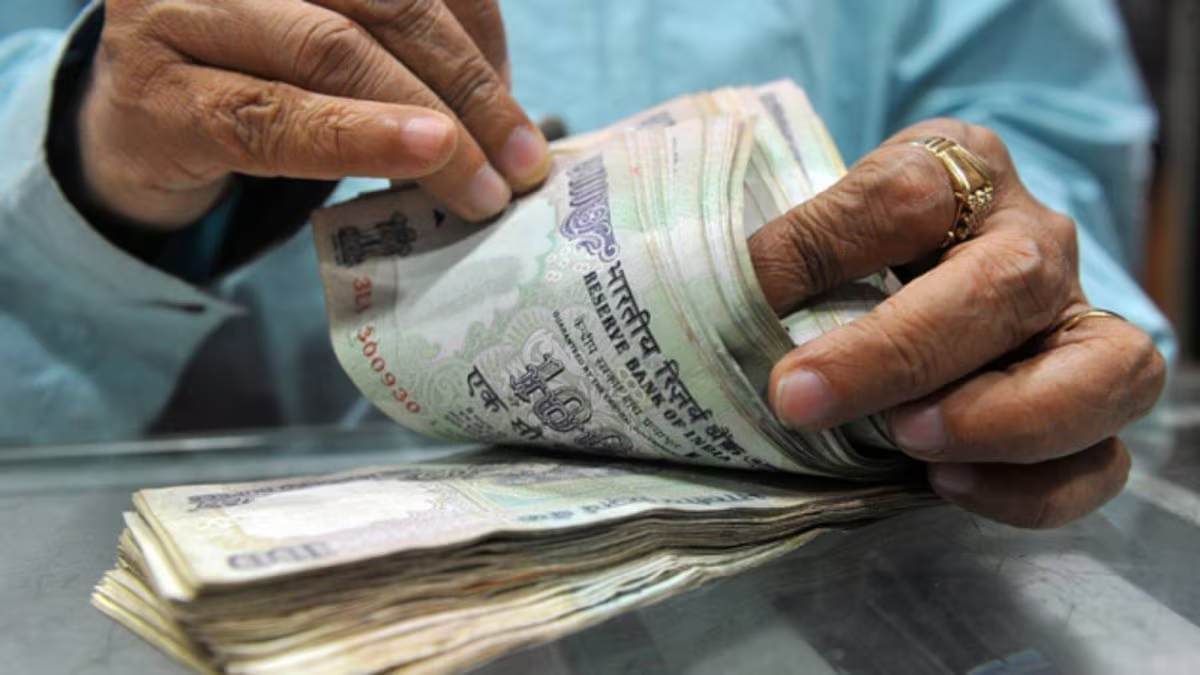
Most of us are guilty of the same habit. Your salary comes in, the equated monthly installments (EMIs) and bills go out, and whatever is left simply sits in the savings bank account.
This approach feels safe because it is very accessible. But with most large banks paying somewhere around 2.5-3% on savings balances, that money is quietly losing the battle against inflation every single day.
The solution to this is not very complicated. If you have money that you will need in the next few weeks or months for an emergency fund, or for a vacation, for a down payment, or for a business surplus, there are dedicated short-term instruments built precisely for parking your money.
These instruments aim to do three things: keep your capital relatively safe, keep it accessible, and earn more than a savings account in the process.
Here, we will look at three of the most popular short-term options for Indian investors. We will discuss how each one works, what returns you can expect, the risks involved, and how to pick the right one for your time horizon.
What Counts as a Short-Term Investment?
Before looking at the three options, let’s first understand what a short-term investment typically means. It’s basically for a holding period that ranges from a few days to about a year.
At this horizon, the rules of investing flip. Growth takes a back seat, and capital preservation and liquidity become the priorities.
You are not trying to build wealth with this money, but you are trying to make sure it is there, intact and slightly grown, when you need it.
That is why equity is generally a poor fit for short-term goals. Markets can swing sharply over weeks or months, and a 10% drawdown right before you need the money can derail your plans.
The three options that we are going to discuss below sit at the other end of the risk spectrum and are designed for stability first.
#1 Liquid Funds
First category on our list is Liquid funds.
As per market regulator SEBI’s categorisation rules, Liquid funds can only invest in debt and money market instruments that mature within 91 days.
Think of treasury bills, certificates of deposit, commercial papers, and other very short-term paper issued by the government, banks, and high-rated companies.
This 91-day cap is what makes liquid funds so stable. The underlying securities mature so quickly, their prices barely react to interest rate movements.
The NAV of a liquid fund, therefore, tends to move up in a near-steady line rather than zigzagging like longer-duration debt funds.
Coming to their returns, liquid fund returns are not fixed. They move with prevailing short-term money market rates.
Historically, they have tended to deliver returns somewhat above what savings accounts offer, which is exactly why they are popular for parking surplus cash.
When the RBI raises rates, liquid fund yields tend to climb and when rates fall, the returns moderate.
Liquidity is where these funds truly shine. Redemption requests are typically credited to your bank account within one working day (T+1).
On top of that, many liquid funds offer an instant redemption facility, which allows you to withdraw up to Rs 50,000 or 90% of your invested value (whichever is lower) per day, with the money hitting your account within minutes.
One nuance worth knowing about liquid funds is that they carry a small, graded exit load if you redeem within the first 7 days of investing.
The exit load starts at a tiny fraction (around 0.007% on day one) and tapers to zero by day seven. Hold for a week or more, and there is no exit load at all.
As far as risk is concerned, liquid funds are among the lowest risk mutual fund categories, but they are not zero-risk. Returns are not guaranteed, and in rare credit events, where an issuer of underlying paper defaults or gets downgraded, the NAV can take a hit.
That is why it makes sense to stick to funds that hold predominantly sovereign and top-rated (AAA/A1+) paper.
Overall, liquid funds suit anyone parking money for a few days to about three months – it can be emergency funds, salary surpluses, money awaiting deployment into equity, or a business float between cycles.
#2 Ultra Short Duration Funds
Next we have ultra short duration funds.
SEBI defines these funds as debt funds whose portfolio maintains a Macaulay duration of 3 to 6 months. In plain English, Macaulay duration measures how long, on average, it takes for the fund to recover the money it has lent through the bonds it holds.
A 3-6 month duration means the fund lends money for slightly longer periods than a liquid fund does. These funds invest in a similar universe – treasury bills, certificates of deposit, commercial papers, but can also hold corporate bonds and securities with somewhat longer maturities.
That extra duration is the source of both their advantage and their additional risk. Lending for longer typically earns a higher rate, ultra short duration funds generally aim to deliver slightly higher returns than liquid funds over comparable periods.
Most ultra short duration funds carry no exit load, and redemptions are typically processed on a T+1 basis. However, they do not offer the instant redemption facility that liquid funds do, and unlike liquid funds, there is no regulatory cap of 91 days on every security they hold.
Now, two key risks matter here. First, interest rate risk: if rates rise sharply, the slightly longer-duration portfolio can see short-term NAV dips.
Second, credit risk: some funds in this category boost yields by holding lower-rated corporate paper. So always check the portfolio quality.
Overall, ultra short duration funds suit investors with a 3-6 month horizon. Think school fees due next quarter, an insurance premium, a planned purchase a few months away, etc.
#3 Short-Term Fixed Deposits
At last, we have the most familiar instrument on this list.
A short-term fixed deposit is simply a bank FD with a tenure ranging from 7 days to 12 months.
You hand the bank a lump sum, the bank promises a fixed interest rate for the chosen tenure, and you get principal plus interest at maturity. No NAV, no market movement, no surprises.
This is the only option of the three where your return is contractually guaranteed the day you invest.
Short-term FD rates vary widely depending on bank and tenure. Large banks typically offer lower rates on very short tenures (rates on 7–45 day deposits can be as low as around 3%), while rates on tenures closer to a year are meaningfully higher.
Small finance banks and NBFCs often pay more than large banks across tenures, and senior citizens typically earn an additional 0.25 to 0.75% at most banks.
On safety, bank FDs come with a layer of protection no mutual fund offers. Deposits are insured by the DICGC (a wholly owned subsidiary of the RBI) up to Rs 5 lakh per depositor per bank, covering both principal and interest.
Now comes the catch. If you break an FD before maturity, most banks levy a premature withdrawal penalty, typically 0.5% to 1%. Crucially, the interest you receive is recalculated at the rate applicable for the period the money actually stayed with the bank, not your originally contracted rate.
An FD booked at an attractive 12-month rate but broken in month two can end up earning very little.
Overall, short-term FDs suit investors who know exactly when they will need the money, want a guaranteed return with zero day-to-day fluctuation, and are confident they will not need to break the deposit midway.
How the 3 Options Compare Against Each Other
| Parameter | Liquid Funds | Ultra Short Duration Funds | Short-Term FDs |
| Underlying | Money market instruments maturing within 91 days | Debt instruments with duration of 3 to 6 months | Bank deposit, tenure of 7 days to 12 months |
| Returns | Market-linked, move with short-term rates | Market-linked, typically slightly higher than liquid funds | Fixed and guaranteed at booking |
| Risk | Very low, minor credit risk | Low, slightly higher rate and credit risk | Negligible, DICGC-insured up to ₹5 lakh |
| Liquidity | T+1, instant redemption up to ₹50,000 in many funds | Typically T+1, no instant redemption | Premature withdrawal allowed, with penalty |
| Exit cost | Graded exit load only within first 7 days | Usually nil | Penalty of 0.5-1% plus lower applicable rate |
| Ideal horizon | Few days to 3 months | 3 to 6 months | Any fixed period from 7 days to 12 months |
What About Taxation?
Taxation is where all three options have converged in recent years, and it is worth getting this right.
Liquid and ultra short duration funds: For mutual fund units purchased on or after 1 April 2023, all capital gains from debt funds are taxed at your income tax slab rate, regardless of how long you hold them. The earlier indexation benefit no longer applies to fresh investments.
One practical advantage remains. In a mutual fund, tax is payable only when you redeem, there is no annual tax on accrued gains.
Fixed deposits: FD interest is added to your income and taxed at your slab rate. Unlike debt funds, this tax applies on an accrual basis, meaning you pay tax on interest earned each financial year even if the FD has not matured.
Banks also deduct TDS at 10% once your interest across deposits exceeds Rs 50,000 in a financial year (Rs 1 lakh for senior citizens), as per the thresholds effective 1 April 2025.
Conclusion
Short-term money deserves the same intentionality as long-term money.
Letting lakhs sit idle in a savings account is a silent cost and locking short-term money into the wrong instrument is an avoidable headache.
Liquid funds, ultra short duration funds, and short-term FDs each solve the parking problem in their own way.
Match the instrument to your horizon, check the portfolio quality (for funds) or the premature withdrawal terms (for FDs), and your idle money can finally start pulling its weight.
Happy investing.
Disclaimer: This article is for information purposes only. It is not a stock recommendation and should not be treated as such. Learn more about our recommendation services here…
The website managers, its employee(s), and contributors/writers/authors of articles have or may have an outstanding buy or sell position or holding in the securities, options on securities or other related investments of issuers and/or companies discussed therein. The content of the articles and the interpretation of data are solely the personal views of the contributors/ writers/authors. Investors must make their own investment decisions based on their specific objectives, resources and only after consulting such independent advisors as may be necessary