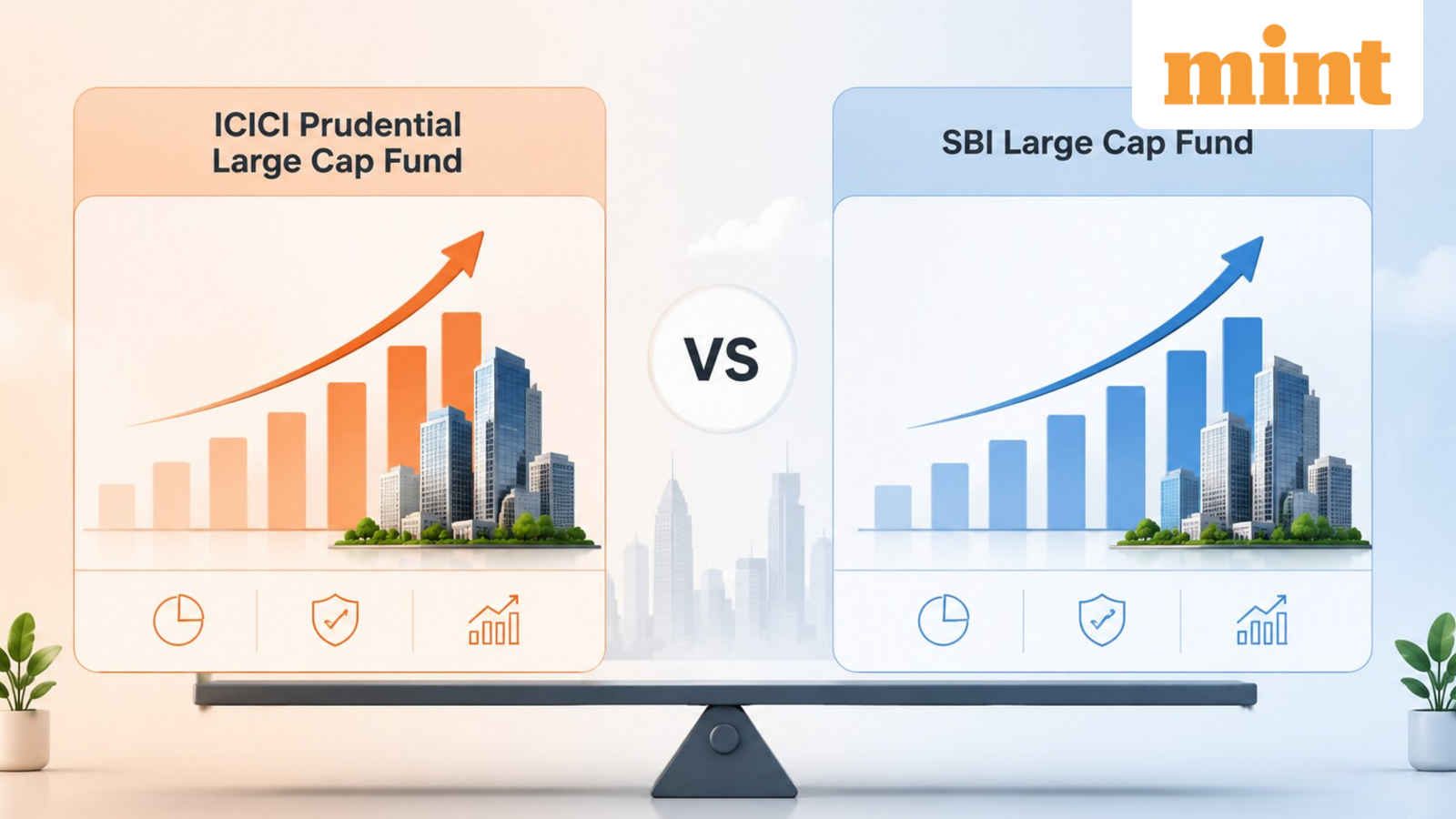
If you are comparing mutual fund returns over the past decade, you may notice a clear trend: flexi-cap funds have generally created more wealth than large-cap funds across 3-year, 5-year, and 10-year periods.
The outperformance may reignite a debate among investors about what exactly has enabled flexi-cap funds to generate superior returns, and whether the trend continues.
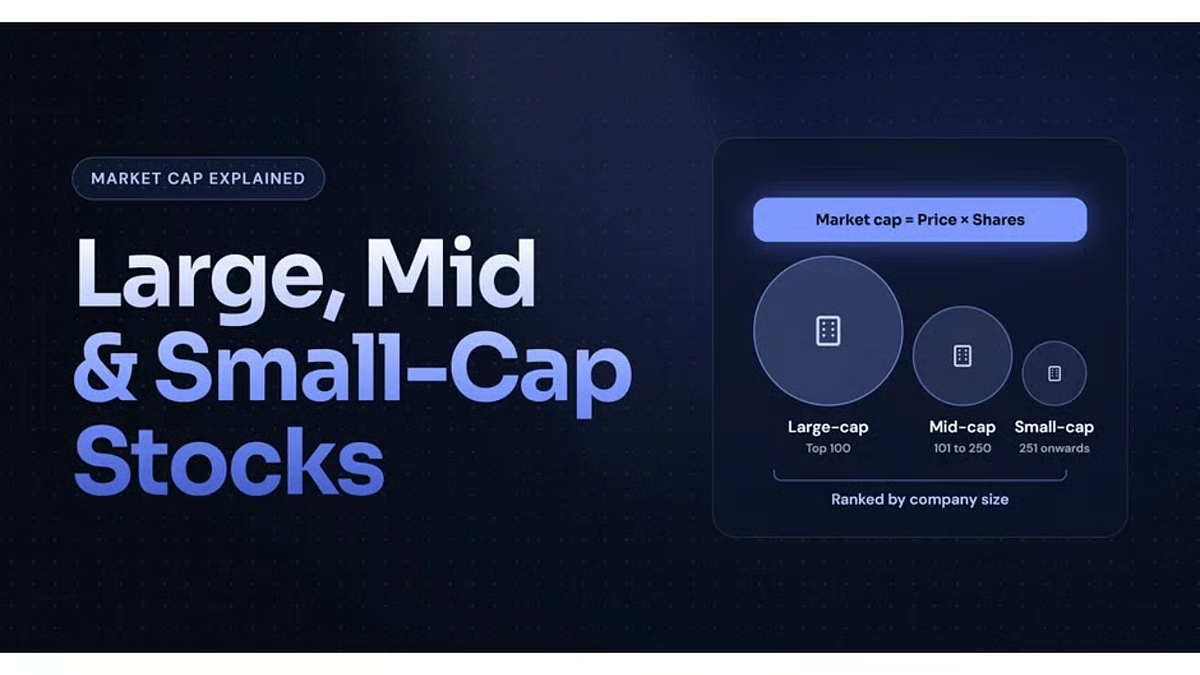
Unlike large-cap funds, which are mandated by SEBI to invest at least 80% of their assets in the top 100 companies by market cap, flexi-cap funds can dynamically shift allocations across market-cap segments, enabling fund managers to move to large-cap stocks when valuation becomes expensive and enhance exposure to mid-cap and small-cap companies during growth stages.
The last five to ten years have witnessed strong performances from mid-cap and small-cap stocks, particularly during the post-pandemic recovery.
In terms of performance, the Nifty Midcap 150 generated returns of around 72% over three years and 127% over five years, while the Nifty Smallcap 250 delivered approximately 69% and 113% over the respective periods. In comparison, the Nifty 100, which represents large-cap stocks, returned 34% over three years and 56% over five years, according to Groww, as of 22nd June 2026.
Since flexi-cap funds are mandated to allocate a minimum 65% of their total assets across equity and equity-related instruments, many fund managers increased exposure to the broader market segments that were outperforming. This enabled flexi-cap funds to capture a larger share of the rally in mid-cap and small-cap stocks, resulting in superior returns and wealth creation compared to large-cap funds.
Large-cap funds, on the other hand, remained largely concentrated in blue-chip stocks, limiting their ability to capture the full upside from the mid-cap and small-cap segments. The performance gap between flexi-cap and large-cap funds has been driven largely by the strong run in mid-cap and small-cap stocks and the flexibility enjoyed by fund managers.
Large-cap vs. Flexi-Cap fund performance
According to Value Research data, the flexi-cap fund category delivered an average return of 13.51% over three years, compared with 12.01% for large-cap funds. Over five years, flexi-cap funds generated 12.11%, outperforming the 11.05% return delivered by large-cap funds.
The gap becomes even more evident over the long term. Over the last 10 years, flexi-cap funds offered an average return of 13.32%, while large-cap funds returned 12.19%. Although the difference may appear modest on an annualized basis, even a 1 percentage point higher return can translate into significantly higher wealth creation for SIP investors over the stated time horizon.
| Category | 3-year returns | 5-year returns | 10-year returns |
| Equity: Flexi Cap | 13.51%% | 12.11% | 13.32% |
| Equity: Large Cap | 12.01% | 11.05% | 12.19% |
| Source: Value Research |
Over the last decade, mid-cap and small-cap companies have experienced periods of strong earnings growth and market outperformance. Flexi-cap funds were able to benefit from these trends while maintaining exposure to established large-cap businesses.
This broader investment universe and the ability to dynamically shift allocations across market segments have been the primary reasons for the superior SIP performance delivered by many flexi-cap funds, up to 21% compared to 16.16% by large-cap funds, according to Value Research as of 22nd June 2026.
Given current market valuations, would you prefer starting a SIP in a large-cap fund or a flexi-cap fund?
Rather than choosing one over the other, we’d encourage investors to view them as complementary, not competing. Large-caps offer relative stability and liquidity depth, while flexi-caps provide the flexibility to navigate valuations across market caps dynamically.
Aditya Mulki, CEO, Navi AMC, says, at current levels, a blend, rather than a binary choice, helps balance stability with growth potential, depending on individual risk capacity and goal horizon.
Since SIPs deploy money gradually over time, short-term market levels become less important compared to maintaining investment discipline over the long term.
For investors seeking relatively lower volatility, large-cap funds remain a strong choice. However, for investors with a longer investment horizon and moderate-to-high risk appetite, flexi-cap funds offer the advantage of professional allocation across different segments of the market, commented Prashant Gupta, Chief Business Officer, SAMCO Wealth.
How much of an equity portfolio should be allocated to flexi-cap funds versus large-cap funds?
There’s no one-size-fits-all ratio. Allocation should flow from an investor’s risk profile, goal horizon, and existing portfolio composition. As a broad construct, conservative investors may lean more toward large-caps for stability, while those with longer horizons and higher risk capacity may allocate a larger share to flexi-caps for their tactical flexibility.
Large-cap funds can provide stability through exposure to established businesses, while flexi-cap funds offer the flexibility to capture opportunities across different market segments and market cycles.
“Investors seeking greater stability may naturally gravitate towards large-cap funds, whereas those willing to accept higher short-term fluctuations in pursuit of potentially higher long-term returns may find a larger role for flexi-cap funds within their portfolio,” said Prashant Gupta.
Flexi-cap SIPs have outperformed large-cap SIPs over 3, 5 and 10 years. What has been the biggest driver of this outperformance?
Flexi-cap funds’ core advantage lies in their unrestricted mandate to move across large, mid, and small-cap segments based on where opportunities are strongest at any given time.
“This adaptability enabled them to participate more fully in market up-cycles, especially when mid- and small-caps outperformed large-caps. Additionally, fund managers aren’t confined to the Nifty 500 universe; they can identify and invest in high-potential opportunities beyond it, which has been a meaningful contributor to the category’s relative outperformance,” commented Aditya Mulki.
Which category has historically handled market corrections better?
Large-cap funds have historically shown relatively lower drawdowns during sharp corrections, given the inherent stability, liquidity, and earnings visibility of larger companies, says Aditya Mulki.
Flexi-cap funds, owing to mid- and small-cap exposure, can see deeper short-term drawdowns, though this same flexibility often aids faster recovery once markets stabilize. Risk tolerance during volatile phases should guide which behaviour an investor is better suited to.
However, downside protection often comes with a trade-off.
“During phases when broader market participation is strong, and mid-cap and small-cap stocks are leading the rally, large-cap funds can sometimes deliver relatively muted or sideways returns compared to more flexible categories,” stated Prashant Gupta.
This has been visible during several periods of the last decade when broader markets significantly outperformed the large-cap segment.
In essence, large-cap funds have historically offered better downside cushioning, while flexi-cap funds have often been better positioned to capture opportunities across different market phases.
Which category offers a better risk-adjusted return opportunity for new SIP investors in 2026?
Investors should assess their risk appetite, investment horizon and financial goals before choosing between the two categories.
“New SIP investors with longer horizons and higher risk tolerance may find flexi-caps offer better risk-adjusted potential through diversification across market caps. Those prioritizing stability across the top 100 companies may find large-caps more suitable,” recommended Aditya Mulki.
For investors beginning a SIP in 2026, flexi-cap funds appear well-positioned from a risk-adjusted return perspective, especially for those with an investment horizon of five years or longer.
The ability to dynamically allocate across market capitalizations enables fund managers to respond to changing valuations, earnings cycles and market sentiment. Rather than being restricted to a single segment of the market, flexi-cap funds can potentially capture opportunities wherever they emerge.
“That said, risk-adjusted returns are not determined solely by returns; they are also influenced by an investor’s ability to remain invested through market volatility. Investors who prioritize stability and lower volatility may find large-cap funds more suitable, even if return expectations are relatively moderate,” says Prashant Gupta.
For most new SIP investors, the choice need not be between large-cap and flexi-cap funds. A combination of both categories can create a balanced portfolio that benefits from the stability of large-cap businesses and the flexibility of a diversified flexi-cap strategy.
Ultimately, the better category is the one that aligns with an investor’s risk tolerance, investment horizon and ability to stay invested through market cycles.
Disclaimer: This article is for informational purposes only and should not be construed as investment advice. Mutual fund investments are subject to market risks. Please read all scheme-related documents carefully before investing.
Every financial journey has a turning point. What’s yours?
Financial Express is launching a new series highlighting real experiences with money, investments, and the taxman. Did a sudden tax rule catch you off guard? Did a piece of financial advice change your life? Your story could provide invaluable, practical lessons for thousands of fellow taxpayers. Share your experience with us. We respect your privacy: no stories will be featured without a direct conversation and your full consent. Thank you.