The way investors view equity markets appears to be gradually changing. After long phases dominated by momentum-driven themes and rapid market swings, there is now a stronger focus on balance – finding investments that can participate in growth while also offering a measure of stability when conditions get uncertain.
This shift is the reason large- and mid-cap funds are gaining attention again.
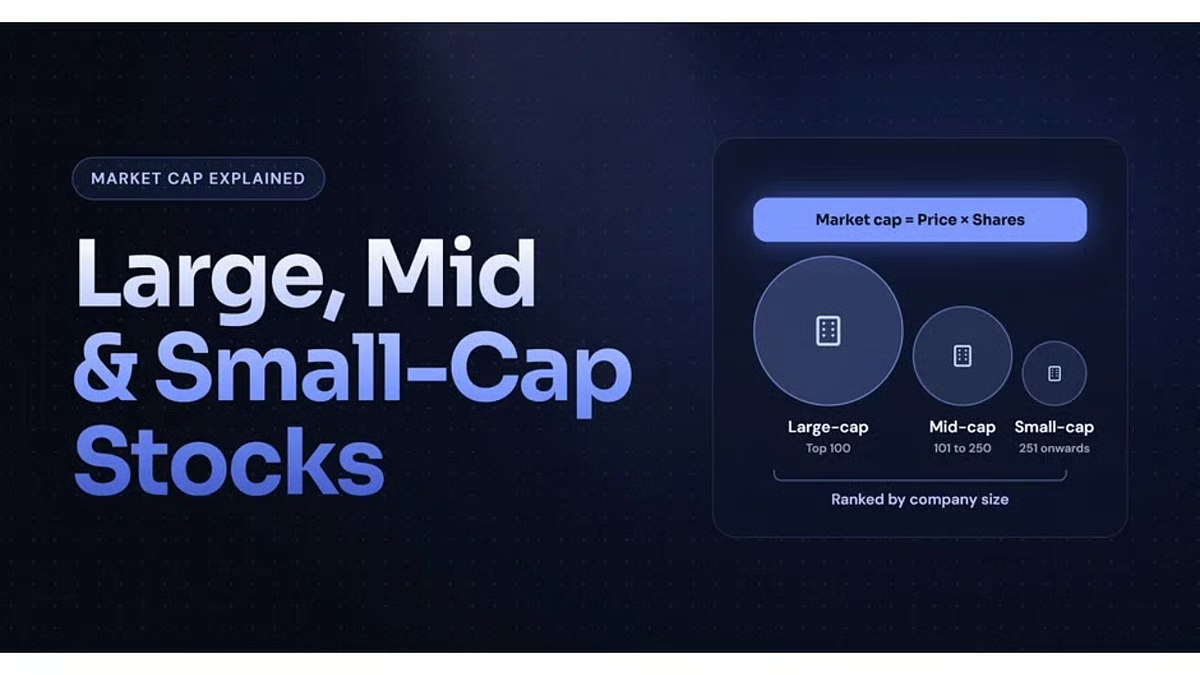
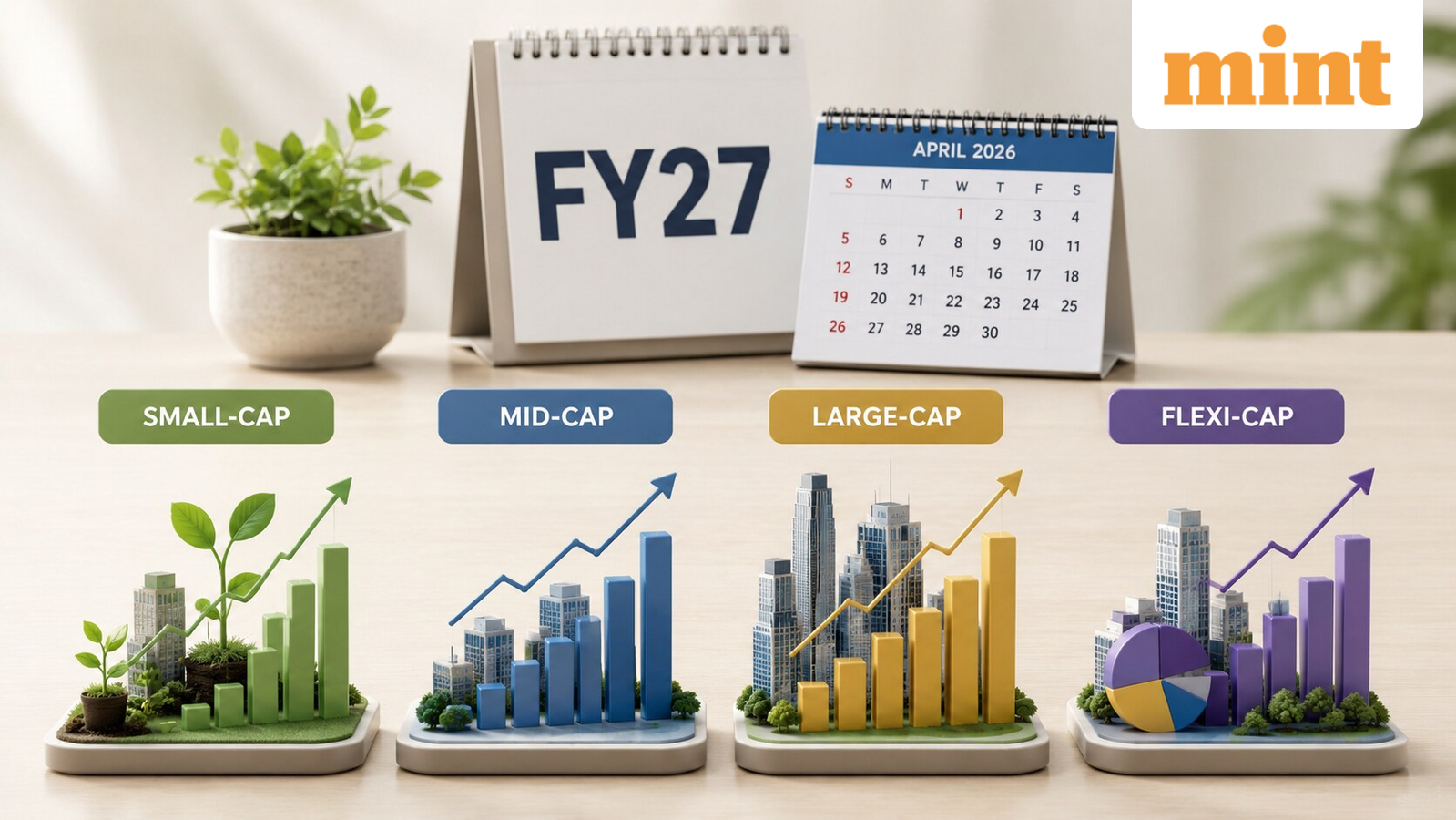
For many investors, the attraction lies in the combination itself. Large-cap companies usually bring scale, operational strength, and established market positions. Mid-cap businesses, on the other hand, often represent the next phase of growth stories – companies that are still expanding their footprint and strengthening their competitive edge.
Together, they create a mix that allows investors to participate across different layers of the economy, rather than relying solely on a single market segment. This balance feels especially relevant in the current environment, where markets continue to respond to changing interest rate expectations, global uncertainty, geopolitical developments, and shifting economic cycles.
Looking Beyond Pure Stability
Large-cap investing has traditionally been associated with resilience, stability and relatively lower volatility. These businesses are often better equipped to handle periods of volatility because of their scale, stronger balance sheets, and diversified operations. But for investors thinking beyond short-term market cycles, stability alone may not always be sufficient.
Mid-cap companies bring a different dimension to portfolios. Many operate in sectors linked to long-term structural changes such as manufacturing expansion, defence, infrastructure, energy transition, digital services, and financialization. As these businesses mature, they can gradually move into stronger market positions and potentially create meaningful long-term value.
Why Diversification Within Equities Matters
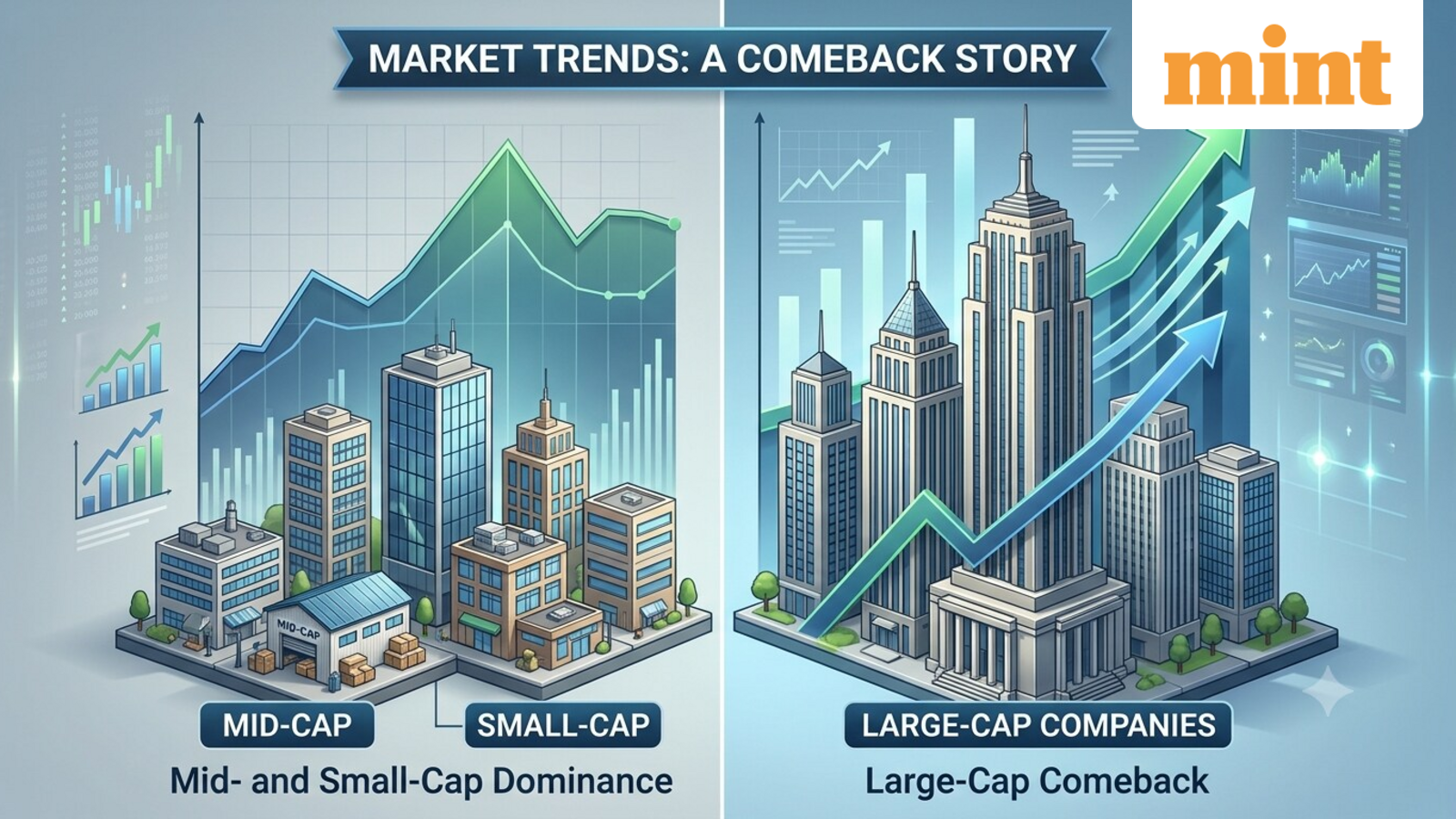
Markets have shown time and again over the years that leadership rarely stays fixed. At different points, large caps, mid-caps, and sector-specific themes have all taken turns driving returns. Economic conditions, liquidity cycles, earnings visibility, and investor sentiment constantly reshape where opportunities emerge.
That is why diversification within equities has become increasingly important. Funds that maintain exposure across both established companies and emerging businesses may be better placed to navigate changing conditions than portfolios concentrated entirely in one segment. The idea is not simply to chase the strongest short-term rally, but to create a steadier path towards long-term wealth creation.
A Bottom-Up Approach to Investing
Over longer periods, successful investing is often shaped less by market noise and more by the discipline behind stock selection. Therefore, many investors today are paying closer attention to how portfolios are constructed rather than only focusing on headline market themes. A bottom-up approach – one that prioritises business fundamentals, management quality, earnings visibility, and long-term potential – can help reduce dependence on short-lived market momentum.
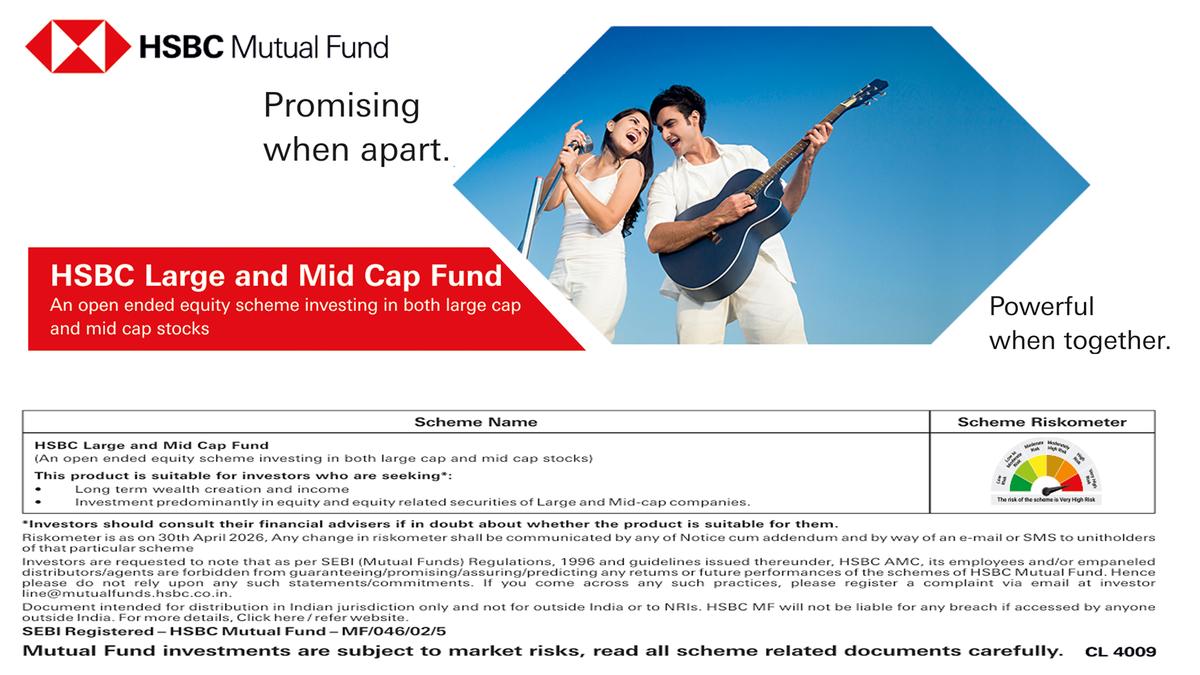
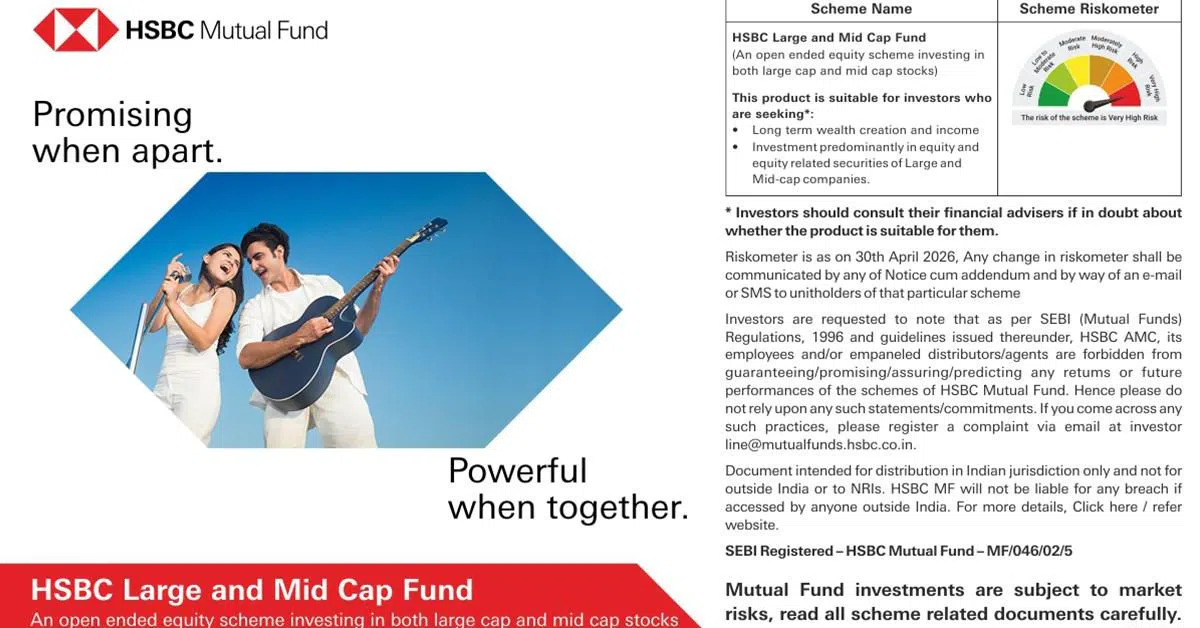
The HSBC Large and Mid-Cap Fund follows a similar framework. Its portfolio is built around a mix of leaders, challengers, and turnaround opportunities across sectors. This creates exposure not only to established businesses but also to companies that could benefit from changing industry trends and improving competitive positions over time. Such an approach can become particularly valuable during volatile phases, when market sentiment and underlying business strength do not always move in sync.
The Growing Preference for SIPs
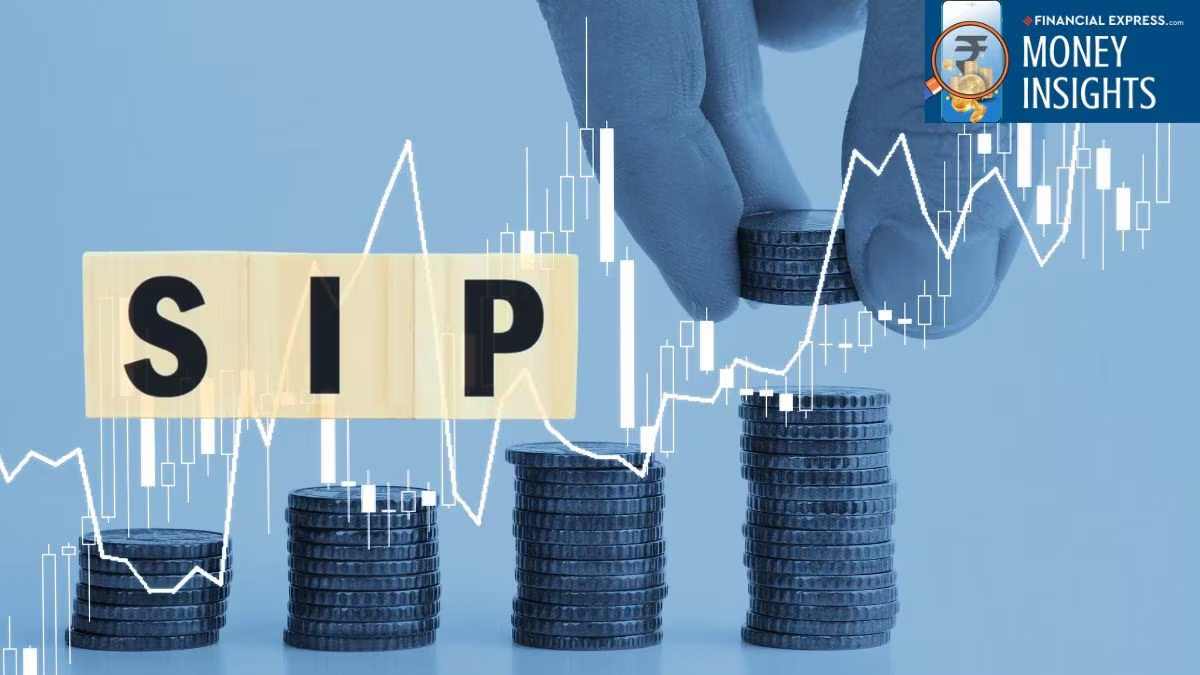
Another noticeable trend is the growing comfort investors have developed with disciplined investing through Systematic Investment Plans (SIPs). For many individuals, SIPs are no longer viewed only as a convenient investing method. They are increasingly seen as a practical way to remain invested through uncertainty without constantly trying to predict market movements.
Regular investing also helps smooth the emotional side of investing. Instead of making decisions based entirely on short-term market swings, investors stay focused on consistency. That discipline matters, especially during periods marked by geopolitical tensions, inflation concerns, economic slowdowns, or sudden market corrections.
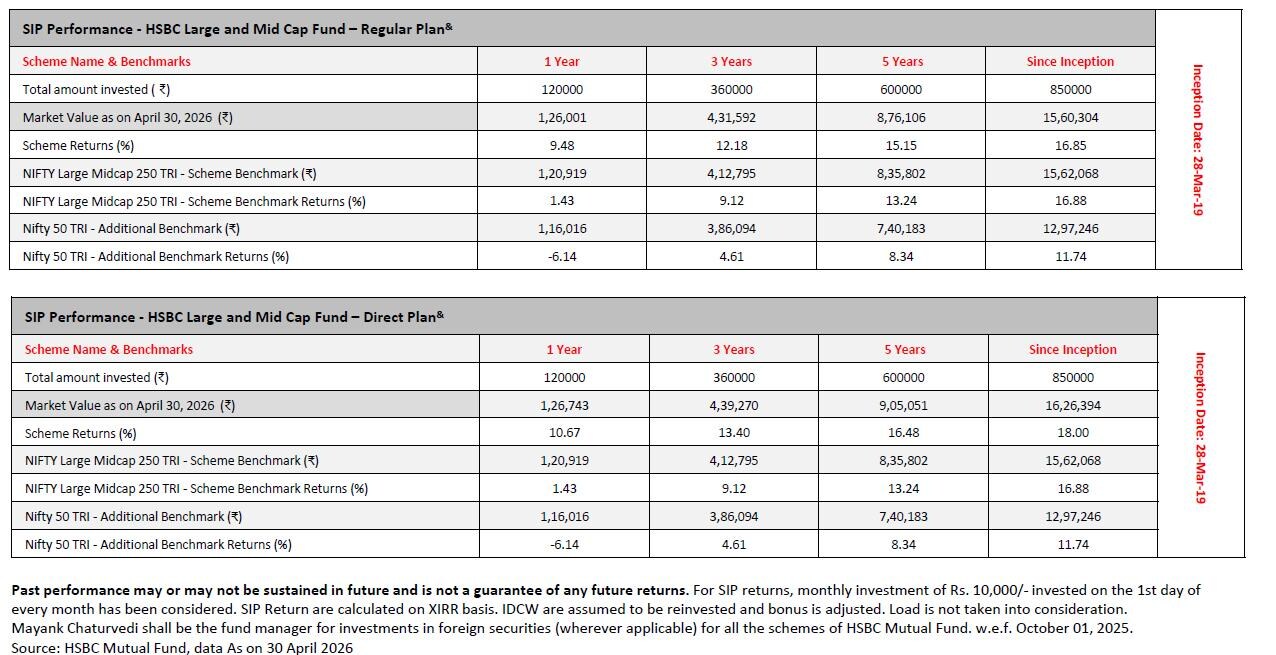
According to data shared by HSBC Mutual Fund, a monthly SIP of ₹10,000 in the HSBC Large and Mid-Cap Fund since its inception in March 2019 would have grown substantially over time despite multiple volatile phases across global and domestic markets. Past performance, naturally, is not a guarantee of future returns. Still, the broader takeaway remains relevant: consistency and patience often play a bigger role in wealth creation than short-term market timing.
Why Investors Are Looking at This Segment
There is also a visible change in investor behaviour today, particularly among younger investors. They are more comfortable exploring diversified equity strategies rather than restricting portfolios entirely to traditional large-cap allocations. The preference is gradually shifting towards investments that can participate in long-term growth while still maintaining some degree of balance during uncertain phases.
India’s economic trajectory also adds another layer to this discussion. Manufacturing growth, infrastructure spending, defence expansion, financial sector development, digital adoption, and energy transition themes are creating opportunities across both established companies and emerging businesses.
Large and mid-cap strategies sit naturally at the intersection of these trends and hence, they are steadily finding a place in long-term portfolios – especially among investors trying to balance growth ambitions with market resilience.
Investing Through Cycles
Equity investing has never been entirely about avoiding volatility. In many ways, volatility is built into the journey itself. What often matters more is whether a portfolio is structured well enough to navigate changing cycles without becoming overly dependent on a single trend, sector, or market segment.
In markets where certainty can shift quickly, that balance may become increasingly valuable for long-term investors willing to stay patient through the cycles.
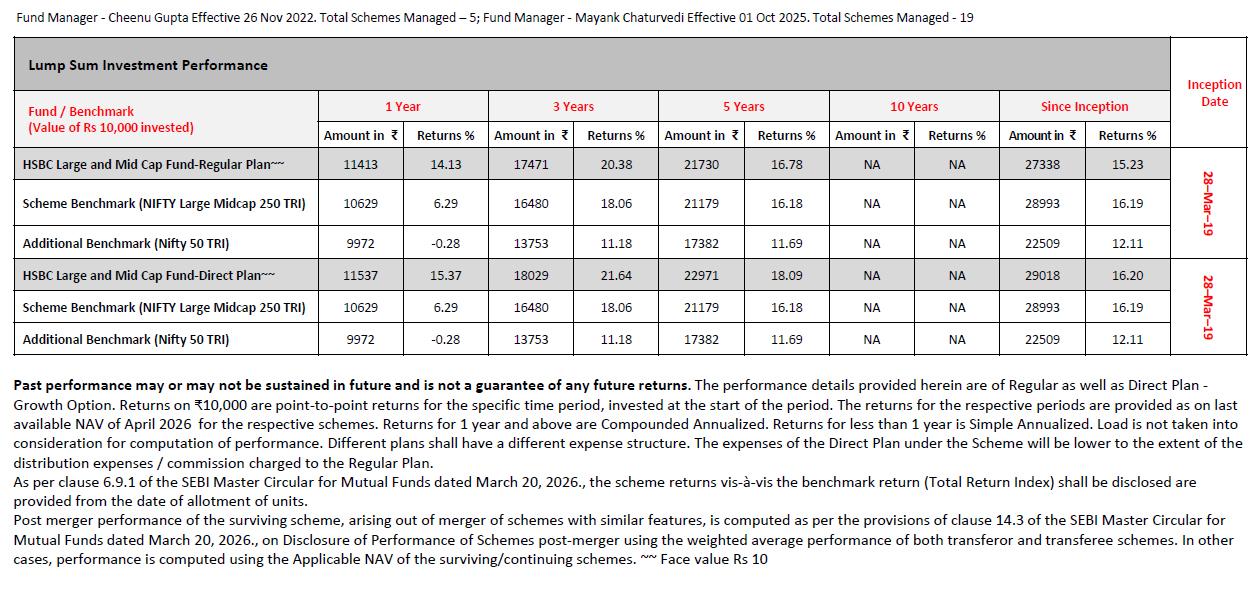
Lump Sum Performance
SIP Performance
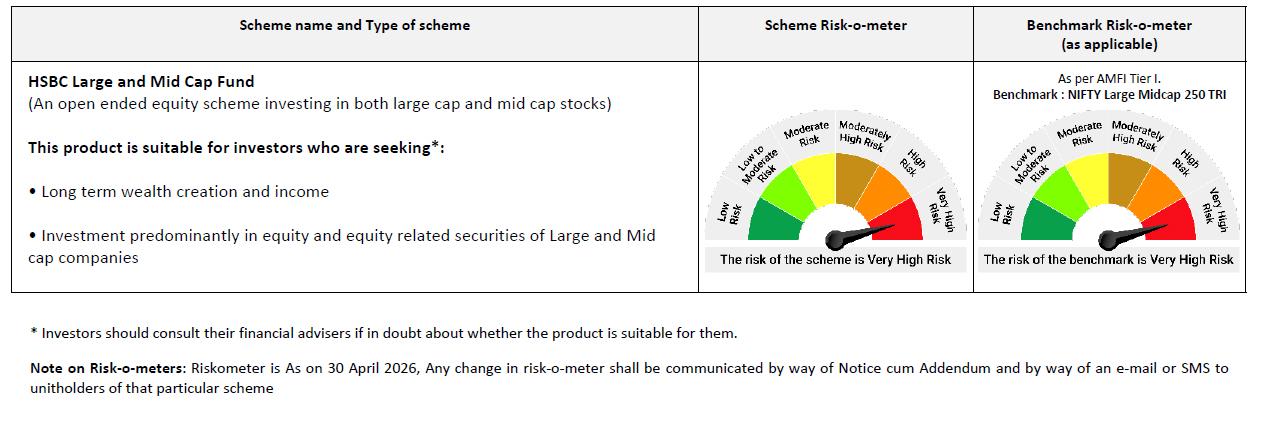
Product label
SEBI Registered Name/Number-HSBC Mutual Fund/MF/046/02/5
Past performance may or may not be sustained in future and is not a guarantee of any future returns. Source: HSBC Mutual Fund. Data as on 30 April 2026
Investors are requested to note that as per SEBI (Mutual Funds) Regulations, 2026 and guidelines issued thereunder, HSBC AMC, its employees and/or empaneled distributors/agents are forbidden from guaranteeing/promising/assuring/predicting any returns or future performances of the schemes of HSBC Mutual Fund. Hence please do not rely upon any such statements/commitments. If you come across any such practices, please register a complaint via email at investor.line@mutualfunds.hsbc.co.in.
Disclaimer: This document has been prepared by HSBC Mutual Fund for information purposes only and should not be construed as i) an offer or recommendation to buy or sell securities, commodities, currencies or other investments referred to herein, or ii) an offer to sell or a solicitation or an offer for purchase of any of the funds of HSBC Mutual Fund, or iii) an investment research or investment advice. It does not have regard to specific investment objectives, financial situation and the particular needs of any specific person who may receive this document. Investors should seek personal and independent advice regarding the appropriateness of investing in any of the funds, securities, other investment or investment strategies that may have been discussed or referred herein and should understand that the views regarding future prospects may or may not be realized. In no event shall HSBC Mutual Fund/HSBC Asset management (India) Private Limited and / or its affiliates or any of their directors, trustees, officers and employees be liable for any direct, indirect, special, incidental or consequential damages arising out of the use of information / opinion herein.
This document is intended only for those who access it from within India and approved for distribution in Indian jurisdiction only. Distribution of this document to anyone (including investors, prospective investors or distributors) who are located outside India or foreign nationals residing in India, is strictly prohibited. Neither this document nor the units of HSBC Mutual Fund have been registered under Securities law/Regulations in any foreign jurisdiction. The distribution of this document in certain jurisdictions may be unlawful or restricted or totally prohibited and accordingly, persons who come into possession of this document are required to inform themselves about, and to observe, any such restrictions. If any person chooses to access this document from a jurisdiction other than India, then such person do so at his/her own risk and HSBC and its group companies will not be liable for any breach of local law or regulation that such person commits as a result of doing so.
© Copyright. HSBC Asset Management (India) Private Limited 2026, ALL RIGHTS RESERVED.
HSBC Mutual Fund, 9-11th Floor, NESCO – IT Park Bldg. 3, Nesco Complex, Western Express Highway, Goregaon East, Mumbai 400063. Maharashtra.
GST – 27AABCH0007N1ZS, Email: investor.line@mutualfunds.hsbc.co.in | Website: www.assetmanagement.hsbc.co/in
Mutual Fund investments are subject to market risks, read all scheme related documents carefully.
CL 4086
Disclaimer: No Business Standard Journalist was involved in creation of this content
First Published: Jun 02 2026 | 4:51 PM IST