This article is an on-site version of our Inside Politics newsletter. Subscribers can sign up here to get the newsletter delivered every weekday. If you’re not a subscriber, you can still receive the newsletter free for 30 days
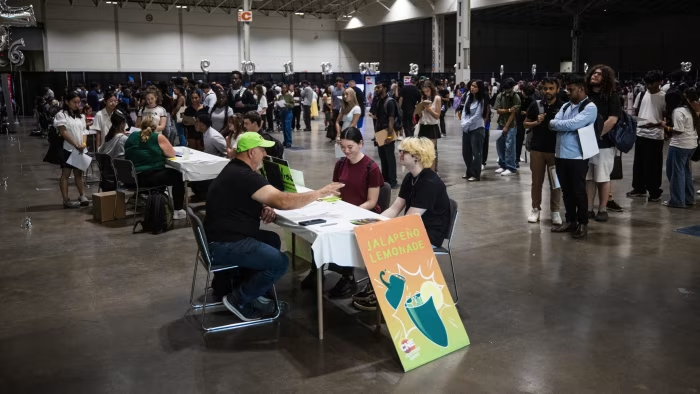
Good morning. The prospect of another minimum wage rise has rattled the City, as the new figure of £12.70 an hour expected in the Budget could overtake its starting salaries in accountancy and finance.
This got me thinking about the endemic recruitment problem in social care, where the minimum wage applies to a huge part of the sector. (About 60 per cent of care workers got a bump in April when the minimum wage rose to £12.21.)
The rise in minimum wage is a double-edged sword. If social care wages rise closer to other sectors, then pay in theory becomes less of a barrier. On the other hand, as jobs with historically lower pay cluster near the same rate, care work can lose what little advantage it has. That means more competition for the same pool of low-paid workers, at a time when the care-dependency ratio is worsening and ministers have shut off overseas recruitment, urging care providers to hire Britons instead. British nationals still make up most of the workforce, but their numbers are falling — not least because of low pay.
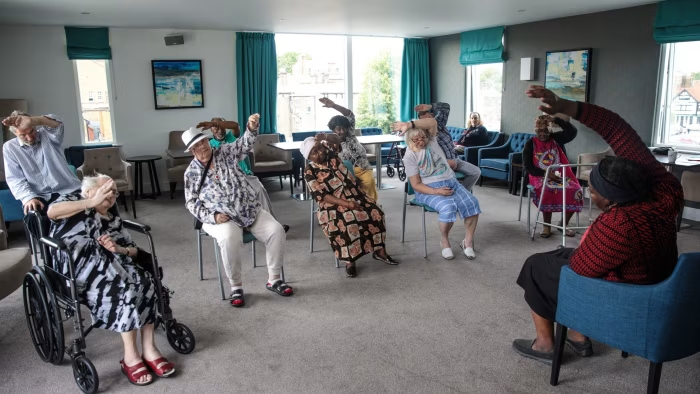
Care homes, where 70 per cent of residents have dementia, are managing increasingly complex tasks. More on the structural challenges facing the sector and Labour’s plan to address them below.
Inside Politics is edited by Darren Dodd today. Follow Stephen on Bluesky and X, and Georgina on Bluesky. Read the previous edition of the newsletter here. Please send gossip, thoughts and feedback to insidepolitics@ft.com
Pressure at the margins
Accountancy firms have more power to raise their bottom rung than nursing homes do. Why? Social care in Britain used to be mostly run by councils directly. By the late 1970s, local authorities could no longer afford it. Reforms in the 1990s pushed councils towards outsourcing provision and “assessments of need” were introduced. I’ve charted that big shift below.

LaingBuisson, which analyses market data on health and social care, puts it succinctly:
The social care transformation has substituted mainly for-profit providers paying staff at close to National Minimum (or Living) Wage in place of public sector in-house provision offering staff higher pay and more generous terms and conditions.
This is the model that successive governments have stuck with. When public money was squeezed, councils responded by cutting the fees they paid to care homes (often below the true operating cost). “Self-funders” — those who pay care costs themselves because they are not entitled to state support — have ended up cross-subsidising the underpayment.
Efficiency has become baked into the day to day. “But there’s only so much you can cut when 75 per cent of your overheads are human beings, and you need them,” says Haris Khan of Curaa Group that operates four care homes. The rising national living wage makes sense — but the government must also consider its practical effects in a care market where councils “set” the fees and 4 in 5 of them in England already overspend their adult social care budget. As it stands, care homes are quickly losing the headroom needed to improve pay, hire quality workers and compete with other employers.
Consequently, care work is a low-paid, high-turnover sector, with vacancy rates (7 per cent) persistently over the England unemployment rate and the vacancy rate in retail (2.4 per cent). LaingBuisson says it follows a cycle — when unemployment rises, care work becomes more attractive. When unemployment falls, social care vacancies rise, as many workers leave for perceived better prospects elsewhere.

Since the national living wage came in, pay for care workers has increased in real terms year on year, but that still isn’t on par with growth in other sectors. As one care manager explained in a parliamentary report on workforce planning, “I dread hearing Aldi opening up nearby . . . I know I will lose staff”.

A lack of career progression — and the higher wages that come with it — is a big grievance in social care. On average this year, care workers with at least five years’ experience received an hourly pay premium of 0.6 per cent (7 pence an hour) compared with new starters. That’s down from a premium of 33 pence in 2016, according to Skills for Care.
In contrast, healthcare assistants in the NHS at band 3 with two or more years’ experience are paid 82 pence more an hour than HCAs with no experience. This is a pay differential of about 6.7 per cent.
More than 70 per cent of private care and nursing homes pay only the legal minimum (3 per cent) in employer pension contributions, per Skills for Care. So there’s less incentive to stick around.

Labour has promised to fix this. The government has assigned Louise Casey to chair an independent commission into adult social care that will report in 2028. The spending review promised a headline £4bn funding boost by 2028-29 — including a new “Fair Pay Agreement”, along with an earmarked initial £500mn, that will set minimum standards for pay and conditions, negotiated by a new national body (which will probably be created in 2027). That suggests the pot for higher wages will be modest. The negotiating body will need to settle on an outcome that is affordable within a government-set cost “envelope”.
But Khan says for smaller providers like his “there is simply no slack”. Additional rules on hiring, firing, and flexibility “risk pushing providers to do without staff”, posing dangers for quality and continuity of care, he says. Many care homes say they can’t afford any additional costs after the increase in employers’ national insurance.
What can be done? One proposed fix is to use regulation to ensure there is clear water between care workers’ pay and that of other low-paid service jobs. Wales and Scotland already do this by requiring the Living Wage Foundation’s voluntary living wage. Support for career progression and values-based recruitment are other interventions (this podcast series interviews companies that have chosen the “values-based” route of focusing less on CVs and more on qualities such as empathy).
Ministers could also do something about the “cliff edge” regarding entitlement to some in-work benefits — where some care staff are disincentivised to take on more hours because they would lose benefits beyond a certain threshold.
All of these things involve self-funders paying more, or local authorities paying more and the taxpayer paying more. The FPA has the potential to tackle one of the root causes of recruitment woes by increasing pay and attracting more staff. But raising wages alone is unlikely to stabilise the sector. The other big policy question is how to share the cost of social care between the state and the individual (for another newsletter).
The challenge for Labour is to make care work a viable career — with fair pay, clear progression, and dignity built in — while keeping providers financially afloat. That means sustained public investment and a long-term plan to match the nation’s growing care needs with a workforce willing and able to deliver them. Unless it does that, the sector will remain trapped in a cycle of recurring shortages and demands to cut corners.
Now try this
I had a lovely time in Oxford recently seeing the stage adaptation of the Talented Mr Ripley at the Playhouse (which unfortunately lacked the chemistry of the Matt Damon-Jude Law film version), followed by a delicious meal at Arbequina.
Top stories today
-
Changing tack | Nigel Farage abandoned his party’s pre-election pledge to cut taxes by £90bn, as he tried to fend off claims that his policies were reckless and would lead to economic ruin.
-
‘Tough but fair’ | Keir Starmer has put Labour MPs on alert for hefty tax rises in this month’s Budget — including a possible income tax increase — as he promised to reduce Britain’s national debt but ruled out deep cuts to public spending.
-
GCSE review | The government will scrap the English baccalaureate, which measures schools on pupil attainment in English, maths, a language, a humanities subject and a science, the Times reports (paywalled). Instead of this Gove-introduced performance measure, teenagers will be expected to take English, maths and two single sciences or combined science. They must choose two GCSEs that are either creative, humanities or languages (but not from the same category) and two free choice subjects.