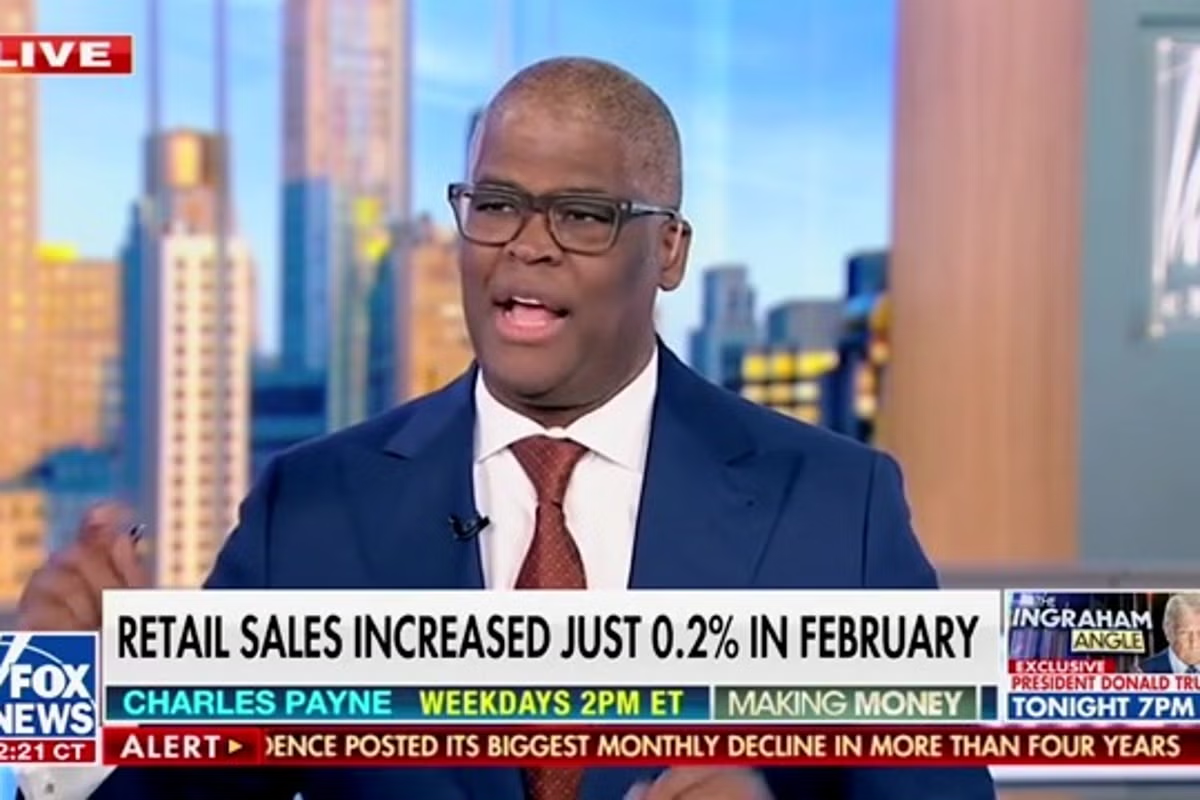
If you’re just starting out in the career of stock trading you’d be forgiven for finding the ongoing obsession in the media with the so-called ‘real economy’ something of a distraction. Job growth has been sagging not only in the US but across the world. Inflation prints are sticky and GDP’s ‘meh’. Has this hurt stocks? The question is purely rhetorical.
But in a new note, two Federal Reserve researchers take a look at the importance or otherwise of macro releases to stock traders. And it turns out that, yes, traders still care about releases. More interestingly, the researchers have been able to quantify how much they care.
One of the annoying things about doing econometric analysis of macroeconomic announcements is that most of the time, nothing happens. Or rather, the market gets told what it was expecting to get told, and so fails to either rally or fall on the (non) news. And so many — perhaps most — macro announcement days will look like pretty much any other day. Market expects CPI to come in at 0.3 per cent and it comes in at 0.3 per cent: no biggie. Market expects it at 0.1 per cent and it comes in at 0.3 per cent: chaos reigns.
So if you *know* there’s a chance of an upset, and that these upsets matter, you’ve got to do the work — both to establish your expectations, and also the soul-searching required to calibrate how much of an upset would translate into how much of a change in the prices you’re willing to pay for stocks.
Until now, the rationale for this work was some combination of common sense, experience, and maybe some regressions using data surprises against consensus expectations. But now that there is a lively options market for stock indices with daily equity option expirations across US and Euro area markets, Juan M. Londono and Mehrdad Samadi have sought to work out how much this stuff actually matters.
They looked at a few US and Euro area data releases to calculate how much of the stock market’s equity risk premium is attributable to each economic release, and how confident we can be that their answer isn’t some weird statistical fluke. We’ve charted their results below:

As a reminder, t-stats are measures of statistical significance. Math nerds can give you detailed and thorough explanations as to what they will mean, but the heuristic — that a number greater than 2 is quite good — is probably all you need to know to read the chart.
What do we learn? A lot of our priors are confirmed:
-
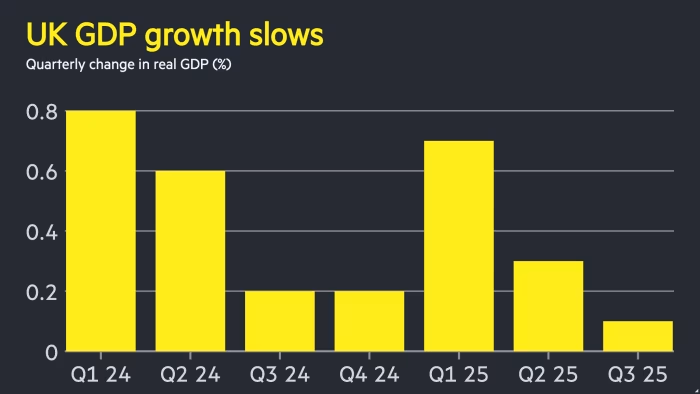
No one in equity markets cares about GDP releases. They are, after all, very backwards-looking.
-
The Fed matters to everyone, while the ECB matters only to euro area stock traders.
-
Inflation everywhere is important, but it is especially so if it is American.
-
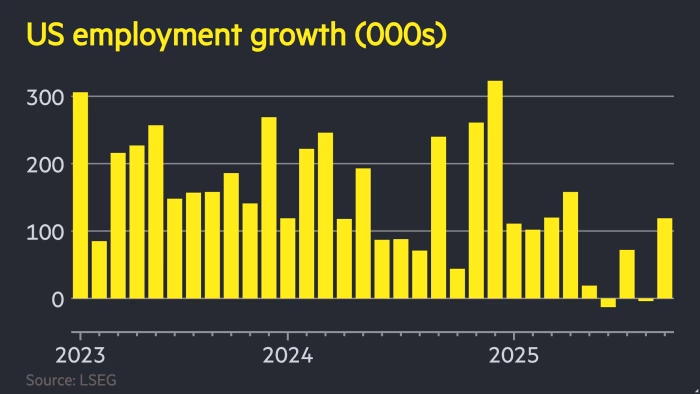
Employment releases are extremely important, having the highest risk premium of all the releases tested, and a very high degree of statistical significance. But this is true only if they are US employment releases; even European stocks don’t care about the euro area ones.
As you’d expect, forward risk premia vary over time. So, for example, euro-area inflation data was really important in September 2023 when the market was looking for data that would signal an end to the ECB’s hiking cycle. And traders get reliably nervy around elections that could go either way:

While it’s always nice to have our hand-wavy priors confirmed, it’s also nice to see them calibrated. Does the work have further use? The authors reckon so, arguing:
this empirical framework can be used to assess how much equity market participants care about both frequently occurring events, such as upcoming economic releases, as well as infrequently occurring events, such as upcoming elections.
So a kind of option-implied calendar of concern can be built for policymakers who are interested in such things.
The note came out on non-farm payrolls day, or as we should probably call it until the government reopens, non-non-farm payrolls day — or ‘Friday’. What the absence of the most important of macro data releases has done to risk premia is not discussed. If the S&P 500 index level is anything to go by, not much.