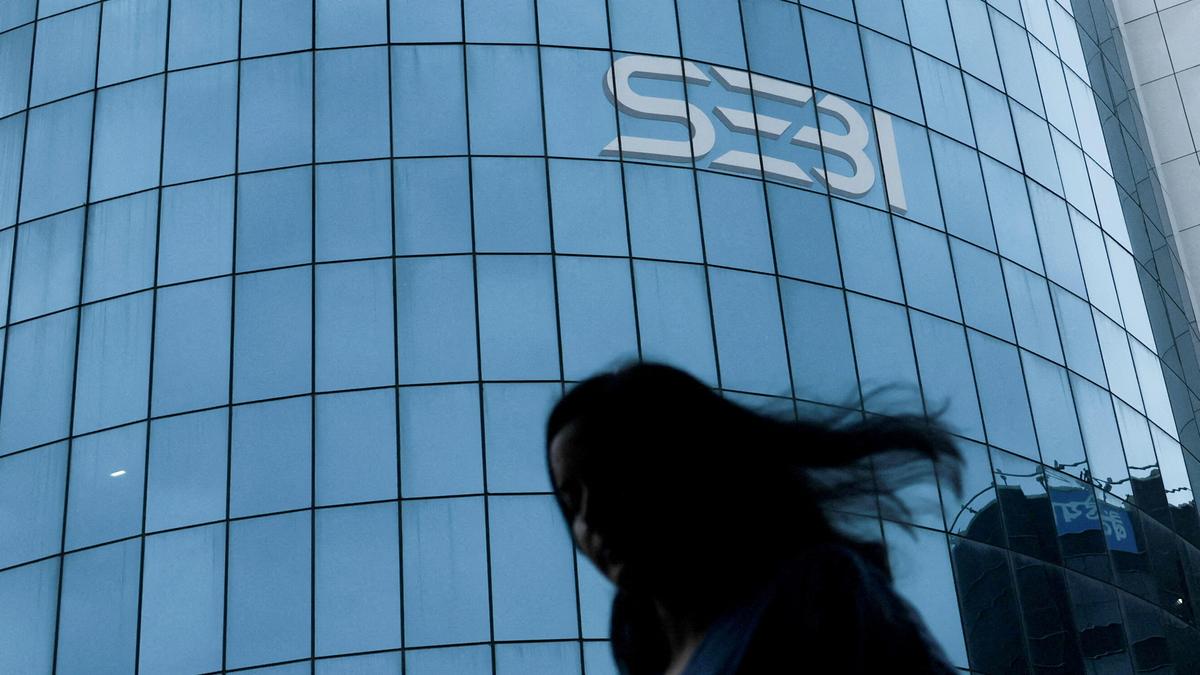
The capital market regulator, the Securities and Exchange Board of India (SEBI), in its recent overhaul of mutual fund categorisation and rationalisation norms, has also clamped down on mutual fund overlap.
Mutual fund overlap refers to a situation where there is duplication of securities in the portfolio. This could be at the fund house level, or even at the individual investor level.
You see, the overlap may not be limited to securities or stocks held, but also in terms of their weight in the scheme’s portfolio and sector composition.
At an individual level, say you invested in a couple of mid-cap funds. Possibly, their top holdings may have exposure to the same set of stocks and sectors.
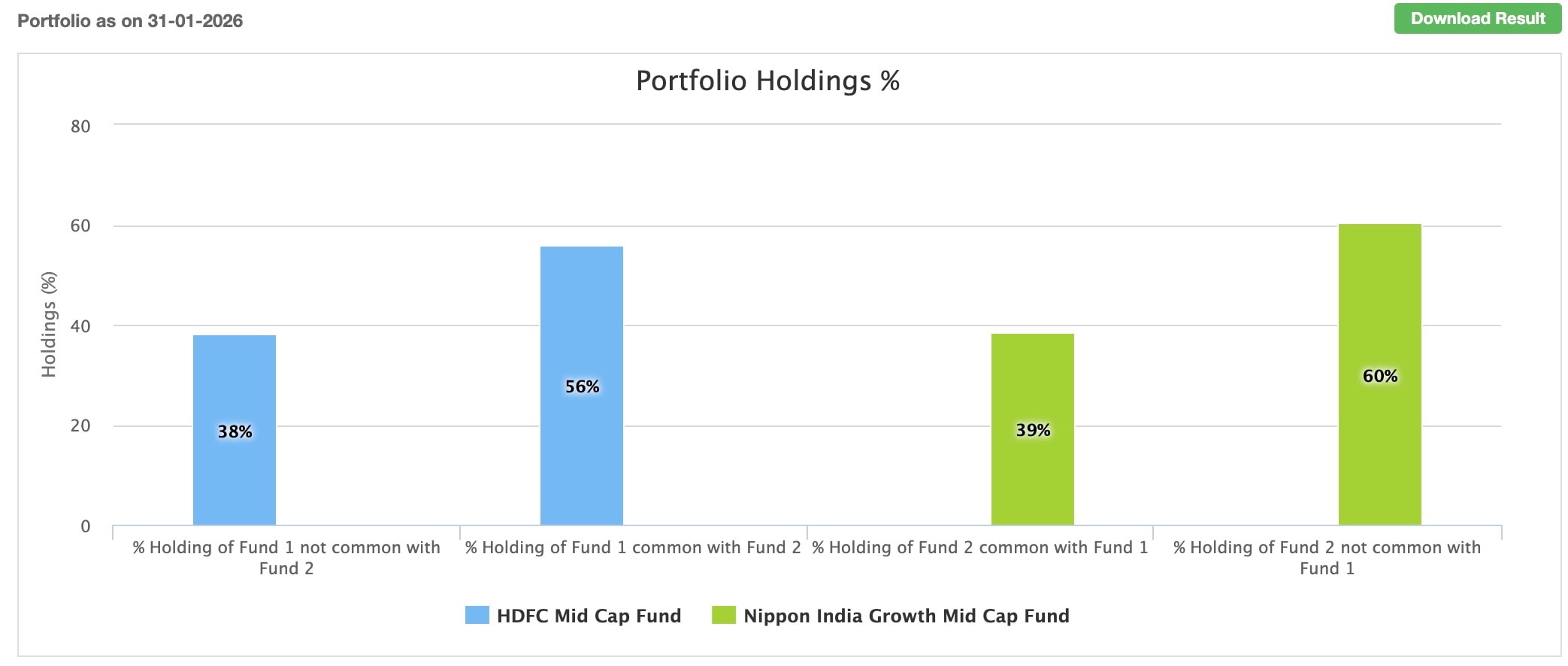
For example, when you compared two popular and highly rated schemes – HDFC Mid Cap Fund and Nippon India Growth Mid Cap Fund – the advisorkhoj.com mutual fund overlap tool reveals that HDFC Midcap Fund (which currently holds a total of 77 stocks) has 56% stocks in common with Nippon India Growth Mid Cap Fund.
On the other hand, the Nippon India Growth Mid Cap Fund (which currently has 99 stocks in its portfolio) has 39% stocks in common with the HDFC Mid Cap Fund.
In other words, Nippon India Growth Mid Cap Fund has fewer common stocks – thanks to the wide portfolio.
Do note, futures and options have not been considered in portfolio overlap / common stocks.
Portfolio Overlap: HDFC Mid Cap Fund v/s Nippon India Growth Mid Cap Fund
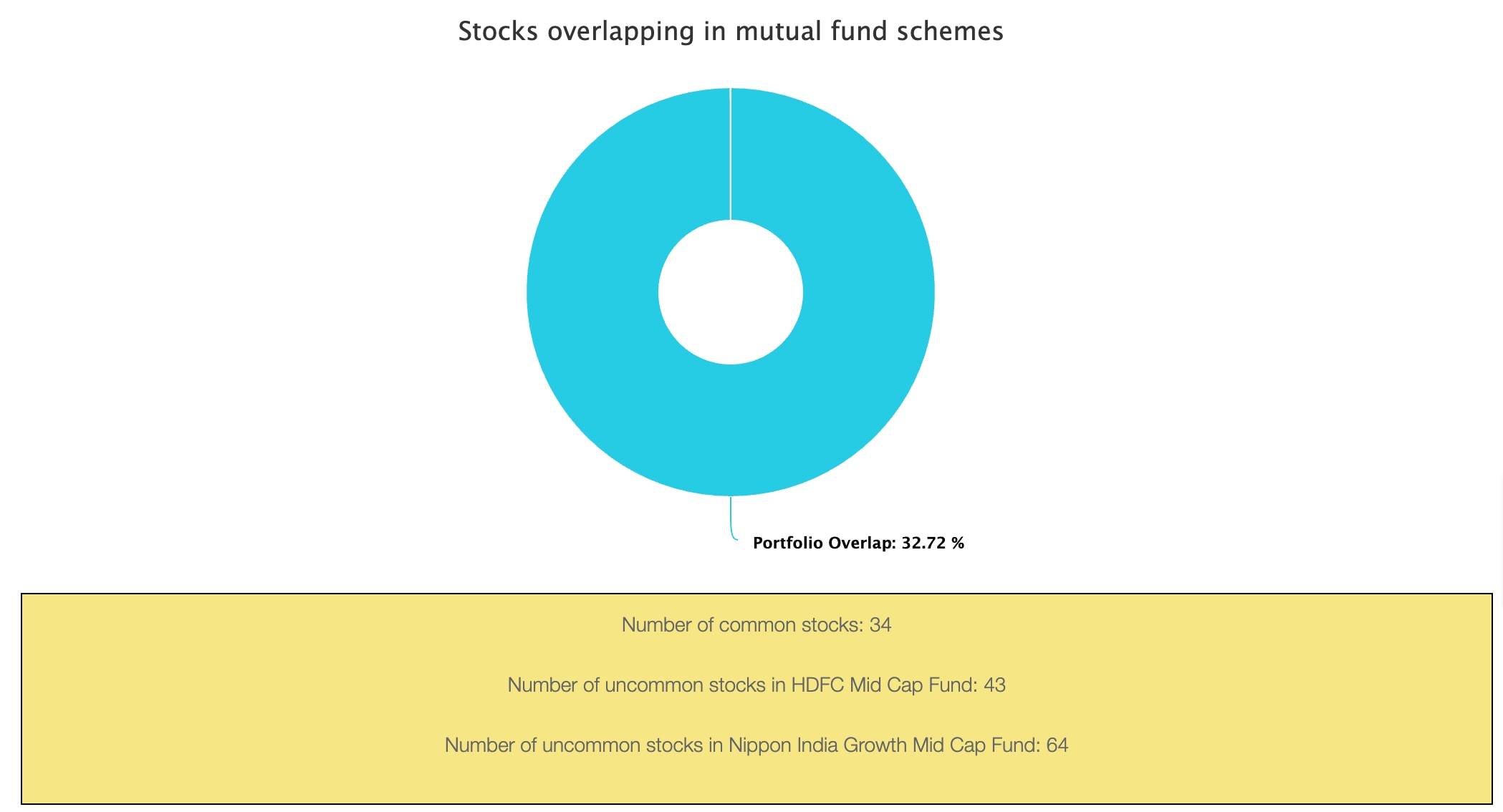
The overall portfolio overlap between the two schemes is nearly 33%. Max Financial Services, AU Small Finance Bank, Federal Bank, Fortis Healthcare, etc., are among the top common holdings of these funds.
From a sectoral exposure point of view, in 2026, many mid-cap fund managers are heavily ‘overweight’ on Financials (Small Finance Banks) and Healthcare, leading to identical top holdings across different AMCs.
Speaking of large-cap funds, given that they have a mandate to predominantly invest in the top 100 stocks by a full market capitalisation basis, the mutual fund portfolio overlap is even higher.
Take, for example, the two top-rated popular schemes: ICICI Prudential Large Cap Fund and Nippon India Large Cap Fund.
In ICICI Prudential Large Cap Fund (which currently has a total of 66 stocks), 72% stock holdings are common with Nippon India Large Cap Fund, as per advisorkhoj.com’s mutual fund overlap tool. Similarly, 69% of the holdings of Nippon India Large Cap Fund (which has a total of 70 stocks currently) are common with ICICI Prudential Large Cap Fund.
Top 10 Common Stocks in ICICI Prudential Large Cap Fund and Nippon India Large Cap Fund
| Company Name | ICICI Prudential Large Cap Fund Holdings (%) | Nippon India Large Cap Fund Holdings (%) |
| HDFC Bank | 9.7 | 9.2 |
| ICICI Bank | 8.4 | 6.4 |
| Reliance Industries | 6.5 | 5.4 |
| Larsen And Toubro | 6.5 | 3.5 |
| Axis Bank | 4.6 | 4.3 |
| Bharti Airtel | 4.4 | 0.0 |
| Maruti Suzuki India | 3.9 | 2.3 |
| Ultratech Cement | 3.5 | 1.5 |
| Infosys | 3.5 | 3.1 |
| NTPC | 2.7 | 2.4 |
The overall portfolio overlap between the two funds is over 54%. HDFC Bank, ICICI Bank, Reliance Industries, L&T, etc., are among the top 10 holdings of the fund.
Even flexi-cap funds, which invest dynamically across the market cap spectrum, have a portfolio overlap.
In the case of Parag Parikh Flexi Cap Fund and HDFC Flexi Cap Fund, the former (which has a total of 86 stocks) has 41% stock holdings in common with the latter.
HDFC Flexi Cap Fund, on the other hand (with a fairly diversified portfolio of 50 stocks currently), has 59% holdings in common with Parag Parikh Flexi Cap Fund.
The overall portfolio overlap between the two funds, Parag Parikh Flexi Cap Fund and HDFC Flexi Cap Fund, is nearly 35%, with common stocks such as Axis Bank, Bharti Airtel, ICICI Bank, Infosys, Maruti Suzuki, etc.
The point is, if you have too many mutual funds with a high portfolio overlap – which is often unintentional — it inflicts high risk, especially when certain stocks or sectors aren’t performing, and the markets are very volatile and susceptible to downswings.
For this reason, you need to be watchful of how much the portfolio overlap is. If it’s too high, it exposes you to concentration risk and may weigh down on the returns.
How Has SEBI Tried to Control Portfolio Overlap?
The regulator has observed a high portfolio overlap even at the fund house level.
For example, currently, HDFC Large & Mid Cap Fund and HDFC Multi Cap Fund have an overall portfolio overlap of nearly 57%.
The DSP ELSS Tax Saver Fund and DSP Large & Mid Cap Fund have an overall portfolio overlap as high as 78%.
The regulator, therefore, as part of the overhaul, in its recent circular dated 26 February 2026, has introduced a mandatory 50% portfolio overlap ceiling to curb scheme duplication, recognising that the portfolio overlap is a significant factor that reduces the real benefit of diversification for investors.
The 50% limit applies to all equity funds, including sector & thematic funds, as well as value funds and contra funds, except for large-cap funds (since they are mandated to invest in the top 100 stocks on a full market capitalisation basis).
SEBI has directed the fund houses to compute overlap quarterly using the daily portfolio overlap values, i.e. the average of daily portfolio overlap values over a quarter.
The existing sectoral/thematic schemes are required to follow the portfolio overlap limits within 3 years from the date of SEBI’s circular.
Schemes unable to meet the portfolio overlap criteria after 3 years are required to mandatorily merge with other schemes as per applicable provisions.
For the realignment, the regulator has said that a glide path approach may be adopted by mutual funds as follows:
Glide Path to Correct Mutual Fund Overlap

In the interest of investors, the regulator has directed fund houses to disclose category-wise portfolio overlap levels, i.e. equity scheme vs. other equity schemes, debt scheme vs other debt schemes and hybrid vs other hybrid schemes.
Fund houses will be required to make this disclosure on their website on a monthly basis.
What Should You, the Investor, Do?
Be conscious of the portfolio overlap at the start, right from the time you select the fund for your personal mutual fund portfolio.
Otherwise, you would end up not paying an expense ratio for funds with similar portfolio holdings and later add to the complexity of reviewing and rebalancing your personal mutual fund portfolio.
Diversify across mutual fund schemes across categories and subcategories, but ensure you aren’t ending up with ‘diworsification’ – that is, holding too many schemes with a high portfolio overlap.
Choose across market capitalisations and style of investing (value, growth or blend) and asset types that are best suited for you.
While it may be practically impossible to eliminate portfolio overlap altogether, your focus should be on minimising it so that your personal mutual fund portfolio is optimally diversified and is aligned with the financial goal/s you plan to achieve.
Also, once your personal mutual fund portfolio is suitably constructed, make sure you are monitoring and timely reviewing it (say biannually), to ensure you are on track to accomplish the envisioned goal/s.
Happy investing!
Note: We have relied on data from www.valueresearchonline.com, www.financialexpress.com, and the factsheets published by the respective fund houses throughout this article. Only in cases where the data was not available, have we used an alternate, but widely used and accepted source of information.
Portfolio data as of 31 January 2026.
Disclaimer:
The above content is for informational purposes only. Mutual Fund investments are subject to market risks. Please consult your financial advisor before investing.
Rounaq Neroy has over 20 years of experience in the financial markets and investments. He is a close observer of the Indian economy and writes deeply on the capital markets, mutual funds, stocks, precious metals, asset allocation, wealth management, and investment strategy. His editorials provide interesting, actionable investment ideas to guide readers in the journey of wealth creation and make wise decisions. Rounaq was the Head of Content at PersonalFN (Quantum Information Services Pvt. Ltd.), which also owns Equitymaster.com – India’s oldest and trusted equity research house.