Alex Savin is a Senior Partner at Blackmoor Investment Partners.

Global investors face an increasingly volatile market environment, forcing a rethink of traditional investment strategies. With tariff threats rattling supply chains and geopolitical uncertainty weighing on sentiment, investors may not be able to turn to traditional large-cap U.S. stocks for consistent returns.
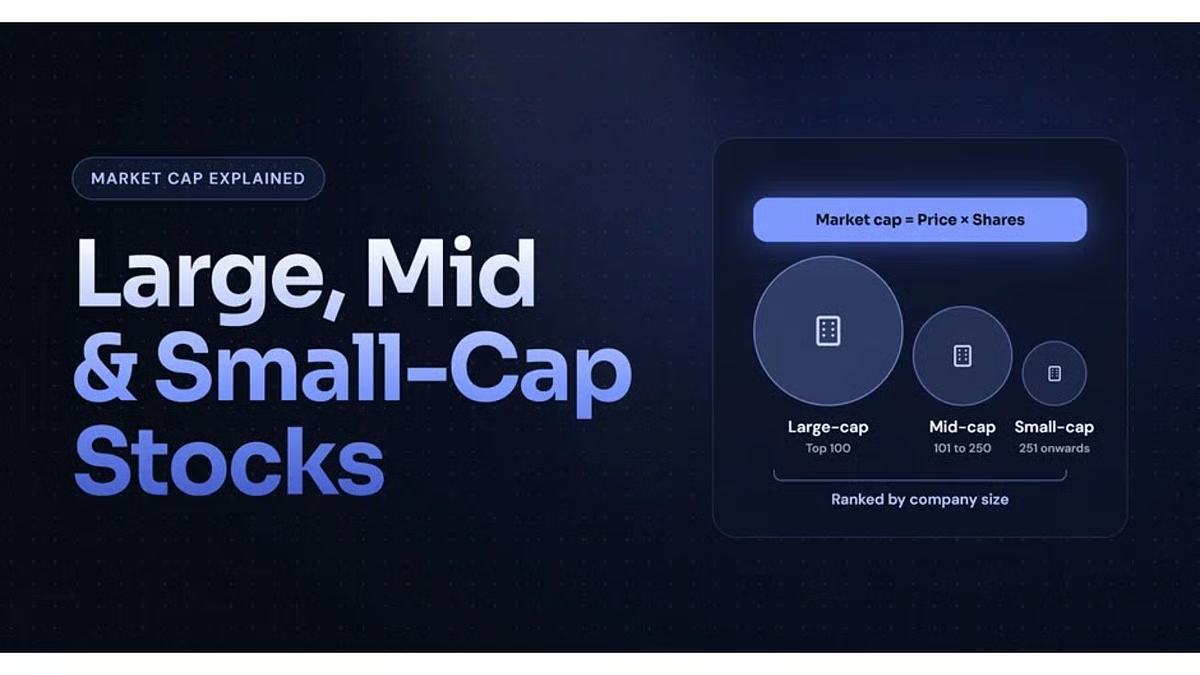
For too long, European small- and mid-cap equities have been overlooked in favor of large-caps and U.S. equities in general. Yet, with discounts compared to U.S. peers at high levels, they currently represent one of the most compelling potential opportunities to deliver long-term value. At my company, Blackmoor Investment Partners, we believe that their attractive valuations and strong fundamentals make European small- and mid-caps particularly well-positioned to provide an opportunity to generate attractive returns in the coming years.
Why Small- And Mid-Caps, And Why Now
The Stoxx Europe Small 200 Index has made significant gains this year to date in dollar terms, thanks to resilient earnings and a stronger euro (paywall). Historical skepticism surrounding European small- and mid-caps has turned into renewed interest, with valuations rebounding as many small mid-caps demonstrate strong performance.
Small- and mid-caps have in the past often traded at a premium to large-caps, but a higher interest rate environment and greater risk aversion globally (in my observation) have reversed that trend, providing an attractive opportunity to enter the space. Additionally, based on my own research, forward earnings-per-share (EPS) expectations taken from Bloomberg suggest that profit growth among small- and mid-caps could surpass larger European peers’ forward EPS over the next 12 to 18 months; this expectation has not been priced in.
Small- and mid-caps are benefiting from supportive policy factors, with Eurozone rate cuts improving financing conditions. Meanwhile, fiscal measures in Germany and across the EU are channeling capital into domestic sectors that are disproportionally represented by small- and mid-caps, from defense, energy transition and infrastructure to sectors focused on cutting-edge technology. (These industries’ supply chains tend to consist of very specialist small- to mid-cap companies providing expertise.)
Caveats Of Small- And Mid-Caps, And Discovering Hidden Gems
The European small- and mid-cap universe consists of over 1,500 companies. Not all of them represent attractive investment opportunities; in my view, investors must be extremely selective in this space. Many of these companies are not well covered by research analysts, leaving them misunderstood by investors. Others do not command sufficient competitive edge. Some are inefficient and operate below their potential.
However, in-depth research, selectivity, sector expertise and thorough due diligence can help uncover gems. Finding these requires significant resources to be focused on understanding a single name, and deploying a private equity-like, in-depth approach to due diligence. The outcome is in many cases worth the effort—some great companies can be identified at extremely attractive valuations.
Rather than chasing short-term momentum, investors should look for sustainable value creation: firms with durable business models, underappreciated competitive moats and capacity for operational enhancements. Highly collaborative expert-driven engagement is critical to the success of such an approach, with expertise deployed to help management refine capital allocation, pursue targeted growth opportunities and manage governance risks—all in the interest of generating alpha.
Generating Alpha With An Active And High-Conviction Approach
At Blackmoor Investment Partners, we believe that a key to success in the European small- and mid-cap space lies in selective, high-conviction investments in companies, paired with active engagement, where an investor works alongside boards and management teams over a number of years to support them to unlock potential.
A catch-all “index-style” approach in the small-cap space hardly generates consistently attractive returns. Unlocking enhanced long-term value hinges on company-specific catalysts, whereby bandwidth is dedicated to an active approach over a smaller number of stocks to ensure investees maintain effective governance and implement all opportunities to unlock value.
The information provided here is not investment, tax or financial advice. You should consult with a licensed professional for advice concerning your specific situation.
Forbes Finance Council is an invitation-only organization for executives in successful accounting, financial planning and wealth management firms. Do I qualify?