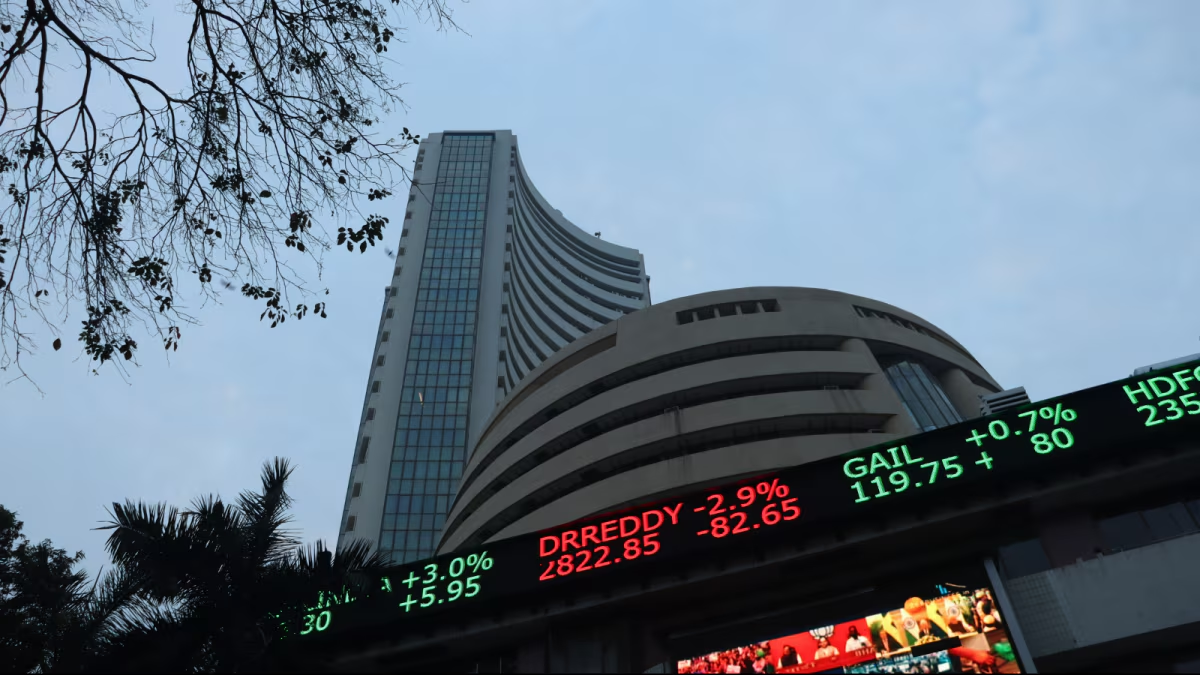
In the current market volatility following the war situation in West Asia, even large-cap indices have seen significant corrections.
Frontline indices across market caps have fallen 14-20 per cent from their recent highs.
Though many large-cap stocks, too, have declined in the last year or so, in general, these names are relied upon for portfolio stability and steady returns over the long term. More so in the case of large-cap mutual funds.
Though many active large-cap funds have struggled to beat the Nifty 100 TRI or the BSE 100 TRI, some schemes still managed steady outperformance over the long term.
Given that it is the key category that must figure in most investor portfolios, fund selection becomes important. Prolonged underperformers must be weeded out of the portfolio.
In this regard, Axis Large Cap (Axis Bluechip earlier) has been a lackadaisical performer in the segment over the medium and long terms.
Investors can consider moving out of the scheme and switching to better funds in the category.
Underwhelming performance
Axis Large Cap has been finding it challenging to beat standard large-cap benchmarks across timeframes over the past several years.
Over one, three, five and seven-year timeframes, the fund has underperformed the Nifty 100 TRI by 0.5-2.6 percentage points.
The fund’s five-year point-to-point returns are modest, at 8.6 per cent. In this timeframe, the Nifty 100 TRI gave 11.2 per cent and the BSE 100 TRI delivered 11.8 per cent. Even on a 10-year basis the fund lags behind these benchmarks.
When five-year rolling returns are considered from March 2016 to March 2026, the fund has outperformed the Nifty 100 TRI a mere 46.1 per cent of the times. The mean return for the fund in this rolling period is 15.3 per cent, while for the Nifty 100 TRI it is 15.5 per cent.
When returns on monthly SIPs (XIRR) over the past 10 years are considered, Axis Large Cap fund has given 11.8 per cent. A similar SIP in the Nifty 100 TRI would have delivered 12.5 per cent.
The risk ratios too point to a similar story of underperformance. The fund has an upside capture ratio of 92.6, indicating that its NAV rises less than the benchmark during market rallies. Axis Large Cap fund has a downside capture ratio of 103.8, indicating that the scheme’s NAV falls more than the benchmark during periods of corrections. A score of 100 indicates that a fund performs exactly in line with its benchmark.
This inference is based on data from March 2021-March 2026. All return figures and the ratios pertain to the direct plan of the fund.

Portfolio moves
Axis Large Cap invests in line with the mandate for the category. Most of the times, the large-cap portion in the portfolio is in excess of 90 per cent.
However, the fund does take significant cash and derivatives exposures, which though insulates the portfolio during falls, could result in lower returns during rallies.
Cash and cash equivalents and net current assets, derivatives (futures) and treasury bills have sometimes gone above 10 per cent of the portfolio.
In terms of sector preferences, financial services (including banking) have been the top holdings across timelines. However, higher weightage to the likes of underperforming stocks such as HDFC Bank, Kotak Mahindra Bank, Bajaj Finance etc. resulted in modest returns.
Though the fund pared exposure to the IT sector, it had heavy exposure in 2025 with Infosys and TCS being among key holdings. The general roiling of domestic software firms and the lower growth recorded by the majors, and AI-led business disruptions in the segment have resulted in their prices coming off sharply over the past 18 months.
In the past, exposure to retailing giant Avenue Supermarts and automobile major tata Motors have hurt returns, though here again exposures are pared.
In its recent portfolio, auto and auto components, healthcare and oil, gas & consumable fuels figure among the top holdings.
Axis Large Cap fund’s top 10 stocks account for more than 50 per cent of the portfolio and generally make for concentrated exposure. A list of underperformers in those top holdings with higher weightage have meant that the fund’s overall returns have tended to lag several peers in the category.
Investors can stop SIPs and exit the fund in light of its prolonged underperformance.
ICICI Prudential Large Cap and Nippon India Large Cap would be our top choices for switching or starting fresh SIPs. Both these funds have excellent long-term track records and have consistently beaten the large-cap benchmark indices convincingly.
These can be part of the core portfolio of investors looking to stay put for long-term goals that are 7-10 years away.
Published on March 14, 2026