Mid-cap stocks are drawing renewed investor interest as steady demand and government spending support growth across key sectors. From infrastructure and defence to biotech, select companies are showing resilience and solid fundamentals in an uncertain market.
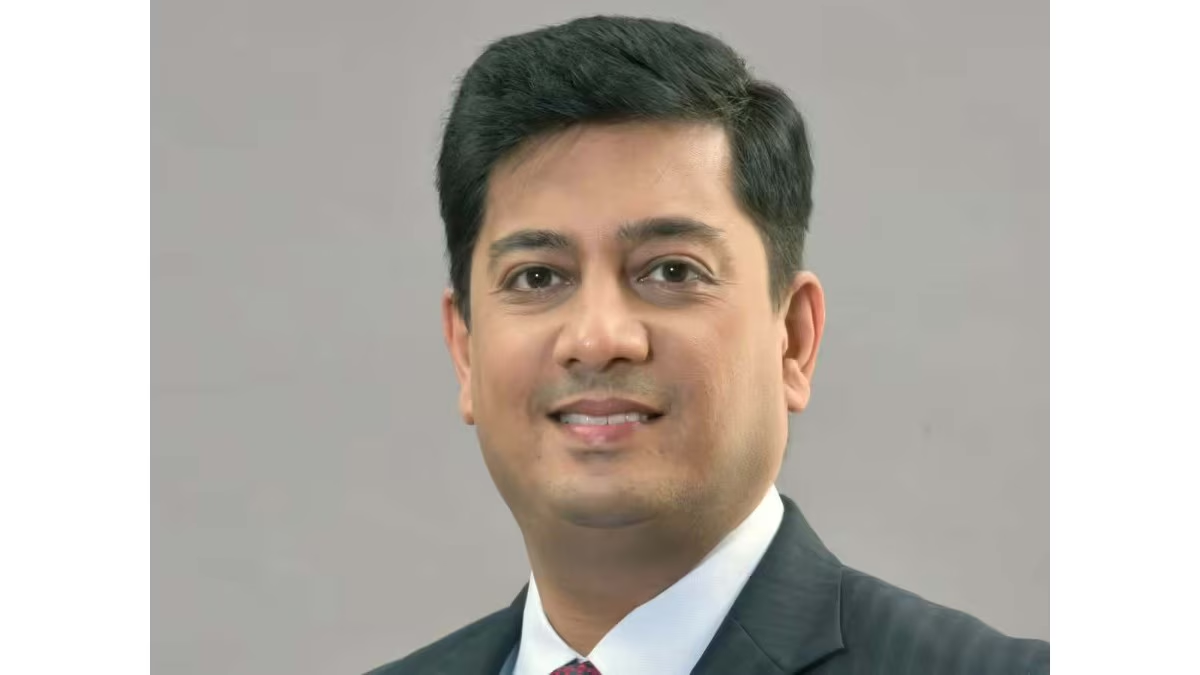
BNN Bloomberg spoke with Dan Skubiz, senior portfolio manager at F/m Investments, about his top mid-cap picks — Federal Signal, ESCO Technologies and Ligand Pharmaceuticals — and why he believes they’re well-positioned to deliver consistent returns.
Key Takeaways
- Federal Signal is benefitting from steady municipal demand and U.S. infrastructure spending, supporting growth in its specialty vehicle business.
- Strong management execution at Federal Signal is driving higher margins, expanding backlogs and successful M&A integration.
- ESCO Technologies is seeing tailwinds from commercial aerospace growth, defence spending and grid modernization.
- A strategic shift at ESCO toward higher-margin segments is improving profitability and resilience across its portfolio.
- Ligand Pharmaceuticals’ royalty-based model offers diversification and cash flow strength without the risks of clinical development.

Read the full transcript below:
ANDREW: Time for Hot Picks. We’re calling them small caps because, by U.S. standards, they are. Our guest has some ideas, including a company that makes street sweepers, sewer cleaners and road-marking vehicles. Let’s bring in Dan Skubiz, senior portfolio manager at F/m Investments. Dan, thanks very much for joining us. Let’s start with your first idea — Federal Signal. What do they do, and what attracts you to the company?
DAN: Good morning, Andrew. You mentioned some of what they do — street sweepers, safe digging equipment, sewer cleaners and road-marking vehicles. They also recently acquired a manufacturer of refuse, or garbage, trucks.
As an example of their M&A strategy, they own several businesses in Canada, including Joe Johnson Equipment, which distributes various types of municipal and industrial equipment. That provides an opportunity to grow their new refuse-truck distribution business within Canada.
More broadly, Federal Signal is seeing steady demand from cities and utilities, along with tailwinds from U.S. infrastructure spending, which still has a long runway. It’s a strong, experienced management team that continues to raise the bar on margins, expand the backlog and successfully integrate acquisitions.
ANDREW: What was the Canadian connection you mentioned?
DAN: They own several businesses in Canada. When they acquired the refuse-truck manufacturer, they saw an opportunity to use Joe Johnson Equipment’s network to bring those vehicles into Canada. It’s a great way to grow distribution and demand in that market.
ANDREW: Your next idea is ESCO Technologies. Among other things, it’s a supplier of aerospace components. Could it be a winner if defence spending rises?
DAN: There are a number of ways for ESCO to win. It’s a bit under the radar for many investors. In addition to aerospace components, it makes defence systems and utility grid testing equipment — all high-barrier niches with strong secular tailwinds.
The company benefits from growth in commercial aerospace and increased defence spending, especially in space and naval programs, including submarines. It’s also gaining from grid modernization, covering both electrical utilities and renewables.
A newer management team took over a few years ago and is hitting its stride. They’ve trimmed lower-margin businesses and are focusing on higher-margin segments through both organic and inorganic growth.
ANDREW: And finally, a very different company — Ligand Pharmaceuticals. Where does it fit into the pharma industry?
DAN: Ligand is a biopharma royalty and licensing company. It develops or acquires drug-discovery platforms that it offers to pharmaceutical and biotech firms, then collects milestone or royalty payments as those partners advance their products.
Its most important technology is called Captisol — a chemical compound that helps drugs dissolve and be delivered into the body more efficiently. Think of it as an ingredient that makes a drug stable and usable. Ligand doesn’t develop the drugs itself; it provides the key compounds that partners use in their own formulations.
It’s a diversified, capital-light business model that generates strong cash flow from dozens of partner programs, without the risk or cost of running its own clinical trials. Its royalties come from a broad set of smaller partner drugs — none large enough to be hit by U.S. Medicare price negotiations, which target products with more than US$1 billion in annual sales. That makes Ligand more insulated from the policy headwinds facing Big Pharma.
ANDREW: So when you say capital light, they don’t actually do the research and development themselves?
DAN: Exactly. They provide key ingredients to biotech or pharma firms. Using Captisol, for example, allows those companies to stabilize their drugs without having to develop those compounds in-house. Ligand licenses that ingredient and earns royalties as the drugs succeed and move through the regulatory process.
ANDREW: Interesting. You mentioned a drying up of venture capital for pharma. Does that make Ligand’s royalty-financing model more attractive?
DAN: Absolutely. With venture funding slowing as rates have risen, smaller biotech firms are looking for alternative financing. Ligand’s royalty-based model lets them avoid big upfront payments — they only pay if their drug succeeds. That helps cash flow on both sides and allows Ligand to share in the upside without taking on the same risk.
ANDREW: Dan, thanks very much for joining us — three fresh names to kick off the week. Dan Skubiz, senior portfolio manager at F/m Investments.
| DISCLOSURE | PERSONAL | FAMILY | PORTFOLIO/FUND |
|---|---|---|---|
| FSS NYSE | N | N | Y |
| ESE NYSE | N | N | Y |
| LGND NASDAQ | N | N | Y |
—
This BNN Bloomberg summary and transcript of the Oct. 6, 2025 interview with Dan Skubiz are published with the assistance of AI. Original research, interview questions and added context was created by BNN Bloomberg journalists. An editor also reviewed this material before it was published to ensure its accuracy and adherence with BNN Bloomberg editorial policies and standards.