By Joseph Adinolfi
Stocks in the Russell 2000 are getting older, while their return on capital has declined
Small caps could struggle to outperform their larger peers over the long term.
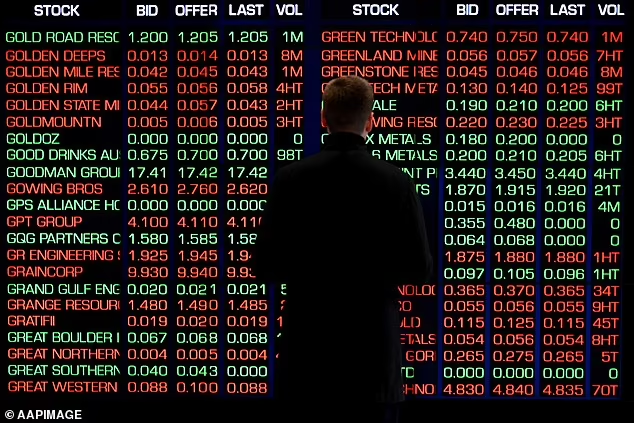
There was a point this summer when it looked like the Russell 2000 index might overtake the S&P 500 index and outperform the large-cap benchmark for the first time in years.
More recently, however, the odds of small caps finally racing ahead of their larger peers – making up for years of lost ground – appear to have fizzled alongside hopes for another Federal Reserve interest-rate cut this year.
Despite outperforming their larger peers Tuesday, the Russell 2000 RUT still was flirting with correction territory, having fallen nearly 8% from its most recent record closing high as of Tuesday’s close, according to FactSet data.
In September, the index tallied its first record close since 2021. If the Russell trails the S&P 500 once again in 2025, it would mark the fifth-straight calendar year that small caps have underperformed – the longest stretch since 1998, according to Dow Jones Market Data.
A few factors have largely been behind this latest unraveling, said Bob Savage, head of markets macro strategy at BNY.
“First, they are very rate sensitive to the Fed, because many of them really need to borrow in order to stay afloat. The second part is: There is a disproportionate number of small banks in the Russell 2000, and that cockroach comment from [JPMorgan Chase & Co. Chief Executive] Jamie Dimon really hit their shares,” Savage said.
Senior Fed officials, including Chairman Jerome Powell, have recently expressed reservations about delivering another rate cut in December. That has helped to derail a momentum trade that had powered many of the Russell 2000’s top-performing constituents in 2025.
No market for small stocks
Still, small-cap stocks had been struggling to keep up since the bull market began three years ago, especially when compared with their larger peers.
A few brief bouts of outperformance have momentarily dazzled investors. But none proved to be a durable turning point. After the latest rally, small-cap investors can’t be blamed for feeling like they have been here before.
Years ago, academics, including economists Eugene Fama and Kenneth French, laid the theoretical groundwork for why small-cap stocks should outperform over the long term.
But over the past decade, the Russell 2000 has changed in several important ways. Some say this raises questions about whether these longstanding academic conclusions still apply.
Since the start of 2014, the S&P 500 has outperformed the Russell 2000. Although the disparity in performance looks less dramatic when one zooms out to a 25-year timespan. The Russell 2000 has appreciated 365.3% since Dec. 31, 1999, through Tuesday’s close and the S&P 500 SPX has increased 350.4% during the same period, per Dow Jones Market Data.
“A lot has to happen for small caps to do well over the long term,” Crit Thomas, global market strategist at Touchstone Investments, told MarketWatch.
Saying no to the IPO
The rise of investments from venture capital and, more broadly, private markets investing, has meant that the most promising technology companies have been staying private for longer. By the time they’ve gone public, companies have often skipped the small-cap phase of their life cycle entirely.
Data from PitchBook show valuations for private companies worth $1 billion or more have exploded over the past 25 years.
“Companies are definitely waiting longer to go public. We’ve noted in the past that small-cap technology IPOs have all but disappeared,” Matthew Kennedy, senior strategist at Renaissance Capital, told MarketWatch.
“A decade ago, the vast majority of VC-backed tech IPOs still went public at market caps under $1 billion. That is no longer the case,” he added.
Aging in place
At the same time, fewer stocks within the Russell 2000 have been moving up – and out – of the index.
Analysts at FTSE Russell found that over the past decade, the number of small-cap and microcap stocks that have graduated into the Russell 1000 has fallen to 20 this year from 28 in 2015.
One result is that the average time since IPO for Russell 2000 members has increased by nearly three years since 2008, according to an analysis by FTSE Russell that was shared with MarketWatch.
A good value?
Valuations for small-cap stocks – at least, for those that are profitable – have declined relative to their larger rivals.
As of the end of October, the S&P 600 small-cap index SML sported a trailing 12-month price-to-earnings ratio of 21.95, compared with 28.46 for the S&P 500, according to Bloomberg data. For the Russell 2000, the same ratio stood at 62.43, largely due to the sizable share of unprofitable or barely profitable companies in the index. The S&P 600 has more strict requirements regarding profitability for its members.
“It used to be that small caps traded at a premium to large caps, but that hasn’t been true for a number of years,” Touchstone’s Thomas said.
Recently, the Russell 2000 has outperformed the S&P 600 as investors have gravitated toward speculative bets on money-losing companies. There are many more of these types of companies in the Russell 2000, hence the higher price-to-earnings ratio.
Thomas also pointed out that smaller companies have seen their return on capital shrink, making it more difficult for them to create value for shareholders. The return on capital for the S&P 500 stood at more than 8% at the end of October, according to Bloomberg data.
For the Russell 2000, the same metric stood at just 0.1%, while the S&P Small Cap 600 sported an ROIC of 1.5%.
Reason for hope
Small-cap bulls still have at least one reason to be hopeful in 2026. With the Fed expected to continue cutting rates in a steady economic backdrop, Wall Street analysts have been aggressively raising their targets for small-cap companies’ earnings.
As a result, the consensus forecast has penciled in earnings growth of 59% for the Russell 2000 in 2026, as a team of equity strategists at Goldman Sachs Group recently pointed out.
Some, including Chip Skinner, a portfolio manager at Royce Investment Partners, said faster earnings growth should help give small caps a boost. Skinner said he believes there is still a case for small caps to race ahead over a period of years.
“I wouldn’t say that small caps are never going to outperform again,” Skinner told MarketWatch. “Investors are taking on greater risk when they invest in the small-cap category, so they should get paid more.”
Touchstone’s Thomas said strong earnings could be good for a short-term bump. Yet in terms of what it might take for small caps to see another decadelong bout of outperformance – like they did between 2000 and 2010 – that remains less clear.
Small-cap stocks boast another advantage: They’re quite small. Collectively, the market cap of every stock in the Russell 2000 was less than $3 trillion, according to Dow Jones Market Data. That means Nvidia Corp. (NVDA), at about a $4.5 trillion market cap, was worth more on its own than all these companies combined.
-Joseph Adinolfi
This content was created by MarketWatch, which is operated by Dow Jones & Co. MarketWatch is published independently from Dow Jones Newswires and The Wall Street Journal.
(END) Dow Jones Newswires
11-19-25 1139ET
Copyright (c) 2025 Dow Jones & Company, Inc.