TLDR
- The XRP Ledger’s tokenized assets have surged from under $80 million to $453 million within approximately 12 months
- Capital flowing into XRP ETFs has exceeded $1.1 billion as of early March 2026
- Cardano’s DeFi ecosystem contains just $138 million in assets, significantly behind its ambitious $3 billion goal for 2030
- XRP’s current price hovers around $1.42 with an $87 billion valuation; Cardano sits at $0.27 with a $10 billion market cap
- Expert predictions suggest XRP may climb to $3–$8 before year-end; Cardano estimates remain conservative at $0.30–$1
As 2026 unfolds, XRP and Cardano remain prominent fixtures in cryptocurrency conversations. While both projects enjoy dedicated supporter bases, their adoption rates and practical applications reveal contrasting trajectories.
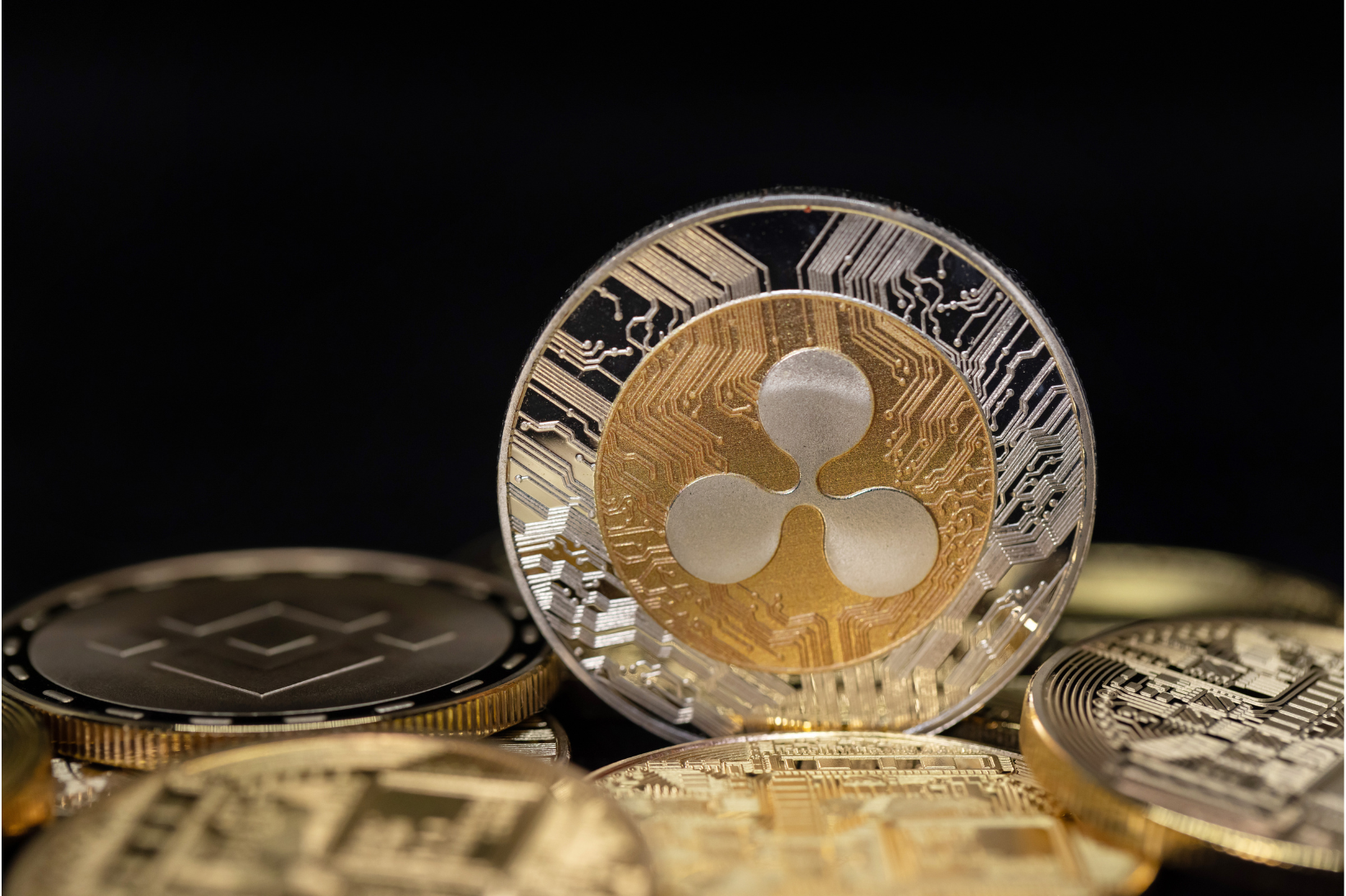
XRP positions itself as an institutional finance solution. Its primary audience includes banking institutions, currency trading platforms, and investment funds. The XRP Ledger facilitates asset tokenization, enabling traditional financial products such as bonds to exist on blockchain infrastructure.
Twelve months ago, tokenized assets on the XRP Ledger totaled less than $80 million. That figure has now exploded to $453 million. This acceleration occurred predominantly throughout late 2025 and into early 2026.
XRP exchange-traded funds have accumulated more than $1.1 billion in investor capital through March 6, 2026. This development allows mainstream investors to participate without managing cryptocurrency wallets directly.
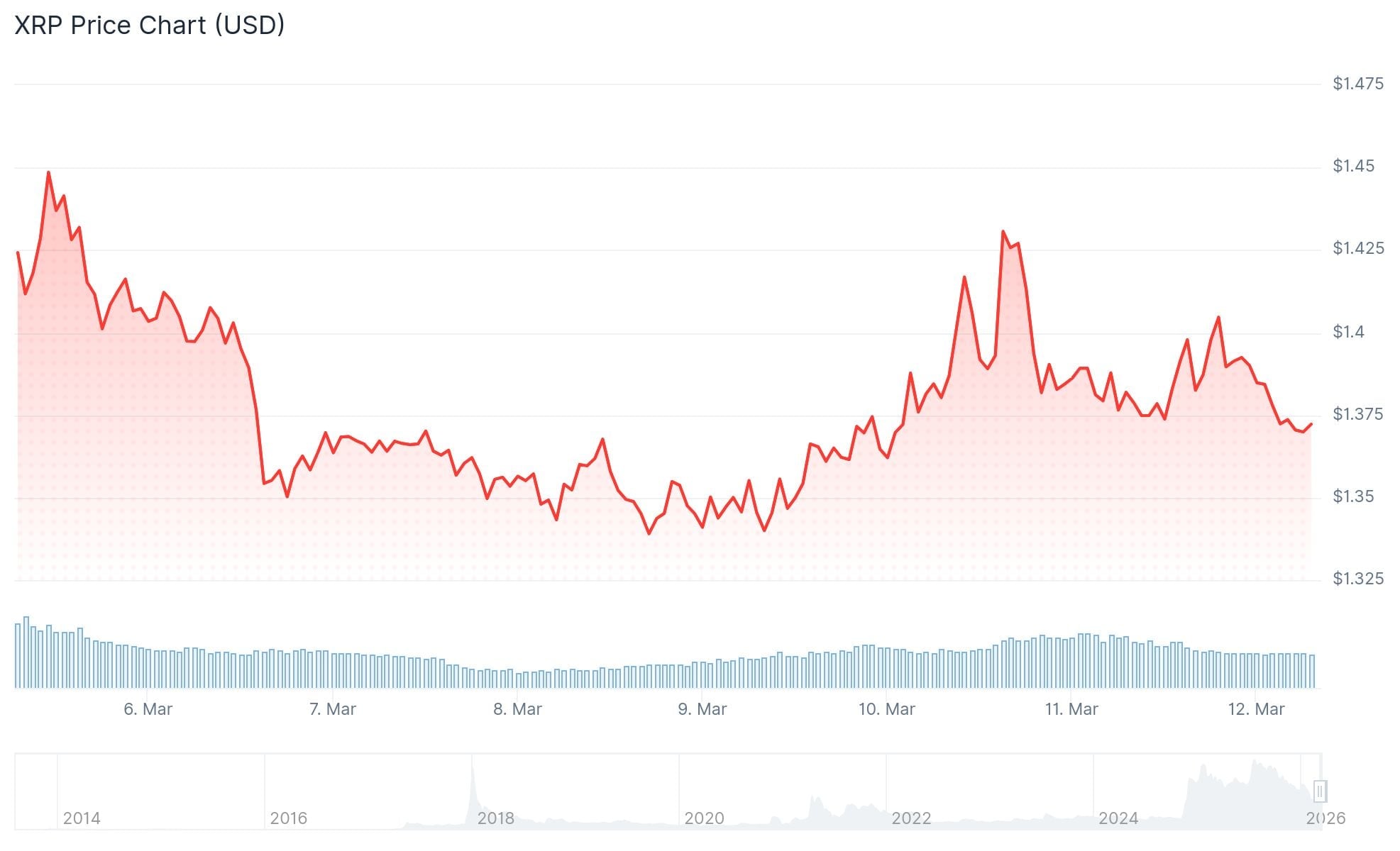
XRP presently changes hands near $1.42, commanding an $87 billion market capitalization. Over the past 52 weeks, it has fluctuated between $1.14 and $3.65.
Cardano pursues an alternative strategy. The project emphasizes scholarly research and academically vetted code. Its ambition centers on creating a versatile blockchain platform supporting smart contracts and decentralized applications.
Cardano’s 2030 strategic plan envisions $3 billion locked in DeFi protocols, one million monthly active wallets, and 324 million yearly transactions. Current metrics suggest these benchmarks remain aspirational.
Where Cardano Stands Today
Cardano presently secures $138 million across its DeFi ecosystem. Network fees generate approximately $1,900 daily. Fewer than 17,000 unique wallet addresses demonstrate activity each day.
These statistics indicate limited network utilization despite years of ongoing development. A late 2025 initiative aimed at enhancing stablecoin liquidity failed to generate noticeable increases in user adoption or capital deployment.
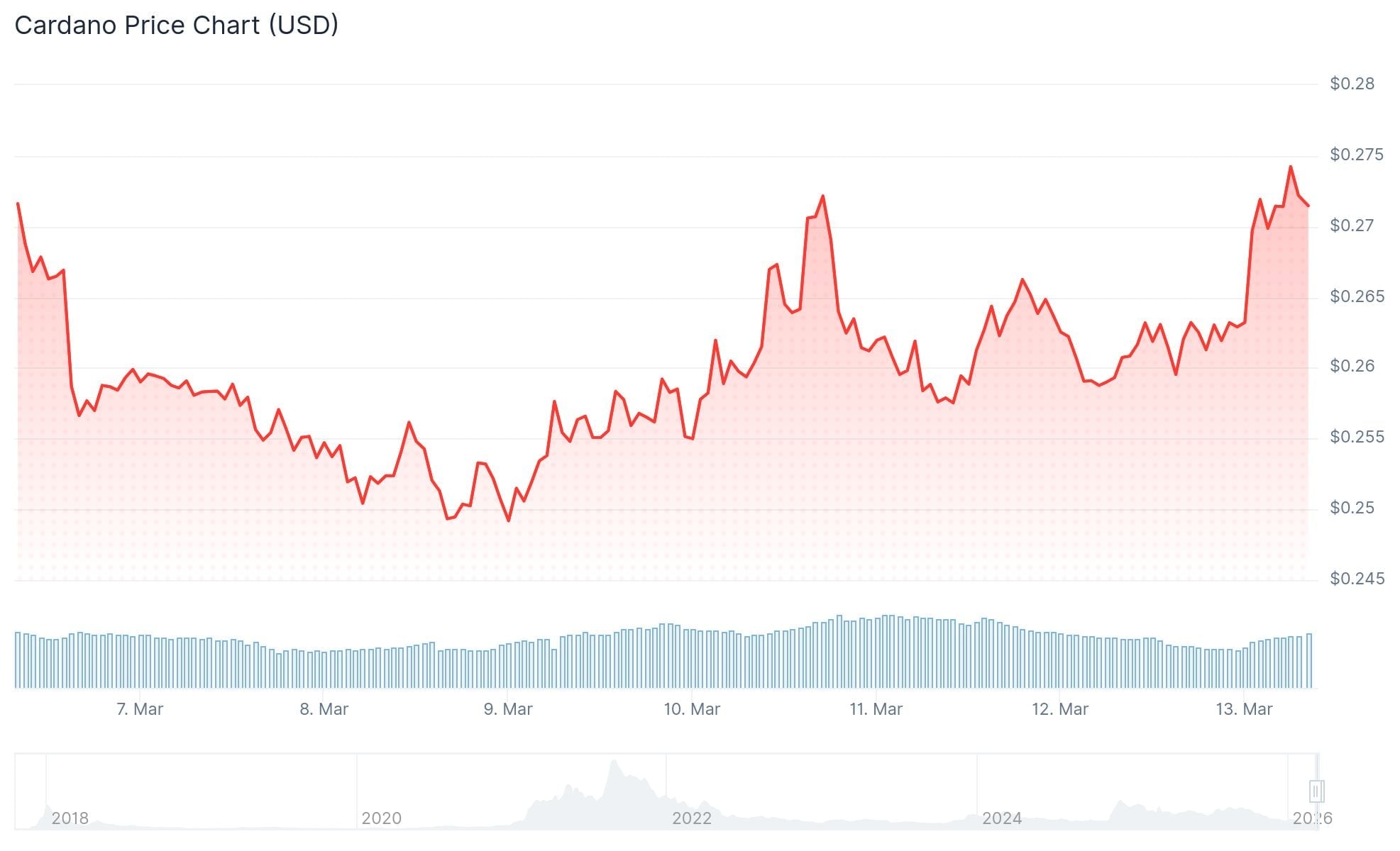
Cardano currently trades at $0.27, reflecting a $10 billion market valuation. Its 52-week trading range extends from $0.23 to $1.01.
What Analysts Are Saying
Regarding XRP, professional forecasters project year-end 2026 valuations spanning $3 to $8. Standard Chartered has publicly endorsed an $8 target contingent on sustained ETF interest. Certain enthusiastic social media commentators propose substantially higher figures, though these represent fringe predictions.
Cardano projections trend more conservatively. Most professional estimates congregate between $0.30 and $1. Several analysts acknowledge potential upside toward $2–$4 if planned network enhancements deliver measurable improvements, while others warn of downside vulnerability should critical price support levels fail.
Upcoming catalysts potentially benefiting XRP include additional ETF product launches and expanded deployment of Ripple’s RLUSD stablecoin throughout Japan via collaboration with SBI Holdings.
Cardano’s immediate catalysts encompass the Midnight Network mainnet activation, emphasizing privacy functionality, plus possible spot ADA ETF introductions from Grayscale.
As of mid-March 2026, XRP demonstrates unambiguous advantages in institutional embrace and blockchain activity relative to Cardano.
Final Thoughts
Both XRP and Cardano constitute speculative investments, and historical performance provides no guarantee of future outcomes. XRP currently exhibits superior real-world integration, heightened institutional participation, and accelerated on-chain expansion. Cardano maintains an ambitious long-range blueprint, but present metrics fail to substantiate that vision. Investors considering allocating $1,500 toward either cryptocurrency today must comprehend inherent risks and conduct independent research before committing capital.