The writer is governor of the Bank of England
Since the onset of modern trade and industrialisation, two forms of money have come to dominate the economic landscape: central bank money, which takes the form of reserve accounts held by banks and the cash that is available to all of us, and commercial bank money, which takes the form of deposits we hold at banks.
Trust in money is critical to economies. Put simply, it depends on confidence that a pound has the same value in whatever form it is held. We must have faith that money should be readily exchangeable within and between these forms. Ensuring this vital underpinning of the economy is the key reason why we regulate banks.
But it should also be possible to have innovation in the form of money. It would therefore be wrong to be against stablecoins as a matter of principle. Indeed, I do not hold that view, recognising their potential in driving innovation in payments systems both at home and across borders. Practice matters however, and it is critical that these stablecoins satisfy the conditions that enable public trust.
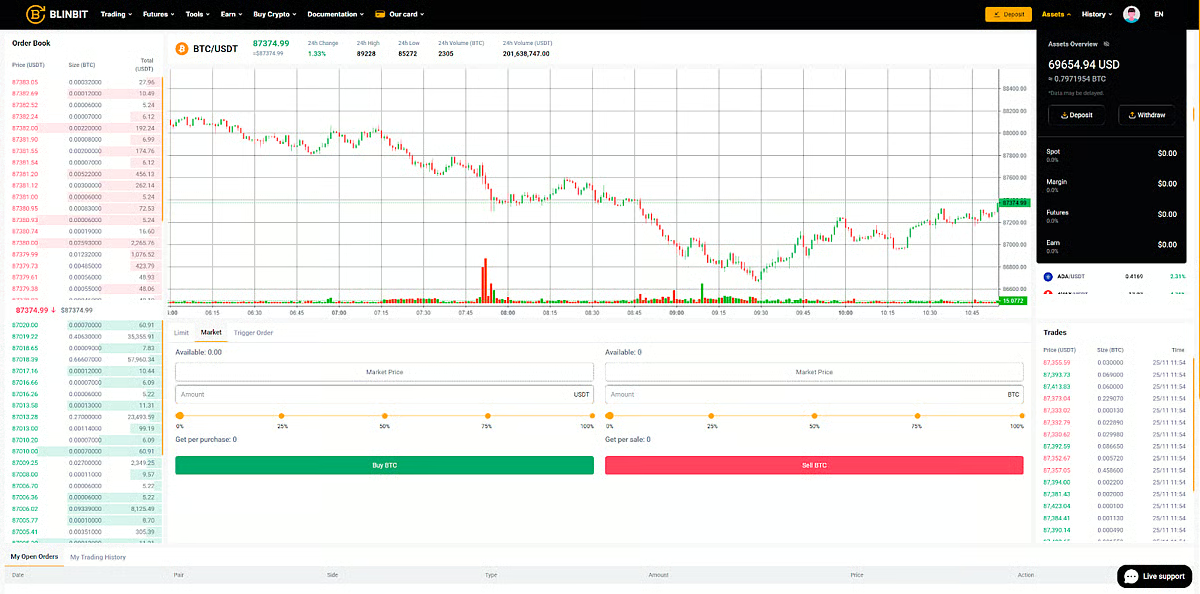
To be clear, my focus here is on stablecoins being used at scale for payments and settlement in the real economy, which matters for stability. In contrast, their main use today — as a way to enter and exit cryptocurrency markets — does not meet, or need to meet, this definition of money. Neither do other cryptocurrency assets themselves.
Stablecoins — where widely used in the real economy — are intended to be money, in the sense that they function as a medium of exchange and payment. As such, they enable the comparison and exchange of value and thus support the price system. With this in mind, there are a number of features that require scrutiny.
First, the so-called backing assets (the other side of the balance sheet) should be free of financial risk in terms of credit, interest and exchange rate risk. This ensures that the value of a coin truly can be stable.
Second, since risk free assets do not protect against operational risks, for instance a successful cyber attack, trust in stablecoins requires an insurance scheme (as with bank deposits), and a statutory resolution arrangement that ensures their holders are preferred creditors in any insolvency process.
Third, the terms of exchange of stablecoins must be known, consistent and enduring. They must be the same for all holders and must be direct into other forms of money, and not dependent on a so-called crypto exchange and its terms of business. As presently set up, not all stablecoins satisfy this condition.
There is another large issue raised by stablecoins becoming more integrated into the financial system. Through banks, the system has combined the holding of money with the provision of credit, meaning that deposits directly support lending that underpins economic activity. This has come to be known as fractional reserve banking. In other words, most of the assets backing commercial bank money are not risk free: they are loans to individuals and to companies. Trust in money has been supported, and from time to time reinforced in the light of experience, by bank regulation, deposit insurance and resolution provisions.
The system does not have to be organised like this. It is possible, at least partially, to separate money from credit provision, with banks and stablecoins coexisting and non-banks carrying out more of the credit provision role. But it is important to consider the implications of such a change thoroughly before going ahead. Only then can we formulate a regime that both supports this coexistence throughout the economic cycle and carefully manages the transition to a future financial system.
The technology behind stablecoins is new. But, as we shape a regime that can put the UK at the forefront of exciting innovation, we should ask a question that has long been at the heart of central banking: how do we ensure the link between money (in whatever form) and credit creation as an underpinning for economic activity? That is the crucial goal here.
In the coming months, the Bank of England will publish a consultation paper on the UK’s systemic stablecoin regime, which will apply to those used in scale as money (ie for everyday payments or for settling tokenised core financial markets) and consider what standards they would need to meet. In doing so, we will set out that widely used UK stablecoins should have access to accounts at the BoE in order to reinforce their status as money. This will be a critical part of creating an advanced regime for stablecoins, one that ensures the UK can reap the benefits while maintaining a stable financial system.
Letter in response:
UK stablecoin issuer responds to BoE governor / From Tom Rhodes, Chief Legal Officer, Agant Finance